Dell G15 5530 (2023) 15.6" FHD Intel Core i7-13650HX 2.6Ghz / Nvidia GeForce RTX 4050 Laptop / 16GB RAM / 1TB SSD specifications and in-depth review

Dell G15 5530 (2023) 15.6" FHD Intel Core i7-13650HX 2.6Ghz / Nvidia GeForce RTX 4050 Laptop / 16GB RAM / 1TB SSD

Manufacturer: Dell

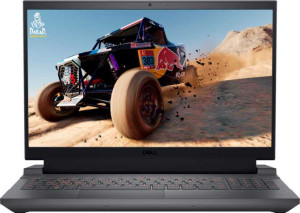
The Dell G15 5530 (2023) is a 15.6-inch gaming laptop built around Intel's Core i7-13650HX processor and an Nvidia GeForce RTX 4050 GPU, targeting users who want a capable gaming machine in a relatively portable form factor. Weighing 2,650g and measuring just 27mm thick, it balances a 165Hz full HD display with a reasonably compact chassis. The panel runs at 1920 x 1080 px with a pixel density of 141 ppi, 300 nits of typical brightness, a 1000:1 contrast ratio, and an anti-reflection coating.

On the performance side, the system ships with 16GB of DDR5 RAM running at 4,800 MHz across two slots, expandable up to 32GB, paired with a 1TB NVMe SSD. The RTX 4050 brings 6GB of GDDR6 VRAM, a 2,370 MHz GPU boost clock, 12.13 TFLOPS of floating-point performance, and support for ray tracing and DLSS. Connectivity includes three USB 3.2 Gen 1 Type-A ports, one USB 3.2 Gen 2 Type-C port, an HDMI 2.1 output, a single RJ45 Ethernet port, Wi-Fi 6, and Bluetooth 5.2. The laptop also features a 0.92MP front camera, stereo speakers, a 3.5mm audio jack, a backlit keyboard, and voice command support.

Pros
  • The 165Hz refresh rate and 1ms-class LED display make for smooth, responsive visuals well-suited to fast-paced gaming
  • Ray tracing and DLSS support extend the GPU's rendering capabilities for compatible titles
  • A 1TB NVMe SSD on PCIe 4 offers fast storage access with ample space for games and applications
  • Wi-Fi 6 support ensures faster and more stable wireless connections in compatible network environments
  • The HDMI 2.1 output allows high-bandwidth video transmission to external displays
  • At 27mm thick and 2,650g, the chassis is relatively slim for an actively cooled gaming laptop with a dedicated GPU
Cons
  • No Thunderbolt or USB 4 ports limits high-speed peripheral and external display options
  • The single-core Geekbench 6 score of 2,524 suggests moderate single-threaded responsiveness for non-gaming workloads
  • Battery specifications are entirely absent from the provided data, making it impossible to assess real-world battery life
  • The front camera is limited to 0.92MP, which is low for video calling in professional or hybrid work scenarios
  • There is no fingerprint scanner, so biometric login is not available
  • No external memory card slot restricts quick file transfers from cameras or other devices
Who is this for?

This laptop is well-suited for casual and mid-range PC gamers who want a capable gaming machine with a smooth 165Hz display, DLSS and ray tracing support, and a dedicated RTX 4050 GPU without needing an overly large or heavy chassis. The combination of a 1TB NVMe SSD and 16GB of DDR5 RAM also makes it practical for users who multitask between gaming and everyday computing tasks. Those who game at a desk and occasionally connect to an external monitor will appreciate the HDMI 2.1 output and multi-display support for up to four screens simultaneously.

Who is this NOT for?

Users who require professional-grade color accuracy or creative workstation performance will find this laptop lacking, as the display specs and absent color calibration support do not cater to that workflow. Those who depend heavily on high-speed peripheral connectivity will be limited by the absence of Thunderbolt and USB 4 ports. Additionally, users who need reliable on-the-go computing will be poorly served here, as no battery data is available and the 2,650g weight makes extended portability less comfortable for daily commuting or travel use.

Design:

Type Gaming
weight 2650 g
Uses a fanless design
Has a backlit keyboard
warranty period 1 years
volume 2641.086 cm³
width 357 mm
height 274 mm
thickness 27 mm

This gaming laptop measures 357mm wide, 274mm deep, and 27mm thick, with a total volume of 2,641.086 cm³ and a weight of 2,650g. It features a backlit keyboard and uses an active cooling design rather than a fanless setup. The chassis carries a one-year warranty, and the overall dimensions reflect a form factor typical of 15-inch gaming machines.

Display:

screen size 15.6"
resolution 1920 x 1080 px
pixel density 141 ppi
Display type LED-backlit
has a touch screen
brightness (typical) 300 nits
refresh rate 165Hz
contrast ratio 1000:1
has anti-reflection coating
supported displays 4

The 15.6-inch LED-backlit display runs at a 1920 x 1080 px resolution with a pixel density of 141 ppi, a 165Hz refresh rate, and a contrast ratio of 1000:1. Typical brightness is rated at 300 nits, and the panel includes an anti-reflection coating to reduce glare in lit environments. Touch input is not supported, and the system can drive up to four displays simultaneously including the built-in screen.

Performance:

RAM 16GB
RAM speed 4800 MHz
Uses flash storage
internal storage 1024GB
CPU speed 6 x 2.6 & 8 x 1.9 GHz
CPU threads 20 threads
VRAM 6GB
floating-point performance 12.13 TFLOPS
GDDR version GDDR6
texture rate 204.8 GTexels/s
pixel rate 113.76 GPixel/s
Is an NVMe SSD
DirectX version DirectX 12 Ultimate
GPU clock speed 1605 MHz
uses multithreading
maximum memory amount 32GB
DDR memory version 5
turbo clock speed 4.9GHz
GPU turbo 2370 MHz
memory slots 2
PCI Express (PCIe) version 4
semiconductor size 4 nm
has XeSS (XMX)
SSD storage capacity 1024GB
Supports 64-bit

The system is equipped with 16GB of DDR5 RAM running at 4,800 MHz across two slots, with a maximum supported capacity of 32GB. The CPU operates at 6 cores clocked at 2.6 GHz and 8 cores at 1.9 GHz across 20 threads, with a turbo boost reaching 4.9 GHz, and it is built on a 4nm semiconductor process with multithreading support. Storage comes in the form of a 1TB NVMe SSD connected via PCIe 4. On the graphics side, the GPU carries 6GB of GDDR6 VRAM, a base clock of 1,605 MHz boosting up to 2,370 MHz, and delivers 12.13 TFLOPS of floating-point performance alongside a texture rate of 204.8 GTexels/s and a pixel rate of 113.76 GPixel/s. The system supports DirectX 12 Ultimate and 64-bit operation, but does not include XeSS support.

Benchmarks:

Geekbench 6 result (multi) 14077
Geekbench 6 result (single) 2524
PassMark (G3D) result 17148
PassMark result 30674
PassMark result (single) 3767

In CPU benchmarking, the system scores 14,077 in Geekbench 6 multi-core and 2,524 in the single-core test, reflecting the combined throughput of its multi-core configuration alongside single-thread responsiveness. The overall PassMark result stands at 30,674, with a single-core PassMark score of 3,767. GPU performance is measured by a PassMark G3D result of 17,148, indicating the graphics processing capability of the discrete GPU under standardized conditions.

Connectivity:

USB 3.2 Gen 2 ports (USB-C) 1
USB 3.2 Gen 2 ports (USB-A) 0
USB 4 20Gbps ports 0
USB 4 40Gbps ports 0
Thunderbolt 4 ports 0
USB 3.2 Gen 1 ports (USB-C) 0
USB 3.2 Gen 1 ports (USB-A) 3
Thunderbolt 3 ports 0
has an HDMI output
supports Wi-Fi
Wi-Fi version Wi-Fi 6 (802.11ax), Wi-Fi 5 (802.11ac), Wi-Fi 4 (802.11n)
has an external memory slot
Bluetooth version 5.2
RJ45 ports 1
HDMI ports 1
HDMI version HDMI 2.1
DisplayPort outputs 0
USB 2.0 ports 0
has AirPlay
mini DisplayPort outputs 0

The laptop provides three USB 3.2 Gen 1 Type-A ports and one USB 3.2 Gen 2 Type-C port, while Thunderbolt 3 and 4, USB 4, and USB 2.0 are all absent. Video output is handled by a single HDMI 2.1 port, with no DisplayPort or mini DisplayPort available. Wired networking is covered by one RJ45 Ethernet port, and wireless connectivity includes Wi-Fi 6 (802.11ax) with backwards compatibility for Wi-Fi 5 and Wi-Fi 4, alongside Bluetooth 5.2. There is no external memory slot and no AirPlay support.

Battery:

Features:

has stereo speakers
has a socket for a 3.5 mm audio jack
megapixels (front camera) 0.92MP
supports ray tracing
supports DLSS
Stylus included
Has a fingerprint scanner
number of microphones 1
has voice commands
has a front camera
Has an optical disc drive

The laptop includes stereo speakers, a 3.5mm headset jack, and a single microphone, along with voice command support for hands-free interaction. A 0.92MP front camera is built in for video calls, though no fingerprint scanner or stylus is included. On the graphics feature side, the system supports both ray tracing and DLSS, enabling more advanced rendering options for compatible titles. There is no optical disc drive.

Miscellaneous:

clock multiplier 26
number of transistors 18900 million
AMD SAM / Intel Resizable BAR Intel Resizable BAR
has LHR
Thermal Design Power (TDP) 115W
Supports 3D
Supports multi-display technology
OpenCL version 3
OpenGL version 4.6
Supports ECC memory
memory bus width 96-bit
effective memory speed 16000 MHz
maximum memory bandwidth 192 GB/s
render output units (ROPs) 48
texture mapping units (TMUs) 80
shading units 2560
Has Double Precision Floating Point (DPFP)
GPU memory speed 2000 MHz
GPU architecture Ada Lovelace
GPU name UHD Graphics 710
Type Laptop
Has an unlocked multiplier
L3 cache 24 MB
Has NX bit
CPU temperature 100 °C
GPU execution units 16
Has integrated graphics
Uses big.LITTLE technology
memory channels 2
instruction sets SSE 4.2, SSE 4.1, AVX, AES, FMA3, F16C, MMX
RAM speed (max) 4800 MHz

The discrete GPU is based on the Ada Lovelace architecture and features 2,560 shading units, 80 texture mapping units, 48 render output units, and 16 execution units, with a 96-bit memory bus running at 2,000 MHz for an effective speed of 16,000 MHz and a maximum bandwidth of 192 GB/s. It supports multi-display output, stereoscopic 3D, Double Precision Floating Point, OpenCL 3, OpenGL 4.6, and Intel Resizable BAR, while LHR is not present. The CPU carries a 24MB L3 cache, a 115W TDP, a clock multiplier of 26, an unlocked multiplier, and a maximum operating temperature of 100°C, and makes use of big.LITTLE technology alongside multithreading across two memory channels with a maximum RAM speed of 4,800 MHz. Supported instruction sets include SSE 4.1, SSE 4.2, AVX, AES, FMA3, F16C, and MMX, and the processor includes NX bit support and ECC memory compatibility. Integrated graphics are present alongside the discrete GPU, identified as UHD Graphics 710 with 16 execution units, and the chip is built with 18,900 million transistors.
Final Verdict

The Dell G15 5530 (2023) presents a focused gaming laptop configuration built around a capable hardware stack, with its RTX 4050 GPU paired with a 165Hz FHD display, DLSS, and ray tracing support forming a coherent package for users whose primary goal is smooth, responsive gameplay at 1080p. The 1TB NVMe SSD, DDR5 memory, and Wi-Fi 6 connectivity round out a specification set that holds up well for its intended use case. That said, the absence of Thunderbolt connectivity, limited webcam resolution, and the lack of any battery data are meaningful gaps that users with broader or more mobile requirements should weigh carefully. For gamers who primarily play at a desk and want a reasonably compact machine without sacrificing core gaming performance, the G15 5530 delivers a well-defined, if narrowly targeted, experience.