General info:
| SSD storage capacity |
512GB |
| form factor |
Micro-ATX |
| Is an NVMe SSD |
✓ |
| thickness |
178 mm |
| height |
206 mm |
| width |
79.3 mm |
| volume |
2907.7724 cm³ |
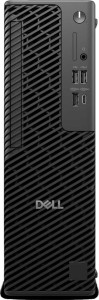
The Dell Pro Max adopts a Micro-ATX form factor and occupies a total volume of 2907.77 cm³, with dimensions of 206 mm in height, 178 mm in thickness, and 79.3 mm in width. For storage, it features a 512GB NVMe SSD, offering faster data access compared to standard SATA-based solid-state drives thanks to the NVMe interface.
CPU:
| Thermal Design Power (TDP) |
70W |
| CPU speed |
8 x 2.4 & 12 x 1.8 GHz |
| turbo clock speed |
5.3GHz |
| CPU threads |
20 threads |
| Has integrated graphics |
✓ |
| L3 cache |
30 MB |
| L2 cache |
36 MB |
| Turbo Boost version |
2 |
| clock multiplier |
24 |
| Has an unlocked multiplier |
✕ |
| Supports 64-bit |
✓ |
| CPU temperature |
105 °C |
The CPU runs a hybrid configuration of 8 cores at 2.4 GHz and 12 cores at 1.8 GHz, totaling 20 threads, with a Turbo Boost 2 clock that reaches up to 5.3 GHz under load. It carries a 70W TDP and a maximum operating temperature of 105 °C, alongside a clock multiplier of 24, though the multiplier is locked. Cache consists of 30 MB of L3 and 36 MB of L2, and the processor includes integrated graphics, supports 64-bit computing, but does not feature an unlocked multiplier.
Graphics card:
| VRAM |
16GB |
| floating-point performance |
12 TFLOPS |
| effective memory speed |
16000 MHz |
| GPU clock speed |
1620 MHz |
| GPU memory speed |
2000 MHz |
| GPU turbo |
2130 MHz |
| texture rate |
187.4 GTexels/s |
| pixel rate |
102.2 GPixel/s |
| supports ray tracing |
✓ |
| supports DLSS |
✕ |
| maximum memory bandwidth |
224 GB/s |
| memory bus width |
128-bit |
| PCI Express (PCIe) version |
4 |
| texture mapping units (TMUs) |
88 |
| shading units |
2816 |
| render output units (ROPs) |
48 |
| DirectX version |
DirectX 12 |
| OpenGL version |
4.6 |
| OpenCL version |
3 |
| semiconductor size |
5 nm |
| supported displays |
4 |
| has LHR |
✕ |
| Supports multi-display technology |
✓ |
| Has Double Precision Floating Point (DPFP) |
✓ |
| has RGB lighting |
✕ |
| number of transistors |
18900 million |
The graphics card is built on a 5 nm semiconductor process and packs 18,900 million transistors, with 16GB of VRAM running at an effective memory speed of 16,000 MHz across a 128-bit bus, delivering a maximum memory bandwidth of 224 GB/s. Core clock speed sits at 1620 MHz with a turbo of 2130 MHz, while the GPU's 2816 shading units, 88 texture mapping units, and 48 ROPs contribute to a texture rate of 187.4 GTexels/s and a pixel rate of 102.2 GPixel/s. Floating-point performance reaches 12 TFLOPS, and the card supports ray tracing, Double Precision Floating Point, multi-display output across up to 4 screens, DirectX 12, OpenGL 4.6, and OpenCL 3, while connecting via PCIe 4. DLSS, LHR, and RGB lighting are not present on this card.
Memory:
| RAM |
32GB |
| RAM speed |
5600 MHz |
| DDR memory version |
5 |
The Dell Pro Max is equipped with 32GB of DDR5 RAM running at 5600 MHz, providing a solid base of system memory on the latest DDR generation for handling multitasking and memory-intensive workloads.
Connectivity:
| supports Wi-Fi |
✕ |
| Has Bluetooth |
✕ |
| USB 2.0 ports |
0 |
| USB 3.2 Gen 2 ports (USB-A) |
4 |
| USB 3.2 Gen 1 ports (USB-A) |
2 |
| USB 3.2 Gen 2 ports (USB-C) |
1 |
| USB 4 40Gbps ports |
0 |
| USB 4 20Gbps ports |
0 |
| USB 3.2 Gen 2x2 ports |
1 |
| USB 3.2 Gen 1 ports (USB-C) |
0 |
| Thunderbolt 4 ports |
0 |
| Thunderbolt 3 ports |
0 |
| DisplayPort version |
DisplayPort 2.1 |
| DisplayPort outputs |
1 |
| HDMI version |
HDMI 2.1 |
| HDMI ports |
1 |
| RJ45 ports |
0 |
| has a socket for a 3.5 mm audio jack |
✓ |
| has a VGA connector |
✕ |
| DVI outputs |
0 |
| Has S/PDIF Out port |
✕ |
The Dell Pro Max offers a wired-only connectivity setup, with no Wi-Fi, Bluetooth, RJ45, or wireless capabilities of any kind. On the USB front, it provides 4 USB 3.2 Gen 2 USB-A ports, 2 USB 3.2 Gen 1 USB-A ports, 1 USB 3.2 Gen 2 USB-C port, and 1 USB 3.2 Gen 2x2 USB-C port, while USB 2.0, USB 4, Thunderbolt 3, and Thunderbolt 4 are absent. Display output is handled by one DisplayPort 2.1 and one HDMI 2.1 port, with no DVI or VGA connectors present. Audio connectivity is covered by a 3.5 mm headset jack, though S/PDIF output is not included.
Benchmarks:
| PassMark result |
48917 |
| PassMark result (single) |
4633 |
| Cinebench R20 (multi) result |
10181 |
| Cinebench R20 (single) result |
847 |
In benchmark testing, the Dell Pro Max achieves a PassMark multi-core score of 48,917 and a single-core score of 4,633, reflecting the processor's overall and per-core throughput. Cinebench R20 results further illustrate its rendering capability, with a multi-core score of 10,181 and a single-core score of 847.
Miscellaneous:
| maximum memory amount |
192GB |
| has an external memory slot |
✕ |
| AMD SAM / Intel Resizable BAR |
Intel Resizable BAR |
| GPU architecture |
Ada Lovelace |
| USB-C ports |
0 |
| GDDR version |
GDDR6 |
| Has air-water cooling |
✕ |
| Supports 3D |
✓ |
| has an HDMI output |
✕ |
| mini DisplayPort outputs |
4 |
| Supports ECC memory |
✓ |
| has XeSS (XMX) |
✕ |
| Type |
Desktop |
| chipset |
Z890 |
| instruction sets |
MMX, F16C, FMA3, AES, AVX, AVX2, SSE 4.1, SSE 4.2 |
| Has NX bit |
✓ |
| CPU socket |
LGA 1851 |
| memory channels |
2 |
| RAM speed (max) |
6400 MHz |
| Uses big.LITTLE technology |
✓ |
| Uses flash storage |
✕ |
The desktop CPU sits in an LGA 1851 socket on a Z890 chipset, employs big.LITTLE technology, and supports a broad set of instruction sets including MMX, F16C, FMA3, AES, AVX, AVX2, SSE 4.1, and SSE 4.2, as well as the NX bit for hardware-level memory protection. System memory can scale up to 192GB across 2 channels, with a maximum RAM speed of 6400 MHz and support for ECC memory, though there is no external memory slot and flash storage is not used. The GPU is based on the Ada Lovelace architecture and uses GDDR6 memory, with Intel Resizable BAR enabled for improved CPU-to-GPU data access; XeSS is not supported. The system offers 4 mini DisplayPort outputs and supports stereoscopic 3D, but does not include a dedicated HDMI output, air-water cooling, or USB-C ports.