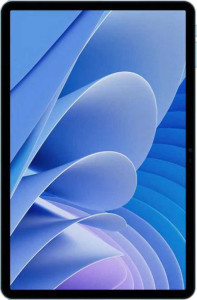
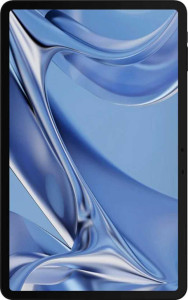
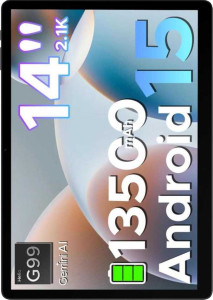
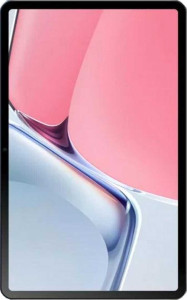
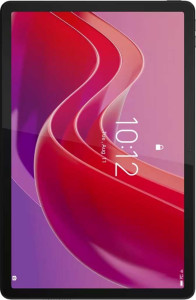
The Doogee T40 measures 256.5 mm wide and 168 mm tall with a thickness of just 7.6 mm, and weighs 530 g, giving it a relatively slim profile for its size class. It carries a total volume of 327.4992 cm³. The tablet does not include a stylus, a detachable keyboard, or backlit keyboard support, and it offers no water resistance rating. Tilt sensitivity is also absent, reflecting a straightforward physical design without advanced input accessories.
The Doogee T40 features an 11″ IPS LCD touchscreen with a resolution of 2560 x 1600 px and a pixel density of 274 ppi, producing a reasonably sharp image across its panel. The display runs at a 90Hz refresh rate, offering smoother motion than standard 60Hz screens. It does not feature branded damage-resistant glass or sapphire glass, and HDR10, HDR10+, and Dolby Vision are all unsupported, meaning the screen handles standard dynamic range content only. It is not an e-paper display.
The Doogee T40 is powered by the Mediatek Helio G99 chipset, built on a 6nm process with an 8-thread CPU configuration running at 2 x 2.2 GHz and 6 x 2 GHz using big.LITTLE and HMP scheduling. It comes with 8GB of RAM running at 4266MHz across dual memory channels, supporting up to 12GB total, with a maximum memory bandwidth of 17.1 GB/s, alongside 512GB of eMMC 5.2 internal storage expandable via a memory card slot up to 2TB. Graphics are handled by the Mali G57 GPU clocked at 950MHz with a turbo of 2133MHz, 32 shading units, DirectX 11, OpenGL ES 3.2, and OpenCL 2 support, capable of driving up to 2 displays. The SoC integrates LTE, TrustZone security, and 64-bit support, operates under a 5W TDP with a maximum CPU temperature of 95°C, and the tablet ships with Android 14. Geekbench 6 scores are recorded at 729 single-core and 1979 multi-core.
The Doogee T40 features a 20MP rear camera capable of recording video at 1440p and 30fps, supported by a single LED flash and a video light, while an 8MP front camera handles selfies and video calls without a front-facing flash. The main camera includes a practical set of manual controls covering ISO, exposure, white balance, and focus, along with touch autofocus and continuous autofocus during video recording. Slow-motion video recording is supported, though optical zoom is absent, and there is no optical image stabilization. HDR photo mode is available, but HDR10 and Dolby Vision recording are not supported. In-camera panorama, 360-degree panorama, burst mode, dual-tone flash, RGB flash, manual shutter speed, and 3D recording are all absent from the feature set.
The Doogee T40 includes stereo speakers and a 3.5mm headphone jack, covering the core audio output options for both built-in and wired listening. It does not have a built-in radio. On the Bluetooth audio codec side, none of the advanced codecs are supported — aptX, aptX HD, aptX Low Latency, aptX Adaptive, aptX Lossless, and LDAC are all absent, meaning wireless audio is limited to standard Bluetooth transmission without high-quality or low-latency codec options.
The Doogee T40 is equipped with an 8580 mAh rechargeable battery that supports fast charging, and it includes a battery level indicator for monitoring remaining charge. The battery is not removable, and wireless charging is not supported.
The Doogee T40 connects via Wi-Fi 4 (802.11n) with download and upload speeds of 650 Mbits/s and 150 Mbits/s respectively, and supports Bluetooth 5.2, though 5G, NFC, HDMI output, and Ethernet are all absent. It accommodates two SIM cards and includes a cellular module, while USB connectivity is handled through a Type-C port running at USB 2.0. On the software and privacy side, the tablet offers location privacy options, camera and microphone access controls, clipboard warnings, and app tracking blocking, though Mail Privacy Protection and cross-site tracking blocking are not available. It supports split screen, Picture-in-Picture, full-page screenshots, dark mode, dynamic and manual theme customization, widgets, media picker, customizable notifications, notification permissions, an extra dim mode, battery health check, child lock, multi-user support, sharing intents, Live Text, offline voice recognition, voice commands, on-device machine learning, and the ability to play games while downloading. Direct OS vendor updates are not provided, and app offloading and focus modes are absent. For sensors, an accelerometer and device position tracking are present, while a gyroscope, compass, barometer, infrared sensor, fingerprint scanner, iris scanner, and 3D facial recognition are all missing. Wi-Fi password sharing and Quick Start are not supported, and the tablet has no built-in projector.
The Doogee T40 uses DDR4 memory.