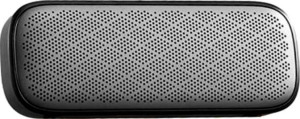
The Edifier M125 has a compact physical footprint, measuring 176 mm wide, 67 mm tall, and 29 mm thick, with a total volume of 341.968 cm³ and a weight of 260 g. It houses two 36 mm drivers and places its control panel directly on the device, keeping operation straightforward without the need for a separate remote. The speaker does not include a neodymium magnet, touch screen, RGB lighting, detachable cable, or a travel bag, and it carries no water resistance rating. It is not a neckband-style speaker.
The Edifier M125 delivers a total audio output of 2 x 4W across its two channels and includes a passive radiator to support low-frequency reproduction without a dedicated subwoofer. It does not feature stereo speakers or magnetic shielding, and there is no noise-canceling microphone on board.
The Edifier M125 is powered by a built-in 2600 mAh rechargeable battery rated for up to 13 hours of playback. The battery is not removable and does not support wireless charging. There is also no battery level indicator, so charge status cannot be checked directly on the device.
The Edifier M125 connects wirelessly via Bluetooth 5.4 with a maximum range of 15 m and supports multipoint pairing with up to two devices at once. It includes a USB Type-C port for charging and an external memory slot for local file playback. The speaker does not support NFC pairing, Wi-Fi, Ethernet, AirPlay, or DLNA, and there is no 3.5 mm audio jack, AUX input, or 3.5 mm male connector. Advanced Bluetooth audio codecs — including aptX, aptX HD, aptX Adaptive, aptX Lossless, aptX Low Latency, LDAC, and AAC — are not supported, and there is no microphone input.
The Edifier M125 can be used fully wirelessly and supports smartphone remote control, allowing playback management from a paired device. It provides voice prompts for audio feedback during use and includes a sleep timer for scheduled shutoff. Fast pairing, voice commands, a mute function, radio, and power bank functionality are not available on this speaker.
The Edifier M125 does not support stereo pairing, meaning it cannot be linked with a second unit to create a two-speaker stereo configuration.