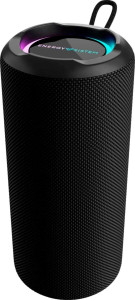
The Energy Sistem TempoRave has a compact cylindrical form factor, measuring 200 mm in height with a width and thickness of 87 mm each, and a total volume of 1,513.8 cm³, with an overall weight of 838 g. Its two 50 mm drivers are housed within a build rated IPX6, meaning it can withstand powerful water jets — a step beyond basic splash resistance. Controls are placed directly on the device for straightforward access, though there is no remote control, touch screen, or RGB lighting included. The speaker does not use neodymium magnets, does not feature a detachable cable, and is not a neckband-style unit. No travel bag is included in the package.
The TempoRave delivers audio through two drivers with a combined output of 2 x 20W, covering a frequency range from 60 Hz at the low end up to 18,000 Hz at the high end. The configuration does not include a subwoofer, a passive radiator, or magnetic shielding, and the speaker operates in mono rather than stereo. For communication, it features a single built-in microphone with noise cancellation, suitable for hands-free use during calls.
The TempoRave is powered by a built-in rechargeable 5,000 mAh battery that provides up to 12 hours of playback on a single charge, with a full recharge taking approximately 3 hours. The battery is not removable and does not support wireless charging, so it must be charged via cable. A battery level indicator is included, allowing users to keep track of remaining power during use.
The TempoRave connects wirelessly via Bluetooth 5.4 with a maximum range of 10 m, and also accepts a wired connection through an AUX input, though it lacks a 3.5 mm headset socket or a 3.5 mm male connector. NFC pairing is not supported, and on the audio codec side, none of the advanced options — including aptX, aptX HD, aptX Adaptive, aptX Lossless, aptX Low Latency, AAC, or LDAC — are available. Streaming protocols such as AirPlay, Chromecast, Auracast, and Bluetooth LE Audio are equally absent, and the speaker does not support Wi-Fi, Ethernet, or DLNA. For physical connectivity, it includes one USB Type-C port and an external memory slot, while a dedicated microphone input is not present.
The TempoRave can be used wirelessly and supports remote smartphone control, giving users a degree of flexibility in how they manage playback. It includes a built-in radio and a sleep timer, adding utility beyond straightforward audio streaming. Voice prompts are present to assist with navigation and status feedback, though voice commands are not supported, meaning the speaker cannot be operated hands-free through spoken instructions. Fast pairing is not available, and the speaker neither functions as a power bank nor includes a mute function.
The TempoRave does not support stereo pairing, meaning two units cannot be linked together to create a stereo sound setup.