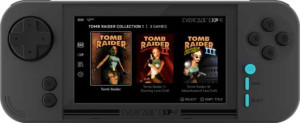
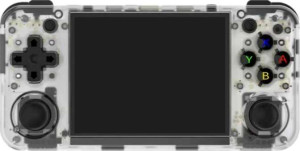
The Evercade EXP-R has a straightforward performance profile suited to its retro-focused purpose. It does not support ray tracing or multithreading, and there is no NVMe SSD in use. Additionally, the device cannot connect to an external hard drive, meaning all storage needs are handled entirely by the onboard internal storage.
The Evercade EXP-R is a handheld retro console with an internal power supply and a 3000 mAh battery, drawing power entirely from its built-in source rather than any replaceable drive mechanism. It offers 4GB of internal storage with no optical disc drive, keeping the hardware compact and self-contained. The device is region free, meaning it places no geographic restrictions on software use. Physically, it measures 192 mm wide, 78 mm tall, and 20 mm thick, resulting in a total volume of 299.52 cm³.
The Evercade EXP-R includes a USB Type-C port as its single USB connection, alongside a 3.5 mm headphone jack for wired audio output. Wi-Fi is supported, though the device is not DLNA-certified and has no cellular module, NFC, or RJ45 ethernet port. There is no HDMI output for connecting to a display, no external memory slot for storage expansion, and no support for connectivity between home and portable devices.
The Evercade EXP-R features a 4.3″ screen and built-in stereo speakers with two-channel sound output, providing a straightforward audiovisual setup for handheld play. It supports access to high scores and achievements, though it does not offer quick resume, play-while-downloading, or backwards compatibility. The display is neither touch-enabled nor autostereoscopic, and the device has no secondary screen, front camera, or optical tracking. Audio features are limited to stereo output, with no 3D audio or Dolby Vision support, and there is no VR capability, Discord voice chat, or voice command functionality. Blu-ray and 4K Blu-ray playback are absent, flash storage is not used, and no child lock is provided.
The Evercade EXP-R comes with one built-in controller offering 17 buttons and no analog sticks, reflecting its focus on traditional retro-style input. The controller is not wireless and does not include adaptive triggers, dual force feedback, or an integrated touchpad. There is also no compatibility with motion-sensing controllers, keeping the input setup straightforward and conventional.