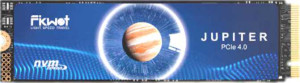
Fikwot FX991 500GB specifications and in-depth review

Fikwot FX991 500GB

Manufacturer: Fikwot

The Fikwot FX991 500GB is an M.2 NVMe solid-state drive that sits within the PCIe 5.0 generation of storage devices, targeting users who need a high-throughput internal drive in a compact form factor. It carries a 5-year warranty, which reflects a reasonable level of long-term confidence for a drive in this category. The unit ships without an integrated heatsink and does not include RGB lighting, keeping the design straightforward and focused on function.

On the technical side, the FX991 500GB is built around the Maxiotek MAP1602 controller, which operates across 4 channels and pairs with QLC NAND flash storage. The drive uses HMB (Host Memory Buffer) caching in place of dedicated DRAM and supports NVMe version 1.4. Sequential read speed reaches 6300 MB/s, while sequential write speed is rated at 3100 MB/s. It recorded a PassMark SSD score of 29,862 and has a maximum operating temperature of 70 °C. The drive does not support hardware-level AES encryption.

Pros
  • Sequential read speed of 6300 MB/s makes it well-suited for sustained large-file transfers on PCIe 5.0 systems
  • Backed by a 5-year warranty, offering meaningful long-term coverage
  • NVMe 1.4 support ensures compatibility with a wide range of modern motherboards
  • The Maxiotek MAP1602 controller uses 4 channels, supporting reasonable parallelism for a 500GB drive
  • Compact M.2 form factor fits standard slots without requiring additional space or mounting adapters
Cons
  • QLC NAND is generally less durable in write-intensive workloads compared to higher-tier NAND types
  • Relies on HMB caching instead of dedicated DRAM, which can limit performance consistency under heavy sustained loads
  • No integrated heatsink included, which may require users to manage thermals independently
  • Hardware-level AES encryption is not supported, limiting use in security-conscious deployments
  • Sequential write speed of 3100 MB/s is notably lower than the read speed, creating an asymmetric performance profile
Who is this for?

This drive is a solid fit for users running PCIe 5.0-compatible systems who want to take full advantage of next-generation storage bandwidth, particularly for tasks involving large sequential file transfers such as video editing, data backup, or working with large datasets. The M.2 form factor and broad NVMe 1.4 compatibility make it straightforward to install in modern desktop or laptop platforms, while the 5-year warranty adds a degree of reliability assurance for users who plan to keep the drive in service for an extended period. Those who prioritize raw read throughput in a compact, no-frills package — without needing hardware encryption or an onboard heatsink — will find the configuration practical for everyday high-bandwidth workloads.

Who is this NOT for?

Users with write-intensive workloads — such as continuous logging, database writes, or heavy virtual machine operations — may find the QLC NAND and HMB-only caching less resilient over sustained periods, as this configuration tends to be more sensitive to prolonged write stress than DRAM-equipped or higher-endurance NAND alternatives. The absence of hardware AES encryption makes it a poor match for enterprise, government, or security-sensitive environments where data-at-rest protection is a requirement. Additionally, users running systems without PCIe 5.0 support will not be able to fully utilize the drive's rated speeds, and those operating in thermally constrained builds may face challenges given the lack of an integrated heatsink and a maximum operating temperature ceiling of 70 °C.

Read speed:

sequential read speed 6300 MB/s

The Fikwot FX991 500GB reaches a sequential read speed of 6300 MB/s, placing it among the faster drives in the PCIe 5.0 generation for sustained data transfers across large files.

Write speed:

sequential write speed 3100 MB/s

The Fikwot FX991 500GB is rated for a sequential write speed of 3100 MB/s, reflecting its sustained throughput capacity when handling large sequential write operations under typical workloads.

Benchmarks:

PassMark result 29862

In benchmark testing, the Fikwot FX991 500GB achieved a PassMark score of 29,862, providing a standardized reference point for evaluating its overall storage performance across the range of read, write, and mixed workload tests that the PassMark suite covers.

General info:

type M2
SSD cache HMB (Host Memory Buffer)
Is an NVMe SSD
NVMe version 1.4
internal storage 500GB
controller Maxiotek MAP1602
SSD storage type QLC
PCI Express (PCIe) version 5
Controller channels 4
warranty period 5 years
Has an integrated heatsink
maximum operating temperature 70 °C
bits of encryption supported 0
has RGB lighting

The Fikwot FX991 500GB is an M.2 NVMe SSD with 500GB of internal storage, running on PCIe 5.0 and conforming to NVMe version 1.4. It is powered by the Maxiotek MAP1602 controller operating across 4 channels, and uses QLC NAND flash as its storage medium. Rather than dedicated DRAM, the drive relies on HMB (Host Memory Buffer) caching, drawing on a portion of system RAM for caching tasks. The maximum operating temperature is rated at 70 °C, and the drive carries a 5-year warranty. It does not include an integrated heatsink, does not support AES hardware encryption, and has no RGB lighting.

Final Verdict

The Fikwot FX991 500GB is a straightforward PCIe 5.0 M.2 NVMe drive built around the Maxiotek MAP1602 controller, offering a sequential read speed of 6300 MB/s that clearly targets users on next-generation platforms who need strong large-file throughput. Its QLC NAND and HMB-only caching approach mean it is better suited to read-heavy and general-purpose workloads than to sustained write-intensive tasks, and the absence of hardware encryption or an integrated heatsink narrows its fit for specialized or thermally demanding environments. That said, the 5-year warranty and compact M.2 form factor make it a practical option for mainstream desktop builds where PCIe 5.0 bandwidth is available and the workload profile aligns with what the drive is designed to handle.