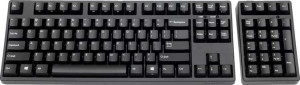
The Filco Majestouch TKSP is a full-size (100%) mechanical keyboard with a standard profile and plate-mount construction, connecting to a host system via USB at a polling rate of 1000 Hz. Its physical footprint measures 447 mm wide, 137 mm tall, and 37 mm thick, with a total weight of 1200 g. The cable is fixed rather than detachable, and the keyboard is not designed specifically for Mac use. A one-year warranty is included, and connectivity is strictly wired with no wireless option.
The Majestouch TKSP features a plastic case paired with an aluminum plate, finished exclusively in black with no additional color options. The keyboard carries no backlighting of any kind — neither RGB nor single-color illumination — keeping the aesthetic minimal and straightforward. Adjustable feet are included to allow for some tilt customization, though no wrist rest is bundled with the board.
The Majestouch TKSP is equipped with Cherry MX Red mechanical switches, delivering a linear feel with no tactile bump or audible click during actuation. They actuate at 2 mm with a light actuation force of 45 g and a total travel distance of 4 mm, making for a smooth and consistent keystroke from top to bottom. The switches are not hot-swappable, meaning they cannot be replaced without soldering.
The Majestouch TKSP supports N-key rollover (NKRO), allowing all keys to be registered simultaneously without conflict. Beyond that, the feature set is intentionally lean — the board does not offer analog input, rapid trigger, dual actuation, or adjustable actuation points. There is no USB passthrough port, no onboard display, and no support for QMK, ZMK, or VIA, meaning firmware customization through those popular open-source platforms is not available.
The Majestouch TKSP uses an ANSI (United States) layout with a fully standard key arrangement, making keycap replacement straightforward. The included keycaps are PBT double-shot in the Cherry profile, a low-to-medium height sculpted profile that is common across many boards. Media functions are accessible via the Fn key rather than through dedicated standalone keys, and there is no rotary dial present on the board.