Gainward GeForce RTX 3050 Pegasus OC 6GB specifications and in-depth review

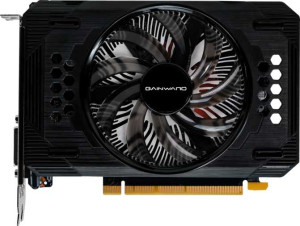
Gainward GeForce RTX 3050 Pegasus OC 6GB

Manufacturer: Gainward

The Gainward GeForce RTX 3050 Pegasus OC 6GB is a low-profile-friendly graphics card built on NVIDIA's Ampere architecture and fabricated on an 8nm process. With a boost clock of 1492 MHz and 2304 shading units, it delivers 6.875 TFLOPS of floating-point performance while keeping power consumption at a modest 70W TDP, making it a practical fit for compact or power-constrained systems.

The card carries 6GB of GDDR6 VRAM running at an effective 14000 MHz across a 96-bit memory bus, yielding up to 168 GB/s of bandwidth, with ECC support included for error-sensitive workloads. Feature coverage includes DirectX 12 Ultimate, OpenGL 4.6, OpenCL 3, hardware ray tracing, DLSS, stereoscopic 3D, and Intel Resizable BAR. Display output is handled by one HDMI 2.1 port, one DisplayPort, and one DVI connector, supporting up to three monitors simultaneously, while the card measures 162 mm wide and 117 mm tall.

Pros
  • A 70W TDP allows the card to operate within very tight power budgets, making it compatible with systems that have limited PSU headroom
  • The compact 162×117 mm footprint makes it a practical choice for small form factor and mini-ITX builds where physical space is restricted
  • Hardware ray tracing and DLSS support bring access to modern rendering techniques without requiring high power draw
  • HDMI 2.1 output supports high-bandwidth display connections from a single port
  • ECC memory support makes the card usable in workloads where memory reliability and error correction are required
  • Intel Resizable BAR compatibility allows the CPU to access the full GPU frame buffer, which can benefit rendering performance in supported systems
Cons
  • The 96-bit memory bus limits memory bandwidth headroom, which can become a bottleneck in resolution or texture-heavy scenarios
  • 6GB of VRAM is a relatively tight allocation for modern workloads involving large assets or higher-resolution rendering targets
  • 32 render output units restrict the pixel fill rate, which may affect performance in scenarios with heavy overdraw or high-resolution output
  • No USB-C or mini DisplayPort outputs reduce flexibility for users with displays or adapters that rely on those interfaces
  • The absence of RGB lighting may be a drawback for users who prioritize visual cohesion with illuminated system builds
  • Air-only cooling with no hybrid option limits thermal headroom if the card is used in a poorly ventilated enclosure
Who is this for?

The Gainward GeForce RTX 3050 Pegasus OC 6GB is well-matched to users assembling or upgrading a small form factor or compact PC, where its 162×117 mm dimensions and 70W TDP make it easy to accommodate without demanding a large chassis or high-capacity power supply. Casual gamers and general users who want a modern feature set — including ray tracing, DLSS, and DirectX 12 Ultimate — for 1080p workloads will find the card's capabilities appropriately matched to that use case. It also suits users with reliability-sensitive compute tasks, given that ECC memory support and OpenCL 3 compatibility are both present for workloads where data integrity matters.

Who is this NOT for?

Users who intend to run demanding workloads at 1440p or 4K — whether in gaming, content creation, or real-time rendering — will find the 6GB VRAM ceiling and 96-bit memory bus insufficient to sustain consistent performance at those resolutions. The card is similarly ill-suited for tasks involving large texture sets or memory-intensive compute pipelines, where bandwidth and VRAM capacity become the primary constraints. Those who rely on a wide range of display connectivity options will also find the port selection restrictive, as the absence of USB-C and mini DisplayPort outputs limits compatibility with certain modern monitors and multi-display professional setups.

Performance:

GPU clock speed 1042 MHz
GPU turbo 1492 MHz
pixel rate 47.74 GPixel/s
floating-point performance 6.875 TFLOPS
texture rate 107.4 GTexels/s
GPU memory speed 1750 MHz
shading units 2304
texture mapping units (TMUs) 72
render output units (ROPs) 32
Has Double Precision Floating Point (DPFP)

The GPU runs at a base clock of 1042 MHz and scales up to a turbo clock of 1492 MHz, with its 2304 shading units and 72 texture mapping units producing a texture rate of 107.4 GTexels/s and a pixel rate of 47.74 GPixel/s. Overall floating-point throughput reaches 6.875 TFLOPS, processed through 32 render output units. GPU-side memory operates at 1750 MHz, and Double Precision Floating Point (DPFP) is supported, adding utility for workloads that require 64-bit precision calculations.

Memory:

effective memory speed 14000 MHz
maximum memory bandwidth 168 GB/s
VRAM 6GB
GDDR version GDDR6
memory bus width 96-bit
Supports ECC memory

Memory consists of 6GB of GDDR6 VRAM operating at an effective speed of 14000 MHz through a 96-bit bus, delivering a maximum bandwidth of 168 GB/s. The 96-bit interface width keeps the card within a low power envelope while still providing reasonable throughput for its intended workloads. ECC memory support is also present, offering error correction capability for tasks where data accuracy is a priority.

Features:

DirectX version DirectX 12 Ultimate
OpenGL version 4.6
OpenCL version 3
Supports multi-display technology
supports ray tracing
Supports 3D
supports DLSS
has XeSS (XMX)
AMD SAM / Intel Resizable BAR Intel Resizable BAR
has LHR
has RGB lighting
supported displays 3

On the software and API side, the card supports DirectX 12 Ultimate, OpenGL 4.6, and OpenCL 3, providing broad compatibility across modern graphics and compute workloads. Hardware-level ray tracing and DLSS are both enabled, and stereoscopic 3D output is also supported. Up to three displays can be driven simultaneously through the card's multi-display technology. Intel Resizable BAR is available for systems that support it, while XeSS (XMX), LHR, and RGB lighting are all absent from this model.

Ports:

has an HDMI output
HDMI ports 1
HDMI version HDMI 2.1
DisplayPort outputs 1
USB-C ports 0
DVI outputs 1
mini DisplayPort outputs 0

The card provides three video outputs: a single HDMI 2.1 port, one DisplayPort, and one DVI output. There are no USB-C or mini DisplayPort connections on this model, resulting in a clean and straightforward bracket layout that covers the most widely used display interfaces without additional complexity.

General info:

GPU architecture Ampere
Thermal Design Power (TDP) 70W
PCI Express (PCIe) version 4
semiconductor size 8 nm
number of transistors 8700 million
Has air-water cooling
width 162 mm
height 117 mm

The GPU is based on the Ampere architecture, produced on an 8nm process with 8700 million transistors, and connects to the host system via PCIe 4. It carries a TDP of 70W, placing it firmly in the low-power segment of the graphics card market. Cooling is air-based only, with no hybrid or liquid cooling solution included. The card's physical dimensions come in at 162 mm wide and 117 mm tall, giving it a compact form factor that suits smaller chassis builds.
Final Verdict

The Gainward GeForce RTX 3050 Pegasus OC 6GB is a focused, purpose-built graphics card that makes a clear case for users working within tight physical and power constraints. Its most defining characteristic is the combination of a 70W TDP and compact 162×117 mm form factor, which opens the door to modern GPU features — including ray tracing, DLSS, and DirectX 12 Ultimate — in system configurations where larger cards simply would not fit or function. ECC memory support adds a layer of utility for reliability-conscious workloads beyond standard gaming. The card's 6GB VRAM and 96-bit bus do place a natural ceiling on how far it can scale, and users with ambitions beyond 1080p or light compute tasks will reach those boundaries relatively quickly. For its intended audience, however, the Pegasus OC 6GB delivers a well-rounded and practically sensible package that doesn't overreach its design brief.