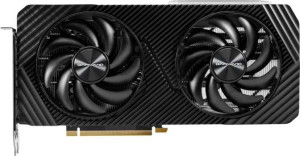
Gainward GeForce RTX 4070 Super Ghost OC specifications and in-depth review

Gainward GeForce RTX 4070 Super Ghost OC

Manufacturer: Gainward

The Gainward GeForce RTX 4070 Super Ghost OC is a graphics card built on Nvidia's Ada Lovelace architecture, fabricated on a 5 nm process with 35,800 million transistors. It runs at a base clock of 1980 MHz and reaches a turbo frequency of 2550 MHz, with a 220W TDP and physical dimensions of 269.1 mm × 131.8 mm. The card uses air cooling exclusively and connects to the system via PCIe 4.

The card is equipped with 12GB of GDDR6X VRAM on a 192-bit bus running at an effective speed of 21,000 MHz, yielding up to 504 GB/s of memory bandwidth. Its 7,168 shading units work alongside 224 texture mapping units and 80 render output units, translating to a texture rate of 571.2 GTexels/s, a pixel rate of 204 GPixel/s, and 36.56 TFLOPS of floating-point throughput. Feature support includes DirectX 12 Ultimate, OpenGL 4.6, ray tracing, DLSS, ECC memory, and multi-display output across one HDMI 2.1a port and three DisplayPort connections, supporting up to four screens simultaneously.

Pros
  • The 2550 MHz boost clock contributes to a floating-point throughput of 36.56 TFLOPS, offering meaningful compute headroom for rendering and GPU-intensive tasks
  • 12GB of GDDR6X memory running at 21,000 MHz effective speed delivers up to 504 GB/s of bandwidth across a 192-bit bus
  • ECC memory support provides error-correction for workloads where data integrity is critical
  • Ray tracing and DLSS are both supported, enabling hardware-accelerated lighting and upscaling in compatible applications
  • Multi-display support accommodates up to four simultaneous screens via one HDMI 2.1a port and three DisplayPort outputs
  • RGB lighting is built into the card, allowing visual customization without additional hardware
Cons
  • No USB-C, DVI, or mini DisplayPort outputs are available, limiting connectivity to HDMI and standard DisplayPort only
  • Air-water cooling is not supported, meaning thermal management is restricted to the included air-cooling solution
  • A single HDMI port may be insufficient for users who need to connect multiple HDMI-only displays
  • XeSS (XMX) upscaling is not supported, excluding compatibility with that specific technology
  • At 269.1 mm in length, the card requires a case with sufficient clearance to accommodate its physical footprint
Who is this for?

This card is a practical fit for users engaged in rendering-intensive creative workflows that benefit from ray tracing and DLSS support, as well as those running compute tasks where DPFP and ECC memory add reliability. Its four-display output capability — combining one HDMI 2.1a port with three DisplayPort connections — makes it well-suited for multi-monitor productivity setups. The 36.56 TFLOPS of floating-point throughput and 504 GB/s of memory bandwidth also support workloads that place sustained demand on both compute and memory resources.

Who is this NOT for?

Users who depend on USB-C display connectivity will find this card lacking, as no USB-C outputs are present. Those looking for liquid or hybrid cooling options will need to look elsewhere, since the card is limited to air cooling only. Additionally, anyone needing to connect more than one HDMI device simultaneously will run into constraints given the single HDMI port, and users whose upscaling workflows rely specifically on XeSS (XMX) will find that technology absent here.

Performance:

GPU clock speed 1980 MHz
GPU turbo 2550 MHz
pixel rate 204 GPixel/s
floating-point performance 36.56 TFLOPS
texture rate 571.2 GTexels/s
GPU memory speed 1313 MHz
shading units 7168
texture mapping units (TMUs) 224
render output units (ROPs) 80
Has Double Precision Floating Point (DPFP)

The card operates at a base GPU clock of 1980 MHz, boosting up to 2550 MHz under load, and delivers 36.56 TFLOPS of floating-point performance. Its 7,168 shading units are supported by 224 texture mapping units and 80 render output units, yielding a texture rate of 571.2 GTexels/s and a pixel rate of 204 GPixel/s. GPU memory runs at 1313 MHz, and Double Precision Floating Point (DPFP) is supported, extending the card's utility to compute workloads that require higher numerical precision.

Memory:

effective memory speed 21000 MHz
maximum memory bandwidth 504 GB/s
VRAM 12GB
GDDR version GDDR6X
memory bus width 192-bit
Supports ECC memory

The card features 12GB of GDDR6X VRAM running across a 192-bit memory bus at an effective speed of 21,000 MHz, producing a maximum memory bandwidth of 504 GB/s. ECC memory support is included, providing error-correction capability for workloads where data reliability is a concern.

Features:

DirectX version DirectX 12 Ultimate
OpenGL version 4.6
OpenCL version 3
Supports multi-display technology
supports ray tracing
Supports 3D
supports DLSS
has XeSS (XMX)
AMD SAM / Intel Resizable BAR Intel Resizable BAR
has LHR
has RGB lighting
supported displays 4

The card supports DirectX 12 Ultimate, OpenGL 4.6, and OpenCL 3, along with ray tracing, DLSS, and stereoscopic 3D. Multi-display technology is available with support for up to four simultaneous outputs, and Intel Resizable BAR is included. XeSS (XMX) and LHR are not supported, while RGB lighting is present on the card.

Ports:

has an HDMI output
HDMI ports 1
HDMI version HDMI 2.1a
DisplayPort outputs 3
USB-C ports 0
DVI outputs 0
mini DisplayPort outputs 0

The card provides one HDMI 2.1a port and three DisplayPort outputs, covering a total of four display connections. USB-C, DVI, and mini DisplayPort outputs are not included on this model.

General info:

GPU architecture Ada Lovelace
Thermal Design Power (TDP) 220W
PCI Express (PCIe) version 4
semiconductor size 5 nm
number of transistors 35800 million
Has air-water cooling
width 269.1 mm
height 131.8 mm

Built on the Ada Lovelace architecture using a 5 nm manufacturing process, the card integrates 35,800 million transistors and connects via PCIe 4. It carries a 220W TDP and relies on air cooling, with no air-water cooling option available. The card measures 269.1 mm in width and 131.8 mm in height.

Final Verdict

The Gainward GeForce RTX 4070 Super Ghost OC is a well-rounded graphics card that brings together a capable feature set under the Ada Lovelace architecture, with ray tracing, DLSS, ECC memory support, and 36.56 TFLOPS of floating-point throughput forming the core of its appeal. Its memory configuration — 12GB of GDDR6X delivering 504 GB/s of bandwidth — holds up well across both rendering and compute-oriented workloads, and the four-display output arrangement adds genuine flexibility for multi-monitor users. Connectivity is limited to standard DisplayPort and a single HDMI 2.1a port with no USB-C option, and the card is restricted to air cooling, which are trade-offs worth factoring in depending on the intended setup. For users whose workflows align with its strengths, the Gainward GeForce RTX 4070 Super Ghost OC represents a technically coherent and capable option within the graphics card category.