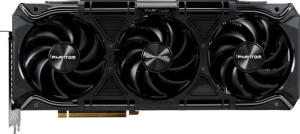
Gainward GeForce RTX 4070 Ti Super Phantom GS specifications and in-depth review

Gainward GeForce RTX 4070 Ti Super Phantom GS

Manufacturer: Gainward

The Gainward GeForce RTX 4070 Ti Super Phantom GS is a graphics card grounded in NVIDIA's Ada Lovelace architecture, produced on a 5 nm process with 45,900 million transistors. It runs at a base clock of 2340 MHz and boosts up to 2685 MHz, sits within a 285W thermal design power envelope, and connects via PCIe 4. The card measures 328.9 mm in length and 141.1 mm in height, with cooling handled entirely by air.

On the memory side, the card carries 16GB of GDDR6X across a 256-bit bus at an effective speed of 21,000 MHz, yielding a maximum bandwidth of 672.3 GB/s and ECC support for error-sensitive workloads. Its 8448 shading units, 264 texture mapping units, and 96 render output units produce a texture rate of 708.8 GTexels/s and 45.37 TFLOPS of floating-point throughput, with Double Precision Floating Point also supported. The feature set includes DirectX 12 Ultimate, OpenGL 4.6, OpenCL 3, ray tracing, DLSS, stereoscopic 3D, Intel Resizable BAR, and RGB lighting, with output available through one HDMI 2.1a port and three DisplayPort connections for up to four displays.

Pros
  • The 2685 MHz turbo clock is the highest boost frequency among the Phantom series variants, translating to slightly elevated texture and pixel throughput figures
  • 16GB of GDDR6X memory on a 256-bit bus with 672.3 GB/s of bandwidth provides substantial capacity for memory-heavy rendering and compute tasks
  • ECC memory support makes the card suitable for sustained workloads where data integrity matters, beyond typical graphics use
  • Hardware ray tracing and DLSS support allow more complex lighting and image reconstruction techniques without depending entirely on rasterization throughput
  • Support for up to four simultaneous displays makes it a functional fit for multi-monitor productivity and visualization environments
  • Intel Resizable BAR support reduces CPU-to-GPU data transfer bottlenecks by giving the processor broader access to the full frame buffer
Cons
  • At 328.9 mm in length and 141.1 mm in height, the card's physical size limits compatibility with compact or smaller mid-tower enclosures
  • The 285W TDP demands a well-specified power supply, making the card unsuitable for systems with limited power headroom
  • No USB-C, DVI, or mini DisplayPort outputs are available, which restricts compatibility with display hardware that relies on those interfaces
  • Water cooling is not supported, so the card depends entirely on air cooling for thermal management during sustained high-load operation
Who is this for?

The Gainward GeForce RTX 4070 Ti Super Phantom GS is well-suited to users working with demanding 3D rendering, video production, or compute-intensive tasks that can take advantage of 16GB of GDDR6X memory and 672.3 GB/s of bandwidth. Its ray tracing and DLSS support make it a practical choice for users engaged in real-time graphically complex workloads at higher resolutions, while the ECC memory support extends its relevance to those who need reliable data integrity over extended operation. Users managing multi-monitor setups of up to four displays will also find the output configuration accommodating for productivity or visualization environments.

Who is this NOT for?

Users planning to install this card in compact or small-form-factor builds will likely face clearance issues, as the card measures 328.9 mm in length and 141.1 mm in height, making it incompatible with many space-constrained enclosures. The 285W thermal design power also makes it a poor fit for systems with modest power supplies, where insufficient headroom under sustained load can lead to instability. Additionally, users who depend on DVI, USB-C, or mini DisplayPort connections for their display setup will find no compatible outputs on this card, limiting its usability in those specific configurations.

Performance:

GPU clock speed 2340 MHz
GPU turbo 2685 MHz
pixel rate 257.8 GPixel/s
floating-point performance 45.37 TFLOPS
texture rate 708.8 GTexels/s
GPU memory speed 1313 MHz
shading units 8448
texture mapping units (TMUs) 264
render output units (ROPs) 96
Has Double Precision Floating Point (DPFP)

This card runs at a base GPU clock of 2340 MHz and reaches a turbo frequency of 2685 MHz, with a GPU memory speed of 1313 MHz. The 8448 shading units are paired with 264 texture mapping units and 96 render output units, delivering a texture rate of 708.8 GTexels/s and a pixel rate of 257.8 GPixel/s. Floating-point throughput comes in at 45.37 TFLOPS, and Double Precision Floating Point support is included for workloads that depend on higher numerical precision.

Memory:

effective memory speed 21000 MHz
maximum memory bandwidth 672.3 GB/s
VRAM 16GB
GDDR version GDDR6X
memory bus width 256-bit
Supports ECC memory

The card features 16GB of GDDR6X memory operating across a 256-bit bus at an effective speed of 21,000 MHz, which translates to a maximum memory bandwidth of 672.3 GB/s. ECC memory support is included, offering error detection and correction for tasks where sustained data accuracy is a requirement.

Features:

DirectX version DirectX 12 Ultimate
OpenGL version 4.6
OpenCL version 3
Supports multi-display technology
supports ray tracing
Supports 3D
supports DLSS
has XeSS (XMX)
AMD SAM / Intel Resizable BAR Intel Resizable BAR
has LHR
has RGB lighting
supported displays 4

Feature support spans DirectX 12 Ultimate, OpenGL 4.6, and OpenCL 3, addressing both modern graphics pipelines and general-purpose compute workloads. Hardware ray tracing, DLSS, and stereoscopic 3D are all supported, whereas XeSS (XMX) and LHR are absent. The card accommodates up to four simultaneous displays via multi-display support, and Intel Resizable BAR is enabled to allow the CPU more flexible access to GPU memory. RGB lighting is also included as part of the card's feature set.

Ports:

has an HDMI output
HDMI ports 1
HDMI version HDMI 2.1a
DisplayPort outputs 3
USB-C ports 0
DVI outputs 0
mini DisplayPort outputs 0

Display connectivity is provided through one HDMI 2.1a port and three DisplayPort outputs, totaling four available connections. USB-C, DVI, and mini DisplayPort outputs are not present on this card.

General info:

GPU architecture Ada Lovelace
Thermal Design Power (TDP) 285W
PCI Express (PCIe) version 4
semiconductor size 5 nm
number of transistors 45900 million
Has air-water cooling
width 328.9 mm
height 141.1 mm

Underpinning the card is the Ada Lovelace architecture, fabricated on a 5 nm process with a transistor count of 45,900 million. It interfaces with the host system through PCIe 4 and operates at a thermal design power of 285W, with cooling handled entirely by air — water cooling is not supported. The card's physical footprint spans 328.9 mm in width and 141.1 mm in height.

Final Verdict

The Gainward GeForce RTX 4070 Ti Super Phantom GS brings together a well-rounded specification set anchored by 16GB of GDDR6X memory with 672.3 GB/s of bandwidth and a 2685 MHz boost clock, making it a capable option for users who need both strong graphical throughput and reliable memory capacity for intensive workloads. Ray tracing, DLSS, ECC support, and multi-display output give it versatility across both creative and compute-oriented scenarios, though its 328.9 mm length, 285W power requirement, and air-only cooling do place real demands on the host system. For users with appropriately sized and provisioned builds, the Gainward GeForce RTX 4070 Ti Super Phantom GS represents a coherent and capable choice within the graphics card category.