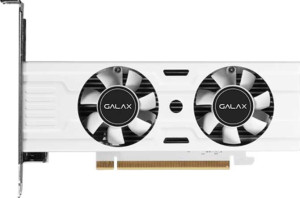
Galax GeForce RTX 3050 Low Profile White 6GB specifications and in-depth review

Galax GeForce RTX 3050 Low Profile White 6GB

Manufacturer: Galax

The Galax GeForce RTX 3050 Low Profile White 6GB is a compact graphics card designed around NVIDIA's Ampere architecture, fabricated on an 8nm process with 8.7 billion transistors. Its low-profile form factor — measuring just 185mm x 121mm — makes it one of the more space-conscious options in its category, while a 70W TDP keeps thermal and power demands in check. The card connects via PCIe 4 and relies on air cooling.

It carries 6GB of GDDR6 VRAM with an effective memory speed of 14000 MHz across a 96-bit bus, yielding a peak bandwidth of 168 GB/s and ECC memory support. The 2304 shading units, 72 TMUs, and 32 ROPs produce a texture rate of 105.8 GTexels/s and 6.774 TFLOPS of floating-point output. On the feature side, it supports DirectX 12 Ultimate, ray tracing, and DLSS, along with OpenGL 4.6, OpenCL 3, stereoscopic 3D, Intel Resizable BAR, and multi-display output across up to four screens via two HDMI 2.1 ports and two DisplayPort outputs.

Pros
  • The low-profile form factor at 185mm x 121mm makes it well-suited for compact or small form factor builds where full-size cards cannot fit
  • A 70W TDP keeps power consumption low, reducing demands on the system power supply and cooling infrastructure
  • Ray tracing and DLSS support bring modern rendering capabilities to a physically small card
  • Two HDMI 2.1 ports and two DisplayPort outputs allow up to four simultaneous displays, offering flexible connectivity for multi-monitor setups
  • ECC memory support adds data reliability for workloads where memory error correction is relevant
  • Intel Resizable BAR support enables broader CPU access to GPU memory, benefiting compatible systems
Cons
  • The 96-bit memory bus is narrow, which can restrict memory throughput in bandwidth-demanding scenarios
  • 6GB of VRAM may prove insufficient for certain modern workloads that require larger memory allocations
  • No USB-C output is available, limiting compatibility with some modern displays and docking solutions
  • RGB lighting is absent, which restricts aesthetic customization options
  • Water cooling is not supported, leaving air cooling as the only thermal solution regardless of the system environment
Who is this for?

This card is a practical fit for users building small form factor or compact systems where physical space is a hard constraint, thanks to its 185mm x 121mm low-profile dimensions and 70W TDP that keeps heat and power demands manageable. Its support for ray tracing, DLSS, and DirectX 12 Ultimate makes it serviceable for everyday gaming and general graphics workloads within those space-limited enclosures. The four display outputs and ECC memory support also make it a reasonable choice for light multi-monitor productivity setups or compute tasks where memory reliability carries some weight.

Who is this NOT for?

Users pursuing demanding gaming or high-resolution workloads will find the 96-bit memory bus and 6GB VRAM capacity restrictive, as both can become bottlenecks when bandwidth and memory size matter most. The card is equally unsuitable for those running GPU-intensive professional or compute applications that require significantly higher throughput. Additionally, builders who want system aesthetics with RGB lighting or advanced thermal management through water cooling will find neither option available on this card.

Performance:

GPU clock speed 1042 MHz
GPU turbo 1470 MHz
pixel rate 47.04 GPixel/s
floating-point performance 6.774 TFLOPS
texture rate 105.8 GTexels/s
GPU memory speed 1750 MHz
shading units 2304
texture mapping units (TMUs) 72
render output units (ROPs) 32
Has Double Precision Floating Point (DPFP)

The GPU runs at a base clock of 1042 MHz and reaches a boost of 1470 MHz, with memory clocked at 1750 MHz. Its 2304 shading units work alongside 72 TMUs and 32 ROPs, translating into a texture rate of 105.8 GTexels/s and a pixel rate of 47.04 GPixel/s. Floating-point performance lands at 6.774 TFLOPS, and Double Precision Floating Point (DPFP) is supported.

Memory:

effective memory speed 14000 MHz
maximum memory bandwidth 168 GB/s
VRAM 6GB
GDDR version GDDR6
memory bus width 96-bit
Supports ECC memory

The card features 6GB of GDDR6 VRAM operating at an effective speed of 14000 MHz over a 96-bit memory bus, with a peak bandwidth of 168 GB/s. ECC memory support is present, providing an added layer of reliability for workloads where memory error correction is beneficial.

Features:

DirectX version DirectX 12 Ultimate
OpenGL version 4.6
OpenCL version 3
Supports multi-display technology
supports ray tracing
Supports 3D
supports DLSS
has XeSS (XMX)
AMD SAM / Intel Resizable BAR Intel Resizable BAR
has LHR
has RGB lighting
supported displays 4

The card supports DirectX 12 Ultimate, OpenGL 4.6, and OpenCL 3, alongside ray tracing, DLSS, stereoscopic 3D, and multi-display output across up to four screens. Intel Resizable BAR is supported, while XeSS (XMX) and LHR are not present. RGB lighting is not included on this model.

Ports:

has an HDMI output
HDMI ports 2
HDMI version HDMI 2.1
DisplayPort outputs 2
USB-C ports 0
DVI outputs 0
mini DisplayPort outputs 0

Output connectivity consists of two HDMI 2.1 ports and two DisplayPort outputs, totaling four available display connections. There are no USB-C, DVI, or mini DisplayPort outputs on this card.

General info:

GPU architecture Ampere
Thermal Design Power (TDP) 70W
PCI Express (PCIe) version 4
semiconductor size 8 nm
number of transistors 8700 million
Has air-water cooling
width 185 mm
height 121 mm

Based on the Ampere architecture and built on an 8nm process with 8700 million transistors, the card connects via PCIe 4 and operates within a 70W TDP. Its compact dimensions of 185mm x 121mm suit space-restricted builds, and cooling is handled exclusively by air — no water-cooling option is available.

Final Verdict

The Galax GeForce RTX 3050 Low Profile White 6GB occupies a well-defined niche as a compact, low-power graphics card built for systems where space and thermal constraints take priority over raw throughput. Its Ampere architecture brings a credible feature set — ray tracing, DLSS, DirectX 12 Ultimate, and flexible multi-display output — within a physically small package that few full-size cards can match. The trade-offs in memory bus width and VRAM capacity are real, and users with demanding workloads will feel them, but for the build type this card is designed for, those limitations are largely expected. For anyone assembling a compact system that needs a modern, capable graphics card without exceeding tight physical or power budgets, this card makes a coherent and well-suited choice.