Galax GeForce RTX 4080 Super SG 1-Click OC specifications and in-depth review

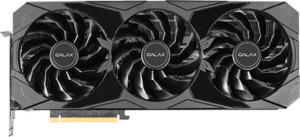
Galax GeForce RTX 4080 Super SG 1-Click OC

Manufacturer: Galax

The Galax GeForce RTX 4080 Super SG 1-Click OC is a graphics card built on NVIDIA's Ada Lovelace architecture, manufactured using a 5 nm process and integrating 45,900 million transistors. It operates at a base GPU clock of 2295 MHz with a boost up to 2610 MHz, and comes equipped with support for ray tracing, DLSS, stereoscopic 3D, and RGB lighting across a feature set typical of the RTX 4080 Super tier.

The card carries 16GB of GDDR6X VRAM on a 256-bit bus running at an effective 23,000 MHz, producing a peak memory bandwidth of 736.3 GB/s. Its 10,240 shading units work in tandem with 320 TMUs and 112 ROPs, achieving a texture rate of 835.2 GTexels/s and a pixel rate of 292.3 GPixel/s, while floating-point performance reaches 53.45 TFLOPS. ECC memory and Double Precision Floating Point are both supported, the card connects via PCIe 4 with a 320W TDP, and output is handled through one HDMI 2.1a port and three DisplayPort connections, supporting up to four displays. Physical dimensions are 352 mm in width and 153 mm in height.

Pros
  • The 16GB of GDDR6X memory operating across a 256-bit bus at 23,000 MHz effective speed delivers 736.3 GB/s of bandwidth, supporting demanding rendering and compute tasks without memory bottlenecks
  • Ray tracing and DLSS are both supported, enabling hardware-accelerated lighting and AI-driven upscaling in compatible applications
  • ECC memory support provides data integrity protection, which is useful for compute workloads where memory accuracy is critical
  • Double Precision Floating Point support broadens the card's usability beyond graphics into compute-intensive scenarios
  • Intel Resizable BAR is included, allowing the CPU to access the full GPU frame buffer simultaneously on compatible PCIe 4 platforms
  • With one HDMI 2.1a port and three DisplayPort outputs, the card can drive up to four displays simultaneously, offering practical flexibility for multi-monitor setups
Cons
  • At 352 mm wide and 153 mm tall, the card's large physical footprint demands a full-size case with substantial internal clearance
  • The 320W TDP places significant load on the power supply and requires a well-ventilated system to maintain stable thermals
  • Air-water cooling integration is not supported, which limits options for users who prefer or rely on liquid cooling solutions
  • There are no USB-C outputs on this card, which may be a drawback for users with displays or peripherals that depend on that connection type
  • XeSS (XMX) upscaling is not supported, meaning users who rely on that technology in their workflow will not find it available here
Who is this for?

This card is well matched to users who regularly push ray tracing and DLSS-enabled workloads, where the hardware acceleration and AI upscaling features can be fully exercised. The 16GB of GDDR6X memory delivering 736.3 GB/s of bandwidth, backed by ECC support, also makes it a practical choice for GPU compute tasks that demand both high throughput and reliable data integrity. Those running multi-monitor setups across up to four displays will find the combination of three DisplayPort outputs and one HDMI 2.1a port well suited to their needs, particularly on PCIe 4 platforms that support Intel Resizable BAR.

Who is this NOT for?

With a width of 352 mm and a height of 153 mm, this card is poorly suited to compact or small-form-factor builds where internal clearance is limited, as it requires a full-size case to install without obstruction. Users who have integrated custom liquid cooling loops into their systems will find no air-water cooling compatibility here, which could be a significant limitation for thermally optimized setups. Additionally, anyone whose workflow or display configuration depends on USB-C connectivity or XeSS (XMX) upscaling will need to look elsewhere, as neither feature is available on this model.

Performance:

GPU clock speed 2295 MHz
GPU turbo 2610 MHz
pixel rate 292.3 GPixel/s
floating-point performance 53.45 TFLOPS
texture rate 835.2 GTexels/s
GPU memory speed 1438 MHz
shading units 10240
texture mapping units (TMUs) 320
render output units (ROPs) 112
Has Double Precision Floating Point (DPFP)

The GPU has a base clock of 2295 MHz that boosts up to 2610 MHz, with memory running at 1438 MHz. The 10,240 shading units are paired with 320 texture mapping units and 112 render output units, yielding a texture rate of 835.2 GTexels/s and a pixel rate of 292.3 GPixel/s. Floating-point performance stands at 53.45 TFLOPS, and Double Precision Floating Point support is included, extending the card's reach into compute workloads alongside graphics rendering.

Memory:

effective memory speed 23000 MHz
maximum memory bandwidth 736.3 GB/s
VRAM 16GB
GDDR version GDDR6X
memory bus width 256-bit
Supports ECC memory

Memory is configured as 16GB of GDDR6X running across a 256-bit bus at an effective speed of 23,000 MHz, resulting in a peak bandwidth of 736.3 GB/s. ECC memory support is included, providing error-correction functionality that benefits users running workloads where data integrity is a priority.

Features:

DirectX version DirectX 12 Ultimate
OpenGL version 4.6
OpenCL version 3
Supports multi-display technology
supports ray tracing
Supports 3D
supports DLSS
has XeSS (XMX)
AMD SAM / Intel Resizable BAR Intel Resizable BAR
has LHR
has RGB lighting
supported displays 4

The card supports DirectX 12 Ultimate, OpenGL 4.6, and OpenCL 3, alongside hardware-accelerated ray tracing and DLSS for AI-based upscaling. Stereoscopic 3D, multi-display technology for up to four screens, RGB lighting, and Intel Resizable BAR are all present, with the latter helping to improve CPU-to-GPU data throughput on compatible platforms. XeSS (XMX) is not supported, and LHR is not included on this model.

Ports:

has an HDMI output
HDMI ports 1
HDMI version HDMI 2.1a
DisplayPort outputs 3
USB-C ports 0
DVI outputs 0
mini DisplayPort outputs 0

Output connectivity consists of three DisplayPort outputs and one HDMI 2.1a port, providing a total of four display connections. USB-C, DVI, and mini DisplayPort outputs are not available on this card.

General info:

GPU architecture Ada Lovelace
Thermal Design Power (TDP) 320W
PCI Express (PCIe) version 4
semiconductor size 5 nm
number of transistors 45900 million
Has air-water cooling
width 352 mm
height 153 mm

The card is grounded in the Ada Lovelace architecture, manufactured on a 5 nm process with 45,900 million transistors, and uses a PCIe 4 interface for system connectivity. It carries a 320W TDP, which places real demands on both the power supply and case cooling, and air-water cooling is not supported. Physically, the card spans 352 mm in width and 153 mm in height, so adequate case clearance is a practical requirement for installation.
Final Verdict

The Galax GeForce RTX 4080 Super SG 1-Click OC presents a thoroughly specified graphics card built on Ada Lovelace, with 16GB of GDDR6X memory delivering 736.3 GB/s of bandwidth and 53.45 TFLOPS of floating-point performance forming the core of its capability. Ray tracing, DLSS, ECC memory, and Intel Resizable BAR support round out a feature set that covers both graphics and compute use cases effectively. Prospective users should plan around its 352 mm length, 320W TDP, and the absence of liquid cooling support and USB-C output when configuring a compatible system. For those with a full-size build and a suitably rated power supply, this card delivers a complete and well-equipped option within the RTX 4080 Super tier.

Popular Comparisons

Galax GeForce RTX 4080 Super SG 1-Click OC
VS
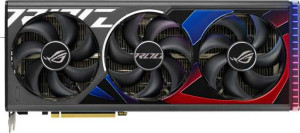
Asus ROG Strix GeForce RTX 4080 Super