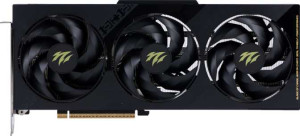
Galax GeForce RTX 5060 Magic Blade specifications and in-depth review

Galax GeForce RTX 5060 Magic Blade

Manufacturer: Galax

The Galax GeForce RTX 5060 Magic Blade is a graphics card based on NVIDIA's Blackwell architecture, fabricated on a 5nm process and equipped with 8GB of GDDR7 memory across a 128-bit bus. It supports ray tracing, DLSS, and RGB lighting, and can drive up to four displays simultaneously through its combination of HDMI and DisplayPort outputs.

On the technical side, the card operates at a base clock of 2280 MHz with a boost up to 2497 MHz, delivering 19.18 TFLOPS of floating-point performance alongside a texture rate of 299.6 GTexels/s and a pixel rate of 119.9 GPixels/s. Its 3840 shading units are complemented by 120 TMUs and 48 ROPs, while memory bandwidth reaches 448 GB/s at an effective speed of 28000 MHz. The card carries a TDP of 145W, measures 316.5 mm in length, and connects via PCIe 5.0, with Intel Resizable BAR support included.

Pros
  • Supports ray tracing and DLSS, enabling more visually detailed rendering and frame rate upscaling in compatible applications
  • GDDR7 memory with an effective speed of 28000 MHz and 448 GB/s bandwidth provides substantial data throughput for the GPU
  • Can drive up to four displays simultaneously through a combination of one HDMI 2.1b and three DisplayPort outputs
  • ECC memory support adds a layer of data integrity useful in compute or content creation workloads
  • RGB lighting is built into the card for those who want a visually customized system
  • Intel Resizable BAR support allows the processor to access the full GPU frame buffer, which can benefit certain workloads
Cons
  • The 128-bit memory bus width is relatively narrow for an 8GB card, which may limit sustained memory throughput in demanding scenarios
  • No USB-C output is available, which restricts connectivity options for certain modern displays and devices
  • Water cooling is not supported; the card relies solely on air cooling, which may be a limitation in thermally constrained builds
  • With only 8GB of VRAM, memory capacity could become a bottleneck in high-resolution or memory-intensive workloads
  • At 316.5 mm in length, the card requires a sufficiently spacious case to fit without clearance issues
Who is this for?

This card is a reasonable fit for users who want to run games or creative applications with ray tracing and DLSS enabled, as both features are fully supported. The GDDR7 memory with 448 GB/s bandwidth and ECC support also makes it a practical option for light compute or content creation tasks where memory reliability matters. Those running multi-monitor setups of up to four displays will find the port configuration accommodating, and the PCIe 5.0 interface ensures compatibility with current-generation platforms without any bandwidth bottlenecks.

Who is this NOT for?

Users who work with memory-intensive workloads at high resolutions — such as 4K texture editing, large 3D scene rendering, or AI model inference — may find the 8GB VRAM ceiling restrictive over time. The 128-bit memory bus, while partially offset by GDDR7 speeds, can limit sustained throughput compared to wider configurations, making this card less suited for tasks that continuously saturate memory bandwidth. Additionally, builders working with compact or thermally limited cases should take note that the card stretches to 316.5 mm and lacks water cooling support, which could present fitment or thermal management challenges in smaller enclosures.

Performance:

GPU clock speed 2280 MHz
GPU turbo 2497 MHz
pixel rate 119.9 GPixel/s
floating-point performance 19.18 TFLOPS
texture rate 299.6 GTexels/s
GPU memory speed 1750 MHz
shading units 3840
texture mapping units (TMUs) 120
render output units (ROPs) 48
Has Double Precision Floating Point (DPFP)

The Galax GeForce RTX 5060 Magic Blade runs at a base clock of 2280 MHz, boosting up to 2497 MHz under load, and delivers 19.18 TFLOPS of floating-point performance alongside a texture rate of 299.6 GTexels/s and a pixel rate of 119.9 GPixels/s. Its 3840 shading units work in tandem with 120 texture mapping units and 48 render output units to handle rendering workloads, while GPU memory operates at 1750 MHz. The card also supports Double Precision Floating Point (DPFP), adding versatility for compute-oriented tasks.

Memory:

effective memory speed 28000 MHz
maximum memory bandwidth 448 GB/s
VRAM 8GB
GDDR version GDDR7
memory bus width 128-bit
Supports ECC memory

The card is equipped with 8GB of GDDR7 VRAM running at an effective speed of 28000 MHz across a 128-bit memory bus, yielding a maximum memory bandwidth of 448 GB/s. ECC memory support is also included, which helps detect and correct memory errors in workloads where data integrity is a priority.

Features:

DirectX version DirectX 12 Ultimate
OpenGL version 4.6
OpenCL version 3
Supports multi-display technology
supports ray tracing
Supports 3D
supports DLSS
has XeSS (XMX)
AMD SAM / Intel Resizable BAR Intel Resizable BAR
has LHR
has RGB lighting
supported displays 4

The Galax GeForce RTX 5060 Magic Blade supports DirectX 12 Ultimate, OpenGL 4.6, and OpenCL 3, covering a broad range of graphics and compute APIs. Ray tracing and DLSS are both supported, while stereoscopic 3D and multi-display technology are also on board, with the card capable of driving up to four displays at once. Intel Resizable BAR is included to help the CPU access GPU memory more efficiently, and RGB lighting is present on the card itself. XeSS (XMX) and LHR are not featured on this model.

Ports:

has an HDMI output
HDMI ports 1
HDMI version HDMI 2.1b
DisplayPort outputs 3
USB-C ports 0
DVI outputs 0
mini DisplayPort outputs 0

The card's output configuration consists of one HDMI 2.1b port and three DisplayPort outputs, totaling four available display connections. There are no USB-C, DVI, or mini DisplayPort outputs on this model.

General info:

GPU architecture Blackwell
Thermal Design Power (TDP) 145W
PCI Express (PCIe) version 5
semiconductor size 5 nm
number of transistors 21900 million
Has air-water cooling
width 316.5 mm
height 140 mm

Built on the Blackwell architecture and fabricated using a 5nm process, the card integrates 21,900 million transistors and connects via PCIe 5.0. It carries a Thermal Design Power of 145W and relies on air cooling, with no water cooling option included. Physically, the card measures 316.5 mm in width and 140 mm in height.

Final Verdict

The Galax GeForce RTX 5060 Magic Blade brings together the Blackwell architecture, GDDR7 memory, and a capable feature set — including ray tracing, DLSS, and multi-display support — in a card that targets users looking for a current-generation option with modern API and platform compatibility. Its GDDR7 memory running at 28000 MHz effective speed is one of the more notable aspects of its specification sheet, delivering strong bandwidth for its class. That said, the 8GB VRAM capacity and 128-bit bus will naturally limit its headroom in the most demanding workloads, and prospective buyers should factor in its 316.5 mm length and air-only cooling when planning a build. Overall, the RTX 5060 Magic Blade represents a well-specified entry for mainstream gaming and light compute use, provided its memory configuration aligns with the user's workload expectations.