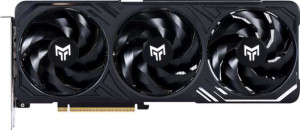
Galax GeForce RTX 5060 Metal Master Black Gold Edition OC specifications and in-depth review

Galax GeForce RTX 5060 Metal Master Black Gold Edition OC

Manufacturer: Galax

The Galax GeForce RTX 5060 Metal Master Black Gold Edition OC is a desktop graphics card based on NVIDIA's Blackwell architecture, manufactured on a 5 nm process with 21,900 million transistors. It ships with a base clock of 2280 MHz and a factory-overclocked boost of 2535 MHz, giving it a floating-point throughput of 19.47 TFLOPS. The card features RGB lighting and a 145W TDP, fitting into a PCIe 5.0 slot with a physical footprint of 316.5 mm in length and 138 mm in height.

On the memory side, the card carries 8GB of GDDR7 across a 128-bit bus, reaching an effective speed of 28,000 MHz and a peak bandwidth of 448 GB/s. It provides 3,840 shading units, 120 texture mapping units, and 48 render output units, yielding a texture rate of 304.2 GTexels/s and a pixel rate of 121.7 GPixels/s. Display connectivity includes one HDMI 2.1b port and three DisplayPort outputs for a total of up to four simultaneous displays. Feature support covers DirectX 12 Ultimate, OpenGL 4.6, OpenCL 3, ray tracing, DLSS, and Intel Resizable BAR, while ECC memory is also supported.

Pros
  • Supports ray tracing and DLSS, extending rendering capabilities for compatible workloads
  • GDDR7 memory with a 448 GB/s bandwidth ceiling gives the card notable data throughput for its 128-bit bus width
  • Up to four displays can be driven simultaneously via three DisplayPort outputs and one HDMI 2.1b port
  • ECC memory support adds a layer of data integrity useful in compute-oriented tasks
  • Intel Resizable BAR support allows the CPU broader access to GPU memory, which can improve frame delivery in supported scenarios
  • Double Precision Floating Point (DPFP) support broadens the card's utility beyond typical consumer graphics workloads
Cons
  • The 128-bit memory bus is relatively narrow, which limits scalability of memory bandwidth despite the fast GDDR7 modules
  • 8GB of VRAM may prove restrictive in memory-intensive scenarios at higher resolutions
  • No USB-C output is available, limiting connectivity options for certain monitors and devices
  • Water cooling is not supported, leaving thermal management entirely dependent on the air cooler
  • The 316.5 mm card length may present fitment challenges in compact or mid-tower cases with limited clearance
Who is this for?

This card is a reasonable fit for users running compute workloads that benefit from DPFP and ECC memory support, such as scientific calculations or data processing tasks where numerical accuracy matters. It also suits those wanting to drive up to four displays simultaneously via its combination of HDMI 2.1b and three DisplayPort outputs, making it a practical choice for multi-monitor setups. Additionally, users who want access to ray tracing and DLSS within a 145W power envelope will find its feature set well-aligned with those needs.

Who is this NOT for?

Users planning to work with memory-intensive workloads at higher resolutions — such as large texture sets or high-resolution video editing — may find the 8GB VRAM ceiling restrictive over time. The 128-bit memory bus, while partially offset by GDDR7 speeds, limits raw bandwidth scalability compared to wider-bus configurations, making this card a poor match for those pushing the upper bounds of GPU memory throughput. Furthermore, users building in compact enclosures should be aware that the 316.5 mm length and reliance solely on air cooling may create fitment and thermal management challenges in tightly constrained cases.

Performance:

GPU clock speed 2280 MHz
GPU turbo 2535 MHz
pixel rate 121.7 GPixel/s
floating-point performance 19.47 TFLOPS
texture rate 304.2 GTexels/s
GPU memory speed 1750 MHz
shading units 3840
texture mapping units (TMUs) 120
render output units (ROPs) 48
Has Double Precision Floating Point (DPFP)

The card operates at a base GPU clock of 2280 MHz, rising to a boost frequency of 2535 MHz under load, while the GPU memory runs at 1750 MHz. With 3,840 shading units, 120 texture mapping units, and 48 render output units, it delivers a texture rate of 304.2 GTexels/s and a pixel rate of 121.7 GPixels/s. Floating-point performance reaches 19.47 TFLOPS, and the GPU also supports Double Precision Floating Point (DPFP), extending its utility to workloads that require higher numerical precision.

Memory:

effective memory speed 28000 MHz
maximum memory bandwidth 448 GB/s
VRAM 8GB
GDDR version GDDR7
memory bus width 128-bit
Supports ECC memory

The card is equipped with 8GB of GDDR7 VRAM running across a 128-bit memory bus, reaching an effective memory speed of 28,000 MHz and a maximum bandwidth of 448 GB/s. ECC memory support is also included, which helps detect and correct memory errors in workloads where data integrity is a concern.

Features:

DirectX version DirectX 12 Ultimate
OpenGL version 4.6
OpenCL version 3
Supports multi-display technology
supports ray tracing
Supports 3D
supports DLSS
has XeSS (XMX)
AMD SAM / Intel Resizable BAR Intel Resizable BAR
has LHR
has RGB lighting
supported displays 4

The card supports DirectX 12 Ultimate, OpenGL 4.6, and OpenCL 3, covering a broad range of graphics and compute workloads. Ray tracing and DLSS are both supported, alongside stereoscopic 3D and multi-display technology for up to four simultaneous outputs. Intel Resizable BAR is included to help improve data transfer between the CPU and GPU, while RGB lighting is built into the card's design. XeSS (XMX) and LHR are not featured on this model.

Ports:

has an HDMI output
HDMI ports 1
HDMI version HDMI 2.1b
DisplayPort outputs 3
USB-C ports 0
DVI outputs 0
mini DisplayPort outputs 0

The card's output configuration consists of one HDMI 2.1b port and three DisplayPort outputs, enabling connection to up to four displays simultaneously. There are no USB-C, DVI, or mini DisplayPort outputs on this model.

General info:

GPU architecture Blackwell
Thermal Design Power (TDP) 145W
PCI Express (PCIe) version 5
semiconductor size 5 nm
number of transistors 21900 million
Has air-water cooling
width 316.5 mm
height 138 mm

Built on the Blackwell architecture and fabricated using a 5 nm process, the GPU integrates 21,900 million transistors and connects to the system via a PCIe 5.0 slot. It carries a Thermal Design Power of 145W and measures 316.5 mm in width and 138 mm in height, making physical fitment a relevant consideration for smaller cases. The card relies solely on air cooling, as water cooling is not supported.

Final Verdict

The Galax GeForce RTX 5060 Metal Master Black Gold Edition OC occupies a defined space within the graphics card market, offering a well-rounded feature set anchored by its Blackwell architecture, ray tracing, DLSS support, and the notable inclusion of DPFP and ECC memory — capabilities that extend its utility into light compute tasks beyond typical consumer rendering. Its GDDR7 memory delivering 448 GB/s of bandwidth is a genuine highlight for the tier, and the four-display output configuration adds practical versatility for multi-monitor users. That said, the 8GB VRAM ceiling and 128-bit bus width are real constraints that define the card's upper limits, and prospective buyers should weigh those boundaries against their intended workloads. For users whose needs align with its strengths — moderate compute, multi-display output, and access to modern rendering features within a 145W power draw — this card delivers a coherent and capable package.