Galax GeForce RTX 5070 Metal Master Black Gold Edition OC specifications and in-depth review

Galax GeForce RTX 5070 Metal Master Black Gold Edition OC

Manufacturer: Galax

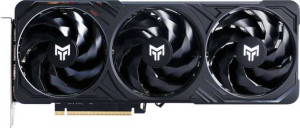
The Galax GeForce RTX 5070 Metal Master Black Gold Edition OC is a factory-overclocked graphics card occupying the upper-midrange segment of NVIDIA's Blackwell generation lineup. It ships with a base clock of 2325 MHz and a boosted frequency of 2557 MHz, and its RGB lighting and Black Gold aesthetic give it a distinctive visual character. Built on a 5 nm semiconductor process, the card packs 31.1 billion transistors into a form factor measuring 316.5 mm in length and 139 mm in height, with a rated TDP of 250W and a PCIe 5.0 interface.

On the memory side, the card carries 12GB of GDDR7 VRAM across a 192-bit bus, delivering an effective speed of 28000 MHz and a peak bandwidth of 672 GB/s. Its 6144 shading units, 192 texture mapping units, and 80 render output units contribute to a texture rate of 490.9 GTexels/s and a floating-point throughput of 31.42 TFLOPS. Feature support includes DirectX 12 Ultimate, OpenGL 4.6, OpenCL 3, ray tracing, DLSS, Intel Resizable BAR, and stereoscopic 3D, while connectivity is handled by three DisplayPort 1.4 outputs and one HDMI 2.1b port, supporting up to four displays simultaneously.

Pros
  • Supports ray tracing and DLSS, enabling hardware-accelerated rendering and AI-based upscaling for compatible applications
  • GDDR7 memory delivers a peak bandwidth of 672 GB/s, facilitating fast data throughput for demanding workloads
  • Four simultaneous display outputs — three DisplayPort and one HDMI 2.1b — offer flexible multi-monitor configurations
  • ECC memory support helps maintain data integrity in error-sensitive compute tasks
  • Intel Resizable BAR support allows the CPU broader access to GPU memory, which can improve data transfer efficiency
  • RGB lighting is included, giving users control over the card's visual appearance
Cons
  • A 250W TDP places notable demands on system power delivery and case airflow
  • The 192-bit memory bus is relatively narrow for a card in this tier, which limits potential memory bandwidth scaling
  • No USB-C output is available, restricting compatibility with displays or devices that rely on that connector
  • Water cooling is not supported, limiting thermal management options to air cooling only
  • XeSS (XMX) is not supported, meaning that specific upscaling technology is unavailable
Who is this for?

This card is well-suited to users who regularly work with ray tracing and DLSS-enabled applications, where hardware-accelerated rendering and AI upscaling can make a tangible difference in output quality and frame consistency. The 12GB of GDDR7 memory combined with a 672 GB/s bandwidth ceiling makes it a capable choice for content creators and compute-oriented workloads that benefit from fast memory throughput, while ECC memory support adds a layer of reliability for tasks where data accuracy matters. Its four display outputs also make it practical for users who need a multi-monitor setup without additional adapters or hardware.

Who is this NOT for?

Users who require water cooling integration for silent or thermally constrained builds will find this card limiting, as it only supports air cooling. The 250W TDP also makes it a poor fit for small form factor or low-wattage systems where power and thermal headroom are restricted. Additionally, users who rely on USB-C display connectivity or XeSS-based upscaling in their workflow will need to look elsewhere, as neither is supported on this model.

Performance:

GPU clock speed 2325 MHz
GPU turbo 2557 MHz
pixel rate 204.6 GPixel/s
floating-point performance 31.42 TFLOPS
texture rate 490.9 GTexels/s
GPU memory speed 1750 MHz
shading units 6144
texture mapping units (TMUs) 192
render output units (ROPs) 80
Has Double Precision Floating Point (DPFP)

The card operates at a base GPU clock of 2325 MHz, rising to 2557 MHz in turbo mode, while the GPU memory runs at 1750 MHz. Its 6144 shading units work alongside 192 texture mapping units and 80 render output units to deliver a texture rate of 490.9 GTexels/s and a pixel rate of 204.6 GPixel/s. Floating-point performance reaches 31.42 TFLOPS, and the card also supports Double Precision Floating Point (DPFP), making it capable of handling workloads that require higher numerical precision.

Memory:

effective memory speed 28000 MHz
maximum memory bandwidth 672 GB/s
VRAM 12GB
GDDR version GDDR7
memory bus width 192-bit
Supports ECC memory

This card is equipped with 12GB of GDDR7 VRAM running across a 192-bit memory bus, reaching an effective memory speed of 28000 MHz and a maximum bandwidth of 672 GB/s. ECC memory support is also included, which helps detect and correct memory errors in workloads where data integrity is a priority.

Features:

DirectX version DirectX 12 Ultimate
OpenGL version 4.6
OpenCL version 3
Supports multi-display technology
supports ray tracing
Supports 3D
supports DLSS
has XeSS (XMX)
AMD SAM / Intel Resizable BAR Intel Resizable BAR
has LHR
has RGB lighting
supported displays 4

The card supports DirectX 12 Ultimate, OpenGL 4.6, and OpenCL 3, covering a broad range of graphics and compute APIs. Ray tracing and DLSS are both supported, while XeSS (XMX) is not included. Multi-display technology is present with support for up to four simultaneous outputs, and stereoscopic 3D is also available. Intel Resizable BAR is supported to help improve data transfer between the CPU and GPU, and Lite Hash Rate (LHR) limiting is not applied. The card features RGB lighting and does not include any hardware-level mining restrictions.

Ports:

has an HDMI output
HDMI ports 1
HDMI version HDMI 2.1b
DisplayPort outputs 3
USB-C ports 0
DVI outputs 0
mini DisplayPort outputs 0

The card's output configuration consists of three DisplayPort outputs and one HDMI 2.1b port, totaling four display connectors. There are no USB-C, DVI, or mini DisplayPort outputs included on this model.

General info:

GPU architecture Blackwell
Thermal Design Power (TDP) 250W
PCI Express (PCIe) version 5
semiconductor size 5 nm
number of transistors 31100 million
Has air-water cooling
width 316.5 mm
height 139 mm

Built on the Blackwell architecture and fabricated using a 5 nm process, the GPU integrates 31,100 million transistors and connects to the system via a PCIe 5.0 interface. It carries a Thermal Design Power (TDP) of 250W and measures 316.5 mm in width and 139 mm in height. The card relies solely on air cooling, as it does not include support for water cooling configurations.
Final Verdict

The Galax GeForce RTX 5070 Metal Master Black Gold Edition OC brings together a well-rounded set of specifications for users who want capable ray tracing, DLSS support, and fast GDDR7 memory in a single package. Its 672 GB/s memory bandwidth and ECC support make it a credible option not just for gaming-oriented workloads but also for lighter compute tasks that demand reliable, high-throughput memory. The card's 250W TDP and air-only cooling do impose some system requirements, and the absence of USB-C output and water cooling compatibility will narrow its appeal for certain build types. Overall, it represents a focused offering from Galax's Metal Master line — one that delivers strong feature coverage within its hardware constraints, best suited to users whose system and workflow align with what its specifications can realistically deliver.