Galax GeForce RTX 5070 Ti Magic Blade OC specifications and in-depth review

Galax GeForce RTX 5070 Ti Magic Blade OC

Manufacturer: Galax

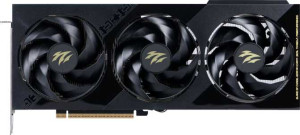
The Galax GeForce RTX 5070 Ti Magic Blade OC is a graphics card from Galax based on NVIDIA's Blackwell architecture, manufactured on a 5 nm process with 45,600 million transistors. It runs at a base clock of 2295 MHz and reaches a boosted speed of 2497 MHz under load, delivering 44.75 TFLOPS of floating-point performance and a texture rate of 699.2 GTexels/s. The card also features RGB lighting and supports up to four displays simultaneously.

On the memory side, the card is equipped with 16GB of GDDR7 across a 256-bit bus, achieving an effective memory speed of 28,000 MHz and a maximum bandwidth of 896 GB/s, with ECC memory support included. Connectivity options include one HDMI 2.1b port and three DisplayPort outputs, while USB-C output is absent. The card supports DirectX 12 Ultimate, OpenGL 4.6, OpenCL 3, ray tracing, DLSS, stereoscopic 3D, and Intel Resizable BAR, with a 300W TDP and dimensions of 316.5 mm in length and 140.1 mm in height.

Pros
  • Supports up to four displays simultaneously, offering flexibility for multi-monitor setups
  • GDDR7 memory with 896 GB/s bandwidth and ECC support ensures both high throughput and data integrity during demanding workloads
  • The combination of ray tracing and DLSS support enables more realistic rendering alongside performance-recovery capabilities
  • HDMI 2.1b and three DisplayPort outputs cover a wide range of modern display connectivity needs
  • RGB lighting is built into the card for users who want visual customization within their build
  • Intel Resizable BAR support allows the CPU broader access to VRAM, which can benefit certain workloads
Cons
  • A 300W TDP places significant power demands on the system, requiring a suitably rated power supply
  • The card lacks USB-C output, limiting compatibility with certain modern displays and adapters that rely on that connector
  • Air-water cooling is not included, meaning thermal management depends entirely on whatever cooling solution comes pre-fitted
  • At 316.5 mm in length, the card may not fit in all mid-tower or smaller PC cases without careful clearance checks
Who is this for?

This card is well-suited to users who work with demanding real-time rendering workloads, including those who rely on ray tracing and DLSS to balance visual fidelity with frame output. The 16GB of GDDR7 memory with ECC support also makes it a reasonable fit for compute-intensive tasks such as simulation or content creation workflows that benefit from high memory bandwidth and error-corrected data. Additionally, users looking to drive multi-monitor setups of up to four displays will find the port configuration practical, especially with HDMI 2.1b and three DisplayPort outputs covering a wide range of modern screens.

Who is this NOT for?

Users working within compact or small-form-factor builds may find the card's 316.5 mm length a physical obstacle, as it requires ample case clearance that smaller enclosures often cannot provide. The 300W TDP also makes this a poor fit for systems with modest power supplies or limited airflow, since the thermal demands are substantial and no air-water cooling solution is included. Additionally, users who rely on USB-C display output — such as those connecting to certain professional monitors or portable displays — will find that connector absent from this card's port configuration.

Performance:

GPU clock speed 2295 MHz
GPU turbo 2497 MHz
pixel rate 239.7 GPixel/s
floating-point performance 44.75 TFLOPS
texture rate 699.2 GTexels/s
GPU memory speed 1750 MHz
shading units 8960
texture mapping units (TMUs) 280
render output units (ROPs) 96
Has Double Precision Floating Point (DPFP)

The Performance section of this card centers on a base GPU clock of 2295 MHz that boosts up to 2497 MHz under load, backed by a floating-point throughput of 44.75 TFLOPS. Rasterization capacity is handled by 96 ROPs delivering a pixel rate of 239.7 GPixel/s, while 280 texture mapping units achieve a texture rate of 699.2 GTexels/s. The GPU memory runs at 1750 MHz, and the card's 8960 shading units provide a broad base for parallel workloads. Double Precision Floating Point (DPFP) is also supported, adding utility for compute-oriented tasks.

Memory:

effective memory speed 28000 MHz
maximum memory bandwidth 896 GB/s
VRAM 16GB
GDDR version GDDR7
memory bus width 256-bit
Supports ECC memory

This card carries 16GB of GDDR7 VRAM across a 256-bit memory bus, reaching an effective memory speed of 28,000 MHz and a maximum memory bandwidth of 896 GB/s. ECC memory support is included, which helps maintain data integrity during intensive workloads by detecting and correcting memory errors.

Features:

DirectX version DirectX 12 Ultimate
OpenGL version 4.6
OpenCL version 3
Supports multi-display technology
supports ray tracing
Supports 3D
supports DLSS
has XeSS (XMX)
AMD SAM / Intel Resizable BAR Intel Resizable BAR
has LHR
has RGB lighting
supported displays 4

The card supports DirectX 12 Ultimate, OpenGL 4.6, and OpenCL 3, covering a broad range of graphics and compute APIs. Ray tracing and DLSS are both supported, alongside stereoscopic 3D and multi-display technology spanning up to four outputs simultaneously. Intel Resizable BAR is included to help the CPU access GPU memory more efficiently, while XeSS (XMX) and LHR are not present on this card. RGB lighting is built in, adding a visual element to the card's exterior.

Ports:

has an HDMI output
HDMI ports 1
HDMI version HDMI 2.1b
DisplayPort outputs 3
USB-C ports 0
DVI outputs 0
mini DisplayPort outputs 0

The card's output configuration consists of one HDMI 2.1b port and three DisplayPort outputs, providing a total of four display connections. DVI, mini DisplayPort, and USB-C outputs are not present on this card.

General info:

GPU architecture Blackwell
Thermal Design Power (TDP) 300W
PCI Express (PCIe) version 5
semiconductor size 5 nm
number of transistors 45600 million
Has air-water cooling
width 316.5 mm
height 140.1 mm

Built on the Blackwell architecture and fabricated at 5 nm, the GPU integrates 45,600 million transistors and connects to the system via a PCIe 5 interface. It carries a Thermal Design Power of 300W and measures 316.5 mm in width and 140.1 mm in height. Air-water cooling is not included with this card.
Final Verdict

The Galax GeForce RTX 5070 Ti Magic Blade OC is a capable graphics card built around NVIDIA's Blackwell architecture, pairing a 2497 MHz boost clock with 16GB of GDDR7 memory at 896 GB/s bandwidth to handle both graphically intensive and compute-oriented workloads. Its support for ray tracing, DLSS, ECC memory, and up to four simultaneous displays reflects a well-rounded specification sheet aimed at users who need reliable output across demanding scenarios. That said, the 300W TDP and 316.5 mm length mean it requires a thoughtfully configured system to perform at its best. For users with a suitably powered and spacious build, this card represents a solid option within its category.