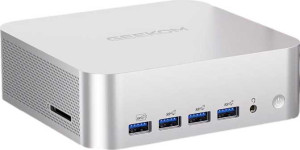
The Geekom A9 Max follows a Micro-ATX form factor with dimensions of 135 mm wide, 132 mm thick, and 46.9 mm tall, resulting in a total volume of 835.758 cm³. Storage is handled by a 2TB NVMe SSD, offering fast sequential access speeds inherent to the NVMe interface. Despite its compact footprint, the chassis manages to accommodate these components within a well-contained physical envelope.
The processor operates with a 15W TDP and features 12 cores running at a base speed of 2 GHz each, with a turbo clock speed reaching 5.1 GHz. It supports multithreading for a total of 24 threads and includes integrated graphics. Cache is organized as 12 MB of L2 (1 MB per core) and 24 MB of L3 (2 MB per core), providing ample fast-access memory for the CPU. The chip carries a clock multiplier of 20 but does not feature an unlocked multiplier, meaning frequency adjustments are fixed. It fully supports 64-bit computing and has a maximum rated CPU temperature of 100 °C.
The integrated GPU has a base clock of 400 MHz and a turbo clock of 2900 MHz, delivering 5.939 TFLOPS of floating-point performance alongside a texture rate of 185.6 GTexels/s and a pixel rate of 92.8 GPixel/s. It is built on a 4 nm process node and houses 34,000 million transistors, with 1024 shading units, 64 texture mapping units, and 32 render output units. The GPU supports ray tracing, double precision floating point, and multi-display output across up to four screens simultaneously, while DLSS is not supported. DirectX 12 Ultimate compatibility is included alongside OpenGL 4.6 and OpenCL 2.1, and the GPU connects via PCIe 4.
The system is equipped with 32GB of DDR5 RAM running at 5600 MHz, providing a solid combination of capacity and memory bandwidth for everyday and demanding workloads alike.
Wireless connectivity covers Wi-Fi 4, 5, 6, 6E, and Wi-Fi 7 (802.11be), complemented by Bluetooth 5.4. On the wired side, the unit provides two USB 4 40Gbps ports, two Thunderbolt 4 ports, four USB 3.2 Gen 1 Type-A ports, and one USB 2.0 port; there are no USB 3.2 Gen 2, Gen 2x2, or USB-C ports below USB 4 speeds. Display output is handled by two HDMI 2.1 ports and two DisplayPort outputs, while network connectivity is covered by two RJ45 Ethernet ports. A 3.5 mm headset jack is present, though there is no VGA connector or S/PDIF output.
In multi-threaded benchmarks, the processor achieves a PassMark score of 35,142 and a Geekbench 6 multi-core result of 13,283, reflecting solid throughput across parallel workloads. Single-core performance is measured at a PassMark single score of 3,872 and a Geekbench 6 single-core score of 2,593, indicating the per-core capability available for lightly threaded tasks.
The Radeon 890M GPU is based on the RDNA 3.5 architecture and features 16 execution units, with stereoscopic 3D support included. Memory can be configured across two channels up to a maximum of 256GB, with a peak supported RAM speed of 7500 MHz, though ECC memory and external memory slots are not supported. The CPU is rated for both laptop and desktop use, does not employ big.LITTLE technology, and supports the NX bit for hardware-level execution protection. Supported instruction sets include MMX, AES, AVX, AVX2, FMA3, F16C, SSE 4.1, and SSE 4.2. The system does not include air-water cooling and carries a one-year warranty.