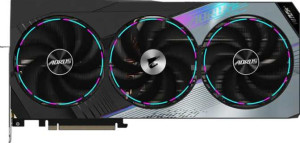
Gigabyte Aorus GeForce RTX 4080 Super Master specifications and in-depth review

Gigabyte Aorus GeForce RTX 4080 Super Master

Manufacturer: Gigabyte

The Gigabyte Aorus GeForce RTX 4080 Super Master is a large-format graphics card built on NVIDIA's Ada Lovelace architecture, manufactured on a 5 nm process with 45,900 million transistors. It features a triple-fan air cooler within a 357 mm x 163 mm body, RGB lighting, and connects to the system via PCIe 4.0. With 53.76 TFLOPS of floating-point throughput backed by 10,240 shading units, the card is designed to handle demanding graphics and compute workloads, and includes support for ray tracing, DLSS, DirectX 12 Ultimate, and Intel Resizable BAR.

On the memory side, the card carries 16GB of GDDR6X running at an effective 23,000 MHz across a 256-bit bus, producing a maximum bandwidth of 736.3 GB/s. The GPU operates at a base clock of 2295 MHz with a boost reaching 2625 MHz, supported by 320 texture mapping units delivering a texture rate of 840 GTexels/s, and 112 ROPs generating a pixel rate of 294 GPixel/s. ECC memory support and DPFP capability are both present. Display output spans four connections — three DisplayPort and one HDMI 2.1a port — with no USB-C, DVI, or mini DisplayPort options, and the card carries a rated TDP of 320W without a hybrid water-cooling option.

Pros
  • 16GB of GDDR6X memory across a 256-bit bus delivers 736.3 GB/s of bandwidth, providing substantial throughput for texture-heavy and high-resolution rendering workloads
  • 53.76 TFLOPS of floating-point performance and 10,240 shading units give the card considerable headroom for demanding graphics and compute tasks
  • Ray tracing and DLSS are both supported, enabling access to current-generation rendering and upscaling technologies in compatible applications
  • ECC memory support adds data integrity protection useful for error-sensitive compute workloads
  • RGB lighting and a triple-fan design make it a visually prominent component suited to builds where aesthetics are a consideration
  • Four simultaneous display outputs — three DisplayPort and one HDMI 2.1a — cover multi-monitor configurations without additional hardware
Cons
  • At 357 mm wide and 163 mm tall, the card has a large physical footprint that limits compatibility with smaller cases and requires careful clearance planning
  • A 320W TDP places significant power and thermal demands on the system, requiring a capable PSU and well-ventilated case
  • No air-water hybrid cooling is available, so long-term thermal performance under sustained loads depends entirely on the air cooler
  • USB-C, DVI, and mini DisplayPort outputs are all absent, limiting direct connectivity for devices and monitors that rely on those interfaces
  • XeSS (XMX) upscaling is not supported, restricting AI-driven upscaling options to DLSS only
Who is this for?

The Gigabyte Aorus GeForce RTX 4080 Super Master is well-matched to users running high-resolution or multi-display workloads, where its 16GB of GDDR6X memory and 736.3 GB/s of bandwidth provide meaningful headroom for texture-intensive rendering and large frame buffers. The combination of ray tracing, DLSS, and 53.76 TFLOPS of floating-point throughput makes it a strong fit for those engaged in demanding real-time 3D rendering or GPU-accelerated compute tasks. ECC memory support and DPFP capability further extend its relevance to users who occasionally process precision-sensitive or error-critical workloads alongside standard graphics use.

Who is this NOT for?

At 357 mm wide and 163 mm tall with a 320W TDP, this card is poorly suited to compact or small form factor builds where both physical clearance and power delivery are constrained — it demands a full-size case and a well-rated PSU to operate reliably. Users who depend on USB-C display connectivity will find no such port available, which rules out direct hookup to monitors or devices that rely on that interface. It is also not the right fit for those who prefer or require XeSS-based upscaling, as that technology is absent and DLSS remains the only AI-driven upscaling option on this card.

Performance:

GPU clock speed 2295 MHz
GPU turbo 2625 MHz
pixel rate 294 GPixel/s
floating-point performance 53.76 TFLOPS
texture rate 840 GTexels/s
GPU memory speed 1438 MHz
shading units 10240
texture mapping units (TMUs) 320
render output units (ROPs) 112
Has Double Precision Floating Point (DPFP)

The GPU runs at a base clock of 2295 MHz and boosts to 2625 MHz, with 10,240 shading units and 320 texture mapping units combining to deliver a texture rate of 840 GTexels/s and a floating-point throughput of 53.76 TFLOPS. The 112 ROPs produce a pixel rate of 294 GPixel/s, while GPU memory operates at 1438 MHz. Double Precision Floating Point (DPFP) is supported, extending the card's utility to compute workloads that require higher numerical precision beyond standard rasterization tasks.

Memory:

effective memory speed 23000 MHz
maximum memory bandwidth 736.3 GB/s
VRAM 16GB
GDDR version GDDR6X
memory bus width 256-bit
Supports ECC memory

The card is equipped with 16GB of GDDR6X VRAM running at an effective speed of 23,000 MHz across a 256-bit bus, yielding a maximum memory bandwidth of 736.3 GB/s. This combination of wide bus width and high-speed memory provides substantial throughput for texture-heavy and high-resolution workloads. ECC memory support is also present, offering error correction for applications where data integrity is a meaningful requirement.

Features:

DirectX version DirectX 12 Ultimate
OpenGL version 4.6
OpenCL version 3
Supports multi-display technology
supports ray tracing
Supports 3D
supports DLSS
has XeSS (XMX)
AMD SAM / Intel Resizable BAR Intel Resizable BAR
has LHR
has RGB lighting
supported displays 4

The card supports DirectX 12 Ultimate, OpenGL 4.6, and OpenCL 3, covering a broad range of graphics and compute API requirements. Ray tracing and DLSS are both enabled, while XeSS (XMX) is not available on this model. Multi-display technology supports up to four simultaneous outputs, and stereoscopic 3D is included alongside Intel Resizable BAR for optimized CPU-to-GPU memory access. RGB lighting is built in, and LHR is not active on this card.

Ports:

has an HDMI output
HDMI ports 1
HDMI version HDMI 2.1a
DisplayPort outputs 3
USB-C ports 0
DVI outputs 0
mini DisplayPort outputs 0

Output connectivity consists of three DisplayPort outputs and a single HDMI 2.1a port, totaling four display connections. There are no USB-C, DVI, or mini DisplayPort outputs on this card.

General info:

GPU architecture Ada Lovelace
Thermal Design Power (TDP) 320W
PCI Express (PCIe) version 4
semiconductor size 5 nm
number of transistors 45900 million
Has air-water cooling
width 357 mm
height 163 mm

The card is built on the Ada Lovelace architecture using a 5 nm manufacturing process, integrating 45,900 million transistors and connecting to the system via PCIe 4.0. It carries a 320W TDP and relies entirely on air cooling, with no air-water hybrid option included. At 357 mm wide and 163 mm tall, it occupies a substantial physical footprint that should be carefully checked against available case clearance before installation.

Final Verdict

The Gigabyte Aorus GeForce RTX 4080 Super Master is a high-specification graphics card that makes its position clear through its core numbers: 16GB of GDDR6X memory with 736.3 GB/s of bandwidth and 53.76 TFLOPS of floating-point throughput place it firmly in the tier of cards built for demanding rendering, multi-display, and compute-adjacent workloads. Ray tracing, DLSS, ECC memory, and DPFP support round out a feature set that covers both graphics and compute use cases effectively. Its 320W TDP and large 357 mm x 163 mm footprint mean it is not a card for constrained builds, and the absence of USB-C output is worth noting for users with specific connectivity needs. For those with a capable system and the space to accommodate it, the Aorus RTX 4080 Super Master delivers a well-equipped and thoroughly specified package.