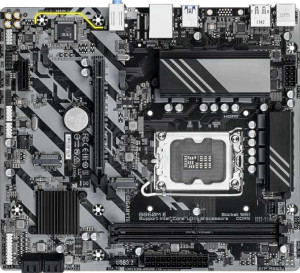
The Gigabyte B860M E is built around the LGA 1851 socket and is compatible with the B860 chipset, housed in a Micro-ATX form factor measuring 244 mm × 215 mm. It supports overclocking and includes dual BIOS for firmware recovery, though it does not offer an easy CMOS reset button. The board provides an HDMI 2.1 output but lacks integrated graphics and has no integrated CPU, meaning a discrete processor is required. Wi-Fi and Bluetooth are not included, and the board ships without RGB lighting. A single CPU socket is present, and the product is backed by a three-year warranty.
The board supports DDR5 memory across two slots in a dual-channel configuration, with a maximum capacity of 128 GB. Standard RAM speed tops out at 6400 MHz, while overclocking can push that figure up to 8800 MHz. ECC memory is not supported.
The rear I/O panel includes four USB 3.2 Gen 1 Type-A ports and two USB 2.0 ports, while USB Type-C, USB 3.2 Gen 2, USB 4, Thunderbolt 3, and Thunderbolt 4 are all absent. Display output is handled by one HDMI port and one DisplayPort, with no DVI or VGA connectors present. Networking is covered by a single RJ45 port, and a PS/2 port is available for legacy input devices. There are no eSATA ports on this board.
Internal connectivity includes two M.2 sockets and four SATA 3 connectors for storage, while SATA 2 and U.2 sockets are not present, nor is an mSATA connector. USB expansion headers consist of two USB 3.2 Gen 1 connectors, two USB 3.0 connectors, and four USB 2.0 connectors, allowing additional ports to be added via the chassis. The board also features three fan headers and a TPM connector for security module support.
Expansion options are modest but focused, with one PCIe 4.0 x16 slot serving as the primary slot for a discrete graphics card or similar full-bandwidth add-in card, alongside one PCIe x1 slot for smaller peripherals. There are no PCIe 5.0, 3.0, or 2.0 x16 slots, and no PCIe x4, x8, or legacy PCI slots are present, which reflects the compact Micro-ATX layout of the board.
The board delivers 7.1-channel audio output through three analog audio connectors on the rear I/O. An S/PDIF Out port is not included, so digital optical or coaxial audio output is not available.
The board supports RAID 0, 1, 5, and 10 configurations, covering a range of needs from performance striping to mirroring and parity-based redundancy. RAID 0+1 is not supported.