Gigabyte B860M Eagle specifications and in-depth review

Gigabyte B860M Eagle

Manufacturer: Gigabyte

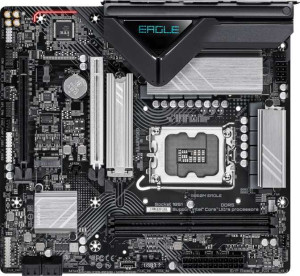
The Gigabyte B860M Eagle is a Micro-ATX motherboard designed around Intel's LGA 1851 platform, pairing the B860 chipset with a compact 244 x 225 mm footprint that suits smaller mid-range builds. It ships with dual BIOS for added firmware resilience and carries a three-year warranty, making it a straightforward option for users who want a dependable foundation without unnecessary frills like RGB lighting or onboard Wi-Fi.

On the memory side, the board accommodates two DDR5 slots with support for up to 128GB, a rated speed of 6400 MHz, and an overclocked ceiling of 9066 MHz. Storage connectivity includes two M.2 sockets, four SATA 3 connectors, and full RAID support across levels 0, 1, 5, and 10. The single PCIe 5.0 x16 slot handles the primary graphics card, while rear I/O includes HDMI 2.1, one DisplayPort output, three USB 3.2 Gen 1 Type-A ports, and a PS/2 port, rounding out a spec sheet oriented toward practical, budget-conscious builds.

Pros
  • Dual BIOS adds a layer of firmware redundancy, reducing the risk of a failed update rendering the board unusable
  • PCIe 5.0 x16 slot ensures the primary graphics card slot is ready for current-generation hardware
  • DDR5 memory support with an overclocked ceiling of 9066 MHz offers meaningful headroom for memory-sensitive workloads
  • RAID 0, 1, 5, and 10 support provides flexible storage configuration options beyond basic single-drive setups
  • Three-year warranty provides solid long-term coverage for a motherboard
  • Compact Micro-ATX footprint suits builds where space is a consideration without sacrificing core functionality
Cons
  • Only two memory slots limits future upgrade flexibility compared to boards with four slots
  • No USB Type-C ports on the rear I/O restricts connectivity for modern peripherals and devices
  • Absence of Wi-Fi and Bluetooth means wireless connectivity requires additional hardware
  • No easy CMOS reset button can complicate BIOS recovery in certain troubleshooting scenarios
  • ECC memory is not supported, ruling out use cases that require error-correcting RAM
  • No S/PDIF output limits digital audio passthrough options for users with external audio equipment
Who is this for?

This board is well suited to users building a compact desktop system around Intel's current LGA 1851 platform who do not need wireless connectivity or extensive expansion options. Its Micro-ATX form factor makes it a natural fit for smaller cases, while the PCIe 5.0 x16 slot and DDR5 support with overclocking headroom up to 9066 MHz cater to users who want a capable, forward-leaning foundation. The inclusion of RAID 0, 1, 5, and 10 also makes it a reasonable choice for users who want basic storage redundancy or performance striping without needing a dedicated workstation board.

Who is this NOT for?

Users who rely on wireless connectivity will find this board limiting, as there is no onboard Wi-Fi or Bluetooth, requiring additional hardware to achieve either. With only two memory slots and no ECC support, it is also poorly matched to memory-intensive workstation or server workloads that benefit from four-slot configurations or error-correcting RAM. Additionally, the lack of USB Type-C on the rear I/O and the absence of Thunderbolt make it a poor fit for users who regularly connect modern high-speed peripherals or external displays through those interfaces.

General info:

CPU socket LGA 1851
chipset B860
form factor Micro-ATX
supports Wi-Fi
Has Bluetooth
HDMI version HDMI 2.1
Easy to overclock
has RGB lighting
Easy to reset BIOS
Has dual BIOS
CPU sockets 1
Has integrated graphics
warranty period 3 years
height 225 mm
width 244 mm
Has integrated CPU

The Gigabyte B860M Eagle is built around the LGA 1851 socket and the B860 chipset, housed in a Micro-ATX form factor measuring 244 x 225 mm, which makes it a compact but capable platform for Intel-based builds. It supports overclocking and features dual BIOS for firmware redundancy, though it does not offer an easy CMOS reset button. The board carries a single CPU socket, has no integrated CPU or integrated graphics, and comes without Wi-Fi, Bluetooth, or RGB lighting. Video output is handled via an HDMI 2.1 port, and the board is backed by a three-year warranty.

Memory:

maximum memory amount 128GB
RAM speed (max) 6400 MHz
overclocked RAM speed 9066 MHz
memory slots 2
DDR memory version 5
memory channels 2
Supports ECC memory

This board supports DDR5 memory across two slots in a dual-channel configuration, with a maximum capacity of 128GB. The rated memory speed tops out at 6400 MHz, while overclocking headroom extends that figure up to 9066 MHz for users looking to push performance further. ECC memory is not supported, making this configuration suited to standard consumer workloads rather than workstation or server use cases.

Ports:

USB 3.2 Gen 2 ports (USB-A) 0
USB 3.2 Gen 1 ports (USB-A) 3
USB 3.2 Gen 2 ports (USB-C) 0
USB 3.2 Gen 1 ports (USB-C) 0
USB 2.0 ports 0
USB 3.2 Gen 2x2 ports 0
USB 4 40Gbps ports 0
USB 4 20Gbps ports 0
Thunderbolt 4 ports 0
Thunderbolt 3 ports 0
has an HDMI output
DisplayPort outputs 1
RJ45 ports 1
Has USB Type-C
eSATA ports 0
DVI outputs 0
has a VGA connector
PS/2 ports 1

The rear I/O panel provides three USB 3.2 Gen 1 Type-A ports as the sole USB connectivity, with no USB 2.0, USB Type-C, USB 4, Thunderbolt, or eSATA ports present. Display output is covered by one HDMI port and one DisplayPort output, while DVI and VGA connections are absent. Networking is handled through a single RJ45 port, and a PS/2 port is included for legacy peripheral support.

Connectors:

USB 3.2 Gen 1 ports (through expansion) 2
USB 2.0 ports (through expansion) 4
SATA 3 connectors 4
fan headers 4
USB 3.0 ports (through expansion) 2
M.2 sockets 2
Has TPM connector
U.2 sockets 0
Has mSATA connector
SATA 2 connectors 0

Internal connectivity includes two M.2 sockets and four SATA 3 connectors for storage, with no SATA 2, mSATA, or U.2 sockets available. USB expansion headers consist of two USB 3.2 Gen 1 connectors and four USB 2.0 headers, allowing additional ports to be added via the case front panel. The board also features four fan headers for cooling management and includes a TPM connector for hardware-based security support.

Expansion slots:

PCIe 4.0 x16 slots 0
PCIe 5.0 x16 slots 1
PCIe 3.0 x16 slots 0
PCIe x1 slots 0
PCI slots 0
PCIe 2.0 x16 slots 0
PCIe x4 slots 1
PCIe x8 slots 0

The board offers a modest but focused expansion layout, centered on a single PCIe 5.0 x16 slot intended for the primary graphics card, alongside one PCIe x4 slot for additional cards or adapters. There are no PCIe 4.0, 3.0, or 2.0 x16 slots, no PCIe x1 or x8 slots, and no legacy PCI slots, keeping the expansion options straightforward and in line with the compact Micro-ATX footprint.

Audio:

audio channels 7.1
Has S/PDIF Out port
audio connectors 3

The onboard audio supports a 7.1-channel configuration and provides three analog audio connectors for connecting speakers, headphones, and microphones. There is no S/PDIF output available for digital audio passthrough to external receivers or DACs.

Storage:

Supports RAID 1
Supports RAID 10 (1+0)
Supports RAID 5
Supports RAID 0
Supports RAID 0+1

The board supports a solid range of RAID configurations, including RAID 0, 1, 5, and 10, covering common use cases from performance striping to mirrored redundancy and combined setups. RAID 0+1 is not supported, though the available modes are sufficient for most consumer and light workstation storage arrangements.
Final Verdict

The Gigabyte B860M Eagle is a focused Micro-ATX motherboard that delivers a capable LGA 1851 platform for users who want a compact, no-frills build with room to grow. Its PCIe 5.0 x16 slot combined with DDR5 support and overclocking headroom up to 9066 MHz gives it a technically current foundation, while dual BIOS and a three-year warranty add a degree of long-term reliability. Users who need wireless connectivity, USB Type-C rear ports, or more than two memory slots will find the feature set narrow, but for those whose requirements align with what it offers, it represents a straightforward and dependable platform choice within the Intel B860 ecosystem.

Popular Comparisons

Gigabyte B860M Eagle
VS
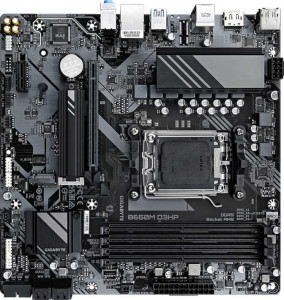
Gigabyte B650M D3HP
Gigabyte B650M D3HP