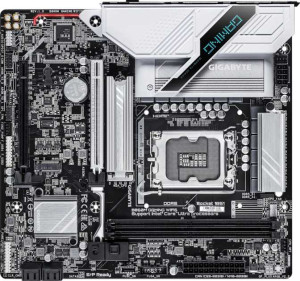
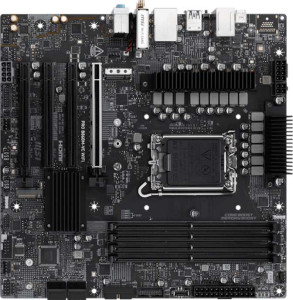
The Gigabyte B860M Gaming WiFi6 is built around the LGA 1851 socket and B860 chipset, housed in a Micro-ATX form factor measuring 244 mm by 225 mm, making it a compact option for the Intel platform. It supports Wi-Fi across three generations — Wi-Fi 4 (802.11n), Wi-Fi 5 (802.11ac), and Wi-Fi 6 (802.11ax) — alongside Bluetooth 5.3, though aptX is not included. The board features HDMI 2.1 output, supports easy overclocking, and comes equipped with dual BIOS for firmware redundancy, while RGB lighting and a dedicated BIOS reset button are absent. There is a single CPU socket, no integrated CPU or graphics, and the board carries a three-year warranty.
This board supports DDR5 memory across two slots in a dual-channel configuration, with a maximum capacity of 128 GB. The standard rated speed tops out at 6400 MHz, while overclocking can push that figure up to 9066 MHz for users looking to extract additional memory bandwidth. ECC memory is not supported.
The rear I/O panel provides three USB 3.2 Gen 1 Type-A ports and three USB 2.0 ports for peripheral connectivity, while USB Type-C, USB 3.2 Gen 2, USB 4, Thunderbolt 3, and Thunderbolt 4 are all absent. Display output is handled by one HDMI port and one DisplayPort output, with no DVI or VGA connectors present. Networking is covered by a single RJ45 port, and a PS/2 port is also included, though eSATA is not available.
Internal connectivity includes two M.2 sockets and four SATA 3 connectors for storage, while SATA 2 and U.2 sockets are not present, nor is an mSATA connector. USB expansion headers allow for two additional USB 3.2 Gen 1 ports and two USB 3.0 ports, along with four USB 2.0 ports through further expansion. The board also provides four fan headers for cooling management and includes a TPM connector for security module support.
The board offers a total of two expansion slots: one PCIe 5.0 x16 slot as the primary option for discrete cards, and one PCIe x4 slot for additional expansion needs. There are no PCIe x1, x8, PCIe 2.0, PCIe 3.0, PCIe 4.0, or legacy PCI slots present.
The board delivers 7.1-channel audio output through three analog audio connectors on the rear panel. An S/PDIF Out port is not included.
The board supports RAID 0, 1, 5, and 10 (1+0) configurations for flexible storage setup and data redundancy options, while RAID 0+1 is not supported.