Gigabyte GeForce RTX 3050 Eagle OC 6GB specifications and in-depth review

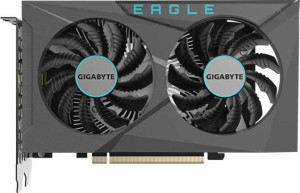
Gigabyte GeForce RTX 3050 Eagle OC 6GB

Manufacturer: Gigabyte

The Gigabyte GeForce RTX 3050 Eagle OC 6GB is a compact, low-power graphics card built on Nvidia's Ampere architecture. Designed for systems with tight power budgets, it operates within a 70W thermal design power envelope, making it a physically modest card measuring 192 mm wide and 117 mm tall. It connects via PCIe 4.0 and supports up to four displays simultaneously.

On the technical side, the card carries 6GB of GDDR6 memory running on a 96-bit bus with an effective speed of 14000 MHz and a maximum bandwidth of 168 GB/s. Its 2304 shading units are paired with 72 texture mapping units and 32 render output units, delivering 6.912 TFLOPS of floating-point performance and a texture rate of 108 GTexels/s. The card supports DirectX 12 Ultimate, OpenGL 4.6, ray tracing, and DLSS, and its connectivity options include two HDMI 2.1 ports and two DisplayPort outputs.

Pros
  • A 70W TDP keeps system power demands low, making it compatible with builds that have limited PSU headroom
  • Support for ray tracing and DLSS expands the range of rendering techniques available without requiring additional hardware
  • Four display outputs — two HDMI 2.1 and two DisplayPort — allow for a flexible multi-monitor setup out of a single card
  • ECC memory support adds a layer of data integrity useful for compute-adjacent workloads
  • Intel Resizable BAR support enables the CPU to access the full GPU frame buffer at once, which can improve data transfer efficiency
  • The compact physical dimensions of 192 mm x 117 mm make it suitable for smaller form factor cases
Cons
  • The 96-bit memory bus width restricts memory bandwidth to 168 GB/s, which may create a bottleneck in memory-intensive workloads
  • With only 6GB of VRAM, the card may fall short in scenarios that demand larger frame buffers
  • The absence of USB-C output limits compatibility with certain modern monitors and display adapters
  • No liquid or hybrid cooling option is available, leaving thermal management entirely dependent on air cooling
Who is this for?

This card is well-suited to users building compact or low-power systems, given its 70W TDP and small physical footprint of 192 mm x 117 mm. It fits comfortably into slim or small form factor cases where larger cards simply won't fit. Users who want access to modern rendering features like ray tracing and DLSS without committing to a high-wattage setup will find the feature set practical, and those running multi-monitor configurations of up to four displays will appreciate the combination of two HDMI 2.1 and two DisplayPort outputs on a single card.

Who is this NOT for?

Users engaged in graphically demanding workloads will likely find the 6GB VRAM on a 96-bit bus a limiting factor, as both the memory capacity and bandwidth ceiling of 168 GB/s can become bottlenecks at higher resolutions or when working with large textures. The card is equally unsuitable for those with memory-intensive compute or professional GPU tasks, where a wider memory bus and greater VRAM headroom are typically required to sustain performance. Additionally, users seeking modern display adapter flexibility may be hindered by the absence of a USB-C output, which is increasingly expected for compatibility with contemporary monitors and docking solutions.

Performance:

GPU clock speed 1042 MHz
GPU turbo 1500 MHz
pixel rate 48 GPixel/s
floating-point performance 6.912 TFLOPS
texture rate 108 GTexels/s
GPU memory speed 1750 MHz
shading units 2304
texture mapping units (TMUs) 72
render output units (ROPs) 32
Has Double Precision Floating Point (DPFP)

The card operates with a base GPU clock of 1042 MHz and a boosted turbo frequency of 1500 MHz, supported by 2304 shading units, 72 texture mapping units, and 32 render output units. It delivers 6.912 TFLOPS of floating-point performance alongside a texture rate of 108 GTexels/s and a pixel rate of 48 GPixel/s. GPU memory runs at 1750 MHz, and the card includes support for Double Precision Floating Point (DPFP), broadening its suitability for compute-oriented workloads.

Memory:

effective memory speed 14000 MHz
maximum memory bandwidth 168 GB/s
VRAM 6GB
GDDR version GDDR6
memory bus width 96-bit
Supports ECC memory

This card is equipped with 6GB of GDDR6 VRAM running at an effective speed of 14000 MHz across a 96-bit memory bus, yielding a maximum memory bandwidth of 168 GB/s. The narrower bus width is a defining characteristic of this memory configuration, directly shaping the available bandwidth. Additionally, the card supports ECC memory, which enables error detection and correction — a useful trait for workloads where data integrity is a priority.

Features:

DirectX version DirectX 12 Ultimate
OpenGL version 4.6
OpenCL version 3
Supports multi-display technology
supports ray tracing
Supports 3D
supports DLSS
has XeSS (XMX)
AMD SAM / Intel Resizable BAR Intel Resizable BAR
has LHR
has RGB lighting
supported displays 4

The card supports DirectX 12 Ultimate, OpenGL 4.6, and OpenCL 3, covering a broad range of graphics and compute APIs. Ray tracing and DLSS are both supported, enabling hardware-accelerated lighting calculations and AI-based upscaling respectively, while stereoscopic 3D and multi-display technology round out the visual feature set with support for up to four simultaneous displays. Intel Resizable BAR is available for improved CPU-to-GPU data throughput, though XeSS (XMX) and LHR are not present on this card. The design does not include RGB lighting.

Ports:

has an HDMI output
HDMI ports 2
HDMI version HDMI 2.1
DisplayPort outputs 2
USB-C ports 0
DVI outputs 0
mini DisplayPort outputs 0

The card offers a total of four video outputs, split between two HDMI 2.1 ports and two DisplayPort outputs. There are no USB-C, DVI, or mini DisplayPort connections on this card, keeping the output configuration straightforward and focused on the two most widely used modern display interfaces.

General info:

GPU architecture Ampere
Thermal Design Power (TDP) 70W
PCI Express (PCIe) version 4
semiconductor size 8 nm
number of transistors 8700 million
Has air-water cooling
width 192 mm
height 117 mm

Built on Nvidia's Ampere architecture, this card is fabricated on an 8 nm process node and integrates 8700 million transistors. It connects to the motherboard via PCIe 4.0 and carries a 70W thermal design power rating, placing it firmly in the low-power segment of the discrete GPU market. The card measures 192 mm in width and 117 mm in height, and relies solely on air cooling — liquid or hybrid cooling is not supported.
Final Verdict

The Gigabyte GeForce RTX 3050 Eagle OC 6GB occupies a well-defined niche as a compact, low-draw discrete graphics card built on the Ampere architecture. Its most compelling characteristic is the combination of modern feature support — including ray tracing, DLSS, and DirectX 12 Ultimate — within a 70W thermal design power envelope that suits space- and power-constrained builds. That said, the 6GB VRAM paired with a 96-bit memory bus sets a clear ceiling on how far this card can scale with more demanding workloads or higher resolutions. For users whose priorities align with those boundaries — particularly those building compact systems or multi-display setups that don't require heavy graphical throughput — this card delivers a coherent and complete feature set; for those pushing beyond those limits, its memory configuration will be the deciding constraint.