Gigabyte GeForce RTX 3050 OC Low Profile 6GB specifications and in-depth review

Gigabyte GeForce RTX 3050 OC Low Profile 6GB

Manufacturer: Gigabyte

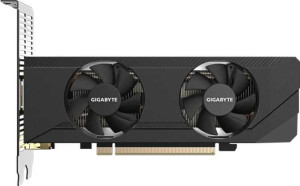
The Gigabyte GeForce RTX 3050 OC Low Profile 6GB is a graphics card specifically designed around a low-profile form factor, measuring just 181 mm wide and 69 mm tall. This makes it one of the more physically constrained discrete GPU options available, suited to slim desktop enclosures and small chassis that cannot accommodate standard-height cards. It operates within a 70W thermal design power limit and uses air cooling exclusively.

Under the hood, the card is built on Nvidia's Ampere architecture using an 8 nm process with 8700 million transistors. It features 2304 shading units, 72 texture mapping units, and 32 render output units, producing 6.806 TFLOPS of floating-point performance with a turbo clock of 1477 MHz. The 6GB of GDDR6 memory runs at an effective 14000 MHz across a 96-bit bus, delivering up to 168 GB/s of bandwidth, and ECC memory support is included. On the feature side, it supports DirectX 12 Ultimate, ray tracing, DLSS, OpenGL 4.6, OpenCL 3, Intel Resizable BAR, and up to four displays via two HDMI 2.1 and two DisplayPort outputs.

Pros
  • The low-profile dimensions of 181 mm x 69 mm allow installation in slim and small form factor cases that cannot accommodate standard-height graphics cards
  • A 70W TDP keeps power draw minimal, making it compatible with systems that have limited power delivery capacity
  • Support for ray tracing and DLSS brings hardware-accelerated lighting and AI-based upscaling to a very compact card
  • Four video outputs — two HDMI 2.1 and two DisplayPort — enable multi-monitor configurations from a single low-profile slot
  • ECC memory support adds error detection and correction capability, broadening the card's suitability for compute-adjacent tasks
  • Intel Resizable BAR support improves CPU-to-GPU data access efficiency without requiring additional hardware
Cons
  • The 96-bit memory bus restricts bandwidth to 168 GB/s, which can become a bottleneck in memory-intensive rendering or compute scenarios
  • 6GB of VRAM sets a firm ceiling on the card's ability to handle higher-resolution textures or larger frame buffers
  • Air cooling is the only thermal option available, with no support for liquid or hybrid cooling solutions
  • The absence of USB-C output limits compatibility with certain modern displays and docking peripherals
Who is this for?

This card is purpose-built for users who need to fit a discrete GPU into a low-profile or slim form factor system, where its 69 mm height and 181 mm width make it one of the few options that will physically fit. Its 70W TDP also suits builds with modest power supplies or limited cooling headroom. Users who want access to modern graphics APIs and features — including ray tracing, DLSS, and DirectX 12 Ultimate — without the physical or power demands of a full-size card will find this a coherent fit. The inclusion of ECC memory support also makes it a reasonable consideration for light compute workloads within constrained enclosures.

Who is this NOT for?

Users targeting graphically intensive workloads or higher resolutions will find the 6GB VRAM paired with a 96-bit, 168 GB/s memory bus insufficient, as both the capacity and bandwidth ceiling are quickly reached under demanding conditions. The card is equally unsuitable for those who require liquid or hybrid cooling, since only air cooling is available — an important limitation in thermally challenged enclosures that lack strong airflow. Additionally, users who depend on USB-C display connectivity for modern monitors or docking solutions will need to look elsewhere, as no USB-C output is present on this card.

Performance:

GPU clock speed 1042 MHz
GPU turbo 1477 MHz
pixel rate 47.26 GPixel/s
floating-point performance 6.806 TFLOPS
texture rate 106.3 GTexels/s
GPU memory speed 1750 MHz
shading units 2304
texture mapping units (TMUs) 72
render output units (ROPs) 32
Has Double Precision Floating Point (DPFP)

The GPU runs at a base clock of 1042 MHz and boosts up to 1477 MHz, driving 2304 shading units alongside 72 texture mapping units and 32 render output units. This translates to a floating-point throughput of 6.806 TFLOPS, a texture rate of 106.3 GTexels/s, and a pixel rate of 47.26 GPixel/s. GPU memory operates at 1750 MHz, and Double Precision Floating Point (DPFP) is supported, extending the card's utility to certain compute workloads alongside its graphics role.

Memory:

effective memory speed 14000 MHz
maximum memory bandwidth 168 GB/s
VRAM 6GB
GDDR version GDDR6
memory bus width 96-bit
Supports ECC memory

The card is equipped with 6GB of GDDR6 VRAM operating at an effective speed of 14000 MHz over a 96-bit memory bus, resulting in a maximum memory bandwidth of 168 GB/s. The 96-bit bus width is a defining constraint of this memory configuration, setting a firm ceiling on available throughput. ECC memory support is included, providing error detection and correction capabilities that can be beneficial in workloads where data accuracy is a concern.

Features:

DirectX version DirectX 12 Ultimate
OpenGL version 4.6
OpenCL version 3
Supports multi-display technology
supports ray tracing
Supports 3D
supports DLSS
has XeSS (XMX)
AMD SAM / Intel Resizable BAR Intel Resizable BAR
has LHR
has RGB lighting
supported displays 4

The card supports DirectX 12 Ultimate, OpenGL 4.6, and OpenCL 3, providing broad API coverage across both graphics and compute workloads. Hardware-accelerated ray tracing and DLSS are both present, enabling more realistic lighting calculations and AI-driven upscaling respectively, while stereoscopic 3D and multi-display support extend its output versatility to up to four simultaneous screens. Intel Resizable BAR is supported, allowing the CPU to access the full GPU frame buffer in a single pass. XeSS (XMX), LHR, and RGB lighting are all absent from this card.

Ports:

has an HDMI output
HDMI ports 2
HDMI version HDMI 2.1
DisplayPort outputs 2
USB-C ports 0
DVI outputs 0
mini DisplayPort outputs 0

Output connectivity consists of two HDMI 2.1 ports and two DisplayPort outputs, giving a total of four video connections with no USB-C, DVI, or mini DisplayPort options present. The port selection is straightforward, covering the two dominant modern display interfaces while omitting legacy and alternative connector types entirely.

General info:

GPU architecture Ampere
Thermal Design Power (TDP) 70W
PCI Express (PCIe) version 4
semiconductor size 8 nm
number of transistors 8700 million
Has air-water cooling
width 181 mm
height 69 mm

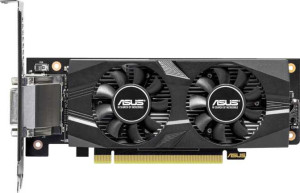
This card is based on the Ampere architecture, manufactured on an 8 nm process node with a transistor count of 8700 million, and connects to the host system via PCIe 4.0. Its 70W thermal design power rating reflects a deliberate focus on low power consumption, and cooling is handled entirely by air — liquid or hybrid cooling is not available. The physical footprint is notably compact at just 181 mm wide and 69 mm tall, conforming to a low-profile form factor that allows installation in slim and small-chassis systems where standard-height cards would not fit.
Final Verdict

The Gigabyte GeForce RTX 3050 OC Low Profile 6GB is a card with a clearly defined purpose: delivering modern GPU feature support within a low-profile form factor that very few discrete graphics cards can match. Its 69 mm height and 70W power envelope make it a genuinely practical solution for slim desktop builds where installation space and power availability are hard constraints, and the inclusion of ray tracing, DLSS, DirectX 12 Ultimate, and multi-display output means users are not sacrificing feature breadth for size. Where it asks for compromise is in raw memory headroom — the 6GB GDDR6 frame buffer and 96-bit bus will limit its reach in more demanding scenarios. For anyone building around a small chassis who needs a capable, standards-compliant discrete GPU, this card delivers on its specific brief with few alternatives that fit the same physical profile.

Popular Comparisons

Gigabyte GeForce RTX 3050 OC Low Profile 6GB
VS
Asus GeForce RTX 3050 LP BRK OC Edition 6GB
Gigabyte GeForce RTX 3050 OC Low Profile 6GB
VS
MSI GeForce RTX 3050 Low Profile OC 6GB
Gigabyte GeForce RTX 3050 OC Low Profile 6GB
VS
MSI GeForce RTX 3050 Low Profile 6GB
Gigabyte GeForce RTX 3050 OC Low Profile 6GB
VS
Nvidia GeForce RTX 3050 6GB