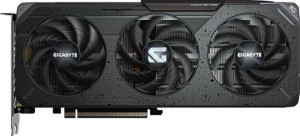
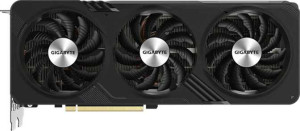
Gigabyte Radeon RX 7600 XT Gaming OC specifications and in-depth review

Gigabyte Radeon RX 7600 XT Gaming OC

Manufacturer: Gigabyte

The Gigabyte Radeon RX 7600 XT Gaming OC is a mid-range graphics card based on AMD's RDNA 3.0 architecture, fabricated on a 6 nm process and packed with 13,300 million transistors. It operates at a base clock of 1720 MHz and reaches a boost clock of 2810 MHz, with RGB lighting and support for up to four simultaneous displays rounding out the feature set.

On the memory side, the card carries 16GB of GDDR6 VRAM across a 128-bit bus, delivering an effective memory speed of 18,000 MHz and a maximum bandwidth of 288 GB/s. Compute performance is rated at 23.02 TFLOPS, with a texture rate of 359.7 GTexels/s and a pixel fill rate of 179.8 GPixel/s produced by 2048 shading units, 128 TMUs, and 64 ROPs. The card supports DirectX 12 Ultimate, OpenGL 4.6, ray tracing, and AMD SAM, and connects via two HDMI 2.1a ports and two DisplayPort outputs, all within a 190W TDP envelope.

Pros
  • The 16GB of GDDR6 VRAM is a substantial amount for this card class, making it well-suited for memory-intensive workloads and high-resolution texture assets
  • With four video outputs — two HDMI 2.1a and two DisplayPort — the card can drive up to four displays simultaneously, offering genuine multi-monitor flexibility
  • Ray tracing support is included, enabling hardware-accelerated lighting effects in compatible titles
  • ECC memory support adds a layer of data integrity assurance for compute-oriented tasks beyond standard gaming
  • AMD SAM is supported, allowing the CPU to access the full VRAM pool in compatible systems for improved frame delivery
  • RGB lighting is built in, giving users control over the card's visual appearance within a system build
Cons
  • The 128-bit memory bus is relatively narrow, which can limit memory bandwidth headroom at higher resolutions despite the fast GDDR6 speeds
  • Neither DLSS nor XeSS upscaling is supported, leaving AMD FSR as the only upscaling path — a meaningful gap for users who prefer those technologies
  • A 190W TDP demands adequate case airflow and a sufficiently rated power supply, adding to system planning requirements
  • Air-water cooling is not supported, so users cannot pursue liquid cooling solutions for this card
  • The two-year warranty period is shorter than what some competing cards in this category offer
Who is this for?

This card is a solid fit for users who work with memory-intensive creative or compute tasks, given the generous 16GB of GDDR6 VRAM paired with ECC memory support. It also suits builders running multi-monitor setups, since four video outputs — including two HDMI 2.1a ports — allow for broad display configurations without additional hardware. The inclusion of ray tracing and AMD SAM makes it a reasonable choice for gamers on AMD-based platforms who want hardware-accelerated lighting in supported titles and can take advantage of resizable BAR for smoother frame delivery.

Who is this NOT for?

Users who rely on DLSS or XeSS upscaling for performance scaling in supported titles will find neither available here, which limits upscaling options to AMD's own solution. The 128-bit memory bus may also be a limiting factor for those pushing very high resolutions or bandwidth-demanding workloads, where a wider bus would offer noticeably more headroom. Additionally, the 190W TDP makes this a poor match for small form factor builds with tight thermal constraints or modest power supplies, as it requires meaningful airflow and adequate power headroom to operate stably.

Performance:

GPU clock speed 1720 MHz
GPU turbo 2810 MHz
pixel rate 179.8 GPixel/s
floating-point performance 23.02 TFLOPS
texture rate 359.7 GTexels/s
GPU memory speed 2250 MHz
shading units 2048
texture mapping units (TMUs) 128
render output units (ROPs) 64
Has Double Precision Floating Point (DPFP)

The card runs at a base GPU clock of 1720 MHz, climbing to a boost clock of 2810 MHz under load, while the GPU memory operates at 2250 MHz. Its 2048 shading units work alongside 128 texture mapping units and 64 render output units to deliver a texture rate of 359.7 GTexels/s and a pixel fill rate of 179.8 GPixel/s. Overall floating-point performance is rated at 23.02 TFLOPS, and the card also supports Double Precision Floating Point (DPFP), adding flexibility for workloads that benefit from higher-precision compute.

Memory:

effective memory speed 18000 MHz
maximum memory bandwidth 288 GB/s
VRAM 16GB
GDDR version GDDR6
memory bus width 128-bit
Supports ECC memory

The card is equipped with 16GB of GDDR6 VRAM running across a 128-bit memory bus, reaching an effective memory speed of 18,000 MHz and a maximum bandwidth of 288 GB/s. ECC memory support is also included, which helps maintain data integrity during compute-oriented tasks.

Features:

DirectX version DirectX 12 Ultimate
OpenGL version 4.6
OpenCL version 2.2
Supports multi-display technology
supports ray tracing
Supports 3D
supports DLSS
has XeSS (XMX)
AMD SAM / Intel Resizable BAR AMD SAM
has LHR
has RGB lighting
supported displays 4

The card supports DirectX 12 Ultimate, OpenGL 4.6, and OpenCL 2.2, covering a broad range of graphics and compute workloads. Ray tracing and stereoscopic 3D are both supported, while DLSS and XeSS (XMX) are not available. AMD SAM is included to help improve data throughput between the CPU and GPU, and there is no LHR restriction present. Up to four displays can be driven simultaneously via the multi-display technology, and RGB lighting is built into the card's design.

Ports:

has an HDMI output
HDMI ports 2
HDMI version HDMI 2.1a
DisplayPort outputs 2
USB-C ports 0
DVI outputs 0
mini DisplayPort outputs 0

The card's output configuration consists of two HDMI 2.1a ports and two DisplayPort outputs, providing four video outputs in total. There are no DVI, mini DisplayPort, or USB-C ports present on this model.

General info:

GPU architecture RDNA 3.0
Thermal Design Power (TDP) 190W
PCI Express (PCIe) version 4
semiconductor size 6 nm
number of transistors 13300 million
warranty period 2 years
Has air-water cooling
width 281.4 mm
height 116.6 mm

Built on AMD's RDNA 3.0 architecture and manufactured using a 6 nm process, the GPU integrates 13,300 million transistors and connects to the system via a PCIe 4 interface. It carries a thermal design power of 190W and does not include air-water cooling. The card measures 281.4 mm in width and 116.6 mm in height, and comes with a 2-year warranty.
Final Verdict

The Gigabyte Radeon RX 7600 XT Gaming OC is a well-specified card that stands out primarily for its 16GB of GDDR6 VRAM — an unusually generous allocation that benefits both gaming at higher texture settings and lighter compute workloads. Built on the RDNA 3.0 architecture with ray tracing support, AMD SAM, and a four-display output configuration, it covers a meaningful range of use cases for AMD-platform users. That said, the 128-bit memory bus and the absence of DLSS and XeSS upscaling are real constraints that will matter depending on the workload. For users whose workflow aligns with what this card genuinely offers — multi-display flexibility, ample VRAM, and solid compute credentials — it represents a coherent and purposeful option; those with different upscaling or bandwidth priorities should weigh those gaps carefully before committing.

Popular Comparisons

Gigabyte Radeon RX 7600 XT Gaming OC
VS
Asus GeForce RTX 5060 LP BRK OC Edition
Gigabyte Radeon RX 7600 XT Gaming OC
VS
Gainward GeForce RTX 5060 Ti PythoN III 16GB
Gigabyte Radeon RX 7600 XT Gaming OC
VS
Asus GeForce RTX 3050 LP BRK 6GB
Gigabyte Radeon RX 7600 XT Gaming OC
VS
Asus Dual GeForce RTX 4070 Super White Edition
Gigabyte Radeon RX 7600 XT Gaming OC
VS
Asus Dual Radeon RX 7600 XT OC Edition
Gigabyte Radeon RX 7600 XT Gaming OC
VS
Palit GeForce RTX 5050 StormX
Gigabyte Radeon RX 7600 XT Gaming OC
VS
Palit GeForce RTX 5050 Dual
Gigabyte Radeon RX 7600 XT Gaming OC
VS
Palit GeForce RTX 4070 Ti Super Infinity 3
Gigabyte Radeon RX 7600 XT Gaming OC
VS
Gigabyte Radeon RX 9060 XT Gaming 8GB
Gigabyte Radeon RX 7600 XT Gaming OC
VS
Sapphire Pulse Radeon RX 7600 XT