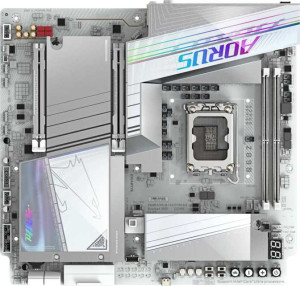
The Gigabyte Z890 Aorus Tachyon Ice uses an LGA 1851 socket paired with the Z890 chipset and adopts the E-ATX form factor, measuring 305 mm × 285 mm with a single CPU socket and no integrated processor or graphics. Wireless connectivity spans Wi-Fi 4 through Wi-Fi 7 (802.11be) alongside Bluetooth 5.4, though aptX audio over Bluetooth is not supported. The board includes RGB lighting, dual BIOS, a clear CMOS button for straightforward BIOS recovery, and is designed with overclocking in mind. It carries a three-year warranty.
The board accommodates DDR5 memory across two slots in a dual-channel configuration, supporting a maximum capacity of 128 GB. Standard RAM speeds top out at 6400 MHz, while overclocking can push that figure up to 9500 MHz. ECC memory is not supported.
The rear I/O panel provides five USB 3.2 Gen 2 Type-A ports and one USB 3.2 Gen 2×2 Type-C port, with no USB 3.2 Gen 1, USB 2.0, USB 4, Thunderbolt 3, or Thunderbolt 4 ports present. A single RJ45 port handles wired networking, and two PS/2 ports are included for legacy input devices. There are no video outputs of any kind — HDMI, DisplayPort, DVI, and VGA are all absent — and no eSATA connectivity is provided.
Internal connectivity is well-stocked, with four M.2 sockets and four SATA 3 connectors for storage, while SATA 2, U.2, and mSATA are not available. USB expansion headers cover two USB 3.2 Gen 1 ports, two USB 3.0 ports, one USB-C 3.2 Gen 2 port, and two USB 2.0 ports. Cooling is supported through nine fan headers, and there is no TPM connector on the board.
The board offers a minimal but focused expansion layout, featuring one PCIe 5.0 x16 slot as the primary expansion slot alongside one PCIe x8 slot. There are no PCIe 4.0, 3.0, or 2.0 x16 slots, no PCIe x1 slots, and no legacy PCI slots.
The onboard audio supports 7.1-channel output and delivers a DAC signal-to-noise ratio of 120 dB, with two analog audio connectors on the rear panel. Digital audio output is also available via an S/PDIF Out port.
The board supports RAID 0, 1, 5, and 10 configurations, covering the most common setups for both performance and redundancy. RAID 0+1 is not supported.