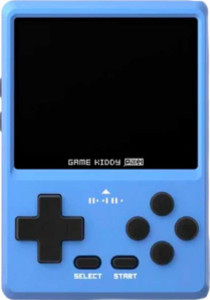
The GKD Pixel 1 is powered by a single-core CPU running at 1.5 GHz and paired with 0.128 GB of DDR2 RAM, a configuration that reflects its focus on lightweight retro gaming rather than demanding workloads. The processor does not support multithreading, and the system lacks NVMe SSD storage as well as the ability to connect an external hard drive. Ray tracing is not supported, which is consistent with the device's retro-oriented purpose.
The GKD Pixel 1 is a handheld retro console with a compact physical footprint, measuring 80 mm tall, 56 mm wide, and 18 mm thick, with a total volume of 80.64 cm³ and a weight of just 107 g. It features an IPS LED-backlit LCD display and an internal power supply backed by a 1,300 mAh battery. The device is region free, imposing no geographic restrictions on compatible software, and it carries no optical disc drive, nor does it offer a replaceable hard drive.
The GKD Pixel 1 offers a minimal but functional connectivity setup, with a single USB Type-C port handling wired connections and a 3.5 mm headset jack available for audio output. An external memory slot allows for storage expansion beyond the internal flash. On the wireless side, the device does not support Wi-Fi, NFC, or cellular connectivity, and it holds no DLNA certification. There is no HDMI output, no RJ45 port, and no support for linking the console with home or portable devices.
The GKD Pixel 1 sports a 2.31″ screen with a pixel density of 173 ppi and relies on flash storage for its internal data. Audio output is handled through a single channel, with no stereo speakers, 3D audio, or Dolby Vision on offer. The device supports quick resume and provides access to high scores and achievements, while practical extras such as a touch screen, front camera, child lock, voice commands, and Discord voice chat are all absent. Display-related features including autostereoscopy, stereoscopic 3D, a secondary screen, and optical tracking are not present, nor is there any support for VR, Blu-ray playback, or a 4K Blu-ray drive.
The GKD Pixel 1 comes with a single built-in controller offering 12 buttons and no analog sticks, reflecting a straightforward input layout suited to classic game genres. There is no wireless controller support, no integrated touchpad, and no adaptive triggers or dual force feedback. The controller is also not compatible with motion-sensing peripherals, keeping the overall input scheme simple and traditional.