GMKtec Evo-T2 specifications and in-depth review

GMKtec Evo-T2

Manufacturer: GMKtec

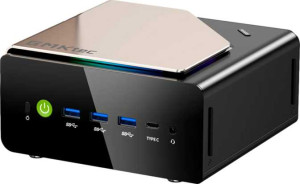
The GMKtec Evo-T2 is a compact Mini PC built around a laptop-class processor that employs big.LITTLE technology, pairing four performance cores with twelve efficiency cores across 16 threads, with a turbo clock speed reaching 5.1GHz. It comes configured with 128GB of DDR5 RAM running at up to 9600MHz across dual channels, complemented by a 1TB NVMe SSD for storage.

On the graphics side, the Evo-T2 integrates an Arc B390 GPU built on a 3nm process, supporting DirectX 12 Ultimate, OpenGL 4.6, OpenCL 3, and up to four simultaneous displays via its HDMI port, DisplayPort output, and USB 4 40Gbps connection. Connectivity is handled by Wi-Fi 7 (802.11be), Bluetooth 5.4, a single RJ45 port, one Thunderbolt 4 port, three USB 3.2 Gen 2 Type-A ports, and a 3.5mm audio jack, while the system posts a PassMark score of 37,904.

Pros
  • Supports up to 128GB of DDR5 RAM at speeds reaching 9600MHz across dual channels, enabling memory-intensive workloads without hitting capacity limits
  • The Arc B390 GPU can drive up to four displays simultaneously, making it practical for multi-monitor desktop setups
  • Wi-Fi 7 support alongside backward compatibility with older Wi-Fi standards ensures flexible and future-ready wireless connectivity
  • A Thunderbolt 4 port combined with a USB 4 40Gbps port provides high-bandwidth options for fast external storage or display connections
  • The 1TB NVMe SSD delivers faster read and write speeds compared to traditional flash-based storage solutions
  • Big.LITTLE architecture across 16 threads with a turbo frequency of 5.1GHz allows the processor to balance efficiency and responsiveness depending on workload demands
Cons
  • The 25W TDP reflects a laptop-class processor, which may limit sustained multi-core throughput in prolonged heavy workloads
  • No USB 2.0, USB 3.2 Gen 1, or legacy VGA output means compatibility with older peripherals and displays is restricted
  • Absence of an S/PDIF port removes the option for digital audio output to compatible receivers or audio equipment
  • The Micro-ATX form factor, while compact, may restrict internal expandability compared to larger desktop form factors
Who is this for?

This Mini PC suits users who need a compact desktop with substantial memory headroom, making it a practical fit for memory-intensive workloads such as virtualization or data processing that benefit from up to 128GB of DDR5 RAM. The ability to connect up to four displays simultaneously via the Arc B390 GPU makes it well-suited for multi-monitor productivity setups, while Wi-Fi 7 support and a Thunderbolt 4 port cater to users who need fast, flexible connectivity without relying on a traditional tower system. The 1TB NVMe SSD and broad instruction set support also make it a reasonable fit for developers or technical users working within a space-constrained environment.

Who is this NOT for?

Users looking for a system capable of sustained, thermally demanding workloads may find the 25W laptop-class processor limiting, as it is not designed for prolonged heavy computation at full multi-core load. The lack of legacy port options — including no VGA output, no USB 2.0, and no S/PDIF — makes this a poor match for environments that still rely on older peripherals or audio equipment. Additionally, users who require dedicated graphics performance for tasks such as 3D rendering or GPU-accelerated workloads at high throughput will find the integrated Arc B390 insufficient for those demands.

General info:

SSD storage capacity 1000GB
form factor Micro-ATX
release date February 2026
Is an NVMe SSD

The GMKtec Evo-T2 adopts a Micro-ATX form factor and comes equipped with a 1000GB NVMe SSD, offering fast storage access thanks to the NVMe interface rather than traditional flash-based storage solutions.

CPU:

Thermal Design Power (TDP) 25W
CPU speed 4 x 2.1 & 8 x 1.6 & 4 x 1.6 GHz
turbo clock speed 5.1GHz
CPU threads 16 threads
Has integrated graphics
L3 cache 18 MB
Turbo Boost version 2
Supports 64-bit
CPU temperature 100 °C

The processor runs across 16 threads with a multi-cluster configuration of 4 cores at 2.1GHz, 8 cores at 1.6GHz, and 4 more at 1.6GHz, and can reach a turbo clock speed of 5.1GHz via Turbo Boost version 2. It operates within a 25W TDP envelope and is rated up to 100°C, keeping its footprint power-efficient while supporting 64-bit operations and integrated graphics. An 18MB L3 cache helps sustain data throughput across the available threads.

Graphics card:

GPU turbo 2500 MHz
PCI Express (PCIe) version 5
DirectX version DirectX 12 Ultimate
OpenGL version 4.6
OpenCL version 3
semiconductor size 3 nm
supported displays 4

The integrated graphics solution is fabricated on a 3nm process and clocks up to 2500MHz in turbo mode, with PCIe 5 providing the underlying interface bandwidth. It supports DirectX 12 Ultimate, OpenGL 4.6, and OpenCL 3, covering a broad range of graphics and compute workloads, and can drive up to four displays simultaneously.

Memory:

RAM 128GB
DDR memory version 5

The system is equipped with 128GB of DDR5 RAM, providing a substantial memory capacity suited to memory-intensive workloads while taking advantage of the higher bandwidth and efficiency characteristics that the DDR5 standard offers over its predecessors.

Connectivity:

Wi-Fi version Wi-Fi 6E (802.11ax), Wi-Fi 6 (802.11ax), Wi-Fi 5 (802.11ac), Wi-Fi 4 (802.11n), Wi-Fi 7 (802.11be)
supports Wi-Fi
Has Bluetooth
Bluetooth version 5.4
USB 2.0 ports 0
USB 3.2 Gen 2 ports (USB-A) 3
USB 3.2 Gen 1 ports (USB-A) 0
USB 3.2 Gen 2 ports (USB-C) 1
USB 4 40Gbps ports 1
USB 4 20Gbps ports 0
USB 3.2 Gen 2x2 ports 0
USB 3.2 Gen 1 ports (USB-C) 0
Thunderbolt 4 ports 1
Thunderbolt 3 ports 0
DisplayPort outputs 1
HDMI ports 1
RJ45 ports 1
has a socket for a 3.5 mm audio jack
has a VGA connector
Has S/PDIF Out port

Wireless connectivity covers Wi-Fi 7 (802.11be) along with backward-compatible Wi-Fi 6E, 6, 5, and 4 standards, paired with Bluetooth 5.4 for peripheral connections. On the wired side, there is one RJ45 port for Ethernet, one HDMI output, one DisplayPort, and a 3.5mm audio jack, while video output via VGA is not available and there is no S/PDIF port. The USB layout includes three USB 3.2 Gen 2 Type-A ports, one USB 3.2 Gen 2 Type-C port, and one USB 4 40Gbps port, with no USB 2.0, USB 3.2 Gen 1, or USB 3.2 Gen 2x2 ports present; a single Thunderbolt 4 port rounds out the high-speed connection options.

Benchmarks:

PassMark result 37904
PassMark result (single) 4451

In PassMark testing, the processor achieves a multi-threaded score of 37,904, reflecting its overall throughput across all available cores and threads, while the single-threaded result of 4,451 indicates the per-core performance level for tasks that rely on sequential execution.

Miscellaneous:

maximum memory amount 128GB
Type Laptop
instruction sets MMX, F16C, FMA3, AES, AVX, AVX2, SSE 4.1, SSE 4.2
Has NX bit
GPU name Arc B390
memory channels 2
RAM speed (max) 9600 MHz
Uses big.LITTLE technology
Uses flash storage

The system uses a laptop-class processor that employs big.LITTLE technology to balance performance and efficiency cores, and pairs it with an Arc B390 GPU. Memory support tops out at 128GB across two channels, with RAM speeds reaching up to 9600MHz, and the platform does not use flash storage. The CPU supports NX bit for hardware-level security and carries a broad set of instruction sets including MMX, F16C, FMA3, AES, AVX, AVX2, SSE 4.1, and SSE 4.2.
Final Verdict

The GMKtec Evo-T2 is a compact Mini PC that makes a strong case for space-constrained environments where memory capacity and display flexibility are priorities, offering 128GB of DDR5 RAM alongside four-display support through the integrated Arc B390 GPU. Its Wi-Fi 7 connectivity, Thunderbolt 4 port, and 1TB NVMe SSD round out a well-specified package for productivity-focused or technically demanding desktop use. That said, the laptop-class 25W processor places a ceiling on sustained heavy workloads, and the absence of legacy ports narrows its compatibility with older hardware ecosystems. For users whose needs align with its strengths — multi-monitor setups, memory-heavy tasks, and a modern connectivity stack in a small footprint — the Evo-T2 delivers a coherent and capable configuration.