GMKtec NucBox K16 specifications and in-depth review

GMKtec NucBox K16

Manufacturer: GMKtec

The GMKtec NucBox K16 is a compact Mini PC built around an 8-core processor running at 3.2 GHz with a turbo frequency reaching 4.75 GHz, paired with 32GB of DDR5 memory clocked at 6400 MHz. Its small footprint — measuring 111 × 107 × 56 mm — makes it suited for space-conscious setups, while the 512GB NVMe SSD provides solid storage performance within that constrained volume.

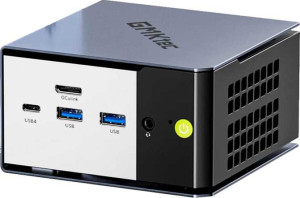
On the graphics side, the integrated Radeon 680M GPU is based on the RDNA 2.0 architecture, delivering 3.379 TFLOPS of floating-point performance with support for DirectX 12 Ultimate and ray tracing. Connectivity is well-covered, with four USB 3.2 Gen 2 Type-A ports, one USB 4 40Gbps port, one Thunderbolt 4 port, dual RJ45 ports, HDMI 2.1, and Wi-Fi 6E alongside Bluetooth 5.2, rounding out a capable and versatile port selection.

Pros
  • Supports up to four simultaneous displays, making it well-suited for multi-monitor setups
  • Includes both a Thunderbolt 4 port and a USB 4 40Gbps port, enabling high-bandwidth peripheral and display connections
  • Dual RJ45 ports allow two wired network connections without additional hardware
  • Wi-Fi 6E support ensures compatibility with the latest wireless networking standards
  • 32GB of DDR5 RAM running at 6400 MHz provides substantial memory bandwidth for multitasking workloads
  • ECC memory support adds a layer of data integrity protection useful in reliability-sensitive environments
Cons
  • The multiplier is locked, removing any possibility of CPU overclocking beyond the rated turbo frequency
  • No USB-C ports of any kind are available beyond the USB 4 and Thunderbolt 4 connections, limiting USB-C flexibility
  • There is no external memory slot, so storage expansion requires internal replacement
  • Does not include air-water cooling, which may be a concern given the 50W TDP in a compact 665 cm³ enclosure
  • Warranty period is limited to one year
  • DLSS is not supported, restricting certain GPU-accelerated upscaling workflows
Who is this for?

This Mini PC is a practical fit for users who need a compact desktop capable of handling demanding multitasking and productivity workloads, thanks to its 8-core processor, 32GB of DDR5 RAM, and 16-thread support. The dual RJ45 ports, Wi-Fi 6E, and Thunderbolt 4 connectivity make it well-matched for home office or small business environments where both wired and wireless network reliability matters. Additionally, support for up to four simultaneous displays and HDMI 2.1 output makes it a reasonable choice for users building multi-monitor workstation setups in space-constrained environments.

Who is this NOT for?

Users looking for a machine capable of dedicated gaming or GPU-intensive rendering will find the integrated Radeon 680M limiting, as it lacks the raw graphical throughput that discrete graphics cards provide, and DLSS is not supported. The absence of any USB-C ports beyond the USB 4 and Thunderbolt 4 connections may frustrate users with a modern peripheral ecosystem that relies on standard USB-C connectivity. Similarly, those requiring on-the-fly storage expansion through external memory slots will need to look elsewhere, as no such slot is available on this unit.

General info:

SSD storage capacity 512GB
form factor Micro-ATX
release date January 2026
Is an NVMe SSD
thickness 107 mm
height 56 mm
width 111 mm
volume 665.112 cm³

The GMKtec NucBox K16 follows a Micro-ATX form factor and occupies a total volume of 665.112 cm³, with dimensions measuring 111 mm wide, 107 mm thick, and 56 mm tall. Storage is handled by a 512GB NVMe SSD, offering faster data access compared to traditional SATA-based drives thanks to its NVMe interface.

CPU:

Thermal Design Power (TDP) 50W
CPU speed 8 x 3.2 GHz
turbo clock speed 4.75GHz
CPU threads 16 threads
Has integrated graphics
uses multithreading
L3 cache 16 MB
L2 cache 4 MB
L1 cache 512 KB
L2 core 0.5 MB/core
L3 core 2 MB/core
clock multiplier 32
Has an unlocked multiplier
Supports 64-bit
CPU temperature 95 °C

The processor runs 8 cores at a base speed of 3.2 GHz, boosting up to a turbo clock speed of 4.75 GHz, and supports multithreading for a total of 16 threads. It carries a TDP of 50W and includes integrated graphics, with a maximum operating temperature of 95 °C. Cache is distributed across three levels — 512 KB of L1, 4 MB of L2 (at 0.5 MB per core), and 16 MB of L3 (at 2 MB per core) — while the chip supports 64-bit computing and uses a clock multiplier of 32, though the multiplier is locked and cannot be adjusted for overclocking.

Graphics card:

floating-point performance 3.379 TFLOPS
GPU clock speed 2000 MHz
GPU turbo 2200 MHz
texture rate 105.6 GTexels/s
pixel rate 70.4 GPixel/s
supports ray tracing
supports DLSS
PCI Express (PCIe) version 4
texture mapping units (TMUs) 48
shading units 768
render output units (ROPs) 32
DirectX version DirectX 12 Ultimate
OpenGL version 4.6
OpenCL version 2
semiconductor size 6 nm
supported displays 4
has LHR
Supports multi-display technology
Has Double Precision Floating Point (DPFP)
number of transistors 13100 million

The integrated GPU runs at a base clock of 2000 MHz with a turbo of 2200 MHz, delivering 3.379 TFLOPS of floating-point performance from its 768 shading units, 48 texture mapping units, and 32 render output units — producing a texture rate of 105.6 GTexels/s and a pixel rate of 70.4 GPixel/s. Built on a 6 nm process with 13,100 million transistors, it supports ray tracing, DirectX 12 Ultimate, OpenGL 4.6, and OpenCL 2, while also offering double precision floating point capability; DLSS, however, is not supported. The GPU connects via PCIe 4, supports up to 4 displays simultaneously through its multi-display technology, and does not include LHR restrictions.

Memory:

RAM 32GB
RAM speed 6400 MHz
DDR memory version 5

The GMKtec NucBox K16 is equipped with 32GB of DDR5 RAM running at a speed of 6400 MHz, providing a solid memory configuration for handling demanding workloads and multitasking within its compact form factor.

Connectivity:

Wi-Fi version Wi-Fi 6E (802.11ax), Wi-Fi 6 (802.11ax), Wi-Fi 5 (802.11ac), Wi-Fi 4 (802.11n)
supports Wi-Fi
Has Bluetooth
Bluetooth version 5.2
USB 2.0 ports 0
USB 3.2 Gen 2 ports (USB-A) 4
USB 3.2 Gen 1 ports (USB-A) 0
USB 3.2 Gen 2 ports (USB-C) 0
USB 4 40Gbps ports 1
USB 4 20Gbps ports 0
USB 3.2 Gen 2x2 ports 0
USB 3.2 Gen 1 ports (USB-C) 0
Thunderbolt 4 ports 1
Thunderbolt 3 ports 0
DisplayPort outputs 1
HDMI version HDMI 2.1
HDMI ports 1
RJ45 ports 2
has a socket for a 3.5 mm audio jack
has a VGA connector
Has S/PDIF Out port

Wireless connectivity is covered by Wi-Fi 6E (802.11ax) — with backward compatibility down to Wi-Fi 4 — alongside Bluetooth 5.2. On the wired side, the device includes four USB 3.2 Gen 2 Type-A ports, one USB 4 40Gbps port, and one Thunderbolt 4 port, while USB 2.0, USB 3.2 Gen 1, and other USB-C variants are absent. Display output is handled through one HDMI 2.1 port and one DisplayPort, and network connectivity is supported by dual RJ45 ports. A 3.5 mm headset jack is present, though there is no VGA connector or S/PDIF output.

Benchmarks:

PassMark result 22707
PassMark result (single) 3268
Geekbench 6 result (multi) 8779
Geekbench 6 result (single) 1904
PassMark result (overclocked) 23708
Cinebench R20 (multi) result 5420
Cinebench R20 (single) result 604

In benchmark testing, the processor achieves a PassMark multi-threaded score of 22,707 and a single-threaded score of 3,268, climbing slightly to 23,708 under overclocked conditions. Geekbench 6 results come in at 8,779 for multi-core and 1,904 for single-core performance. Cinebench R20 records a multi-threaded result of 5,420 alongside a single-threaded score of 604.

Miscellaneous:

maximum memory amount 64GB
has an external memory slot
GPU architecture RDNA 2.0
Has air-water cooling
Supports 3D
Supports ECC memory
has XeSS (XMX)
GPU name Radeon 680M
Uses big.LITTLE technology
Type Laptop
instruction sets MMX, F16C, FMA3, AES, AVX, AVX2, SSE 4.1, SSE 4.2
Has NX bit
GPU execution units 12
memory channels 2
RAM speed (max) 6400 MHz
warranty period 1 years
Uses flash storage

The Radeon 680M GPU, based on the RDNA 2.0 architecture, features 12 execution units and supports stereoscopic 3D, though XeSS (XMX) is not available. Memory can be configured up to a maximum of 64GB across 2 channels, with a top RAM speed of 6400 MHz, and the system supports ECC memory; there is no external memory slot, and flash storage is not used. The CPU is classified as a laptop-type processor and supports a range of instruction sets including MMX, AES, AVX, AVX2, FMA3, F16C, SSE 4.1, and SSE 4.2, along with an NX bit for hardware-level security. The unit does not use big.LITTLE technology or air-water cooling, and comes with a 1-year warranty.
Final Verdict

The GMKtec NucBox K16 presents itself as a capable and well-rounded Mini PC for users who need a compact, connectivity-rich desktop without sacrificing meaningful processing power. Its combination of an 8-core processor, 32GB of DDR5 RAM at 6400 MHz, and broad port selection — including Thunderbolt 4, USB 4, dual RJ45, and Wi-Fi 6E — gives it a strong footing in productivity-oriented and multi-display environments. While the integrated Radeon 680M GPU and locked CPU multiplier place natural limits on graphics-heavy and overclocking use cases, the overall specification set is coherent and purposeful for the category it occupies. For users seeking a space-efficient workstation with modern connectivity and solid multitasking headroom, the NucBox K16 makes a compelling and well-considered option.