GMKtec NucBox M8 specifications and in-depth review

GMKtec NucBox M8

Manufacturer: GMKtec

The GMKtec NucBox M8 is a compact Mini PC built around the Mini-ITX form factor, targeting users who need a capable desktop replacement in a small footprint. It ships with 128GB of DDR5 RAM running at 6400 MHz across four memory channels, paired with a 1TB NVMe SSD for storage. The system includes integrated graphics with a GPU turbo frequency of 1900 MHz and PCIe 4 support, along with a 45W TDP processor featuring six cores clocked at 3.3 GHz base and a 4.5 GHz turbo speed.

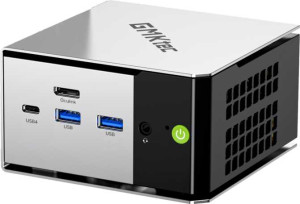
On the connectivity side, the NucBox M8 offers a notable selection of ports, including a Thunderbolt 4 port and a USB 4 40Gbps port, alongside two USB 3.2 Gen 2 Type-A ports and one USB 2.0 port. Display output is handled through a single HDMI 2.1 port and a DisplayPort 1.4 output. Wireless connectivity covers Wi-Fi 6E and Bluetooth 5.2, while a 3.5mm audio jack is also present. Benchmark results include a PassMark score of 17,936 and a Geekbench 6 multi-core result of 6,930, with the unit backed by a one-year warranty.

Pros
  • Supports up to 128GB of DDR5 RAM across four memory channels, offering substantial memory capacity for a Mini-ITX form factor device
  • The USB port selection includes a Thunderbolt 4 port and a USB 4 40Gbps port, enabling high-bandwidth peripheral and display connections
  • Wi-Fi 6E support provides access to the latest wireless standard alongside backward compatibility with Wi-Fi 6, 5, and 4
  • A 1TB NVMe SSD delivers fast storage access without relying on slower flash-based solutions
  • Display output through both HDMI 2.1 and DisplayPort 1.4 allows connection to two monitors simultaneously
  • The CPU supports multithreading across 12 threads with a turbo frequency of 4.5 GHz, enabling handling of multi-threaded workloads
Cons
  • No RJ45 Ethernet port is present, meaning wired network connectivity is not available
  • The GPU has only 6 execution units, which limits graphical processing capability for demanding visual tasks
  • There are no USB Type-C ports beyond the Thunderbolt 4 and USB 4 connections, leaving no standard USB-C option for everyday peripherals
  • The warranty period is limited to one year
  • No S/PDIF output is available for digital audio connections to compatible receivers or audio equipment
Who is this for?

This Mini PC suits users who need a compact desktop setup with substantial memory headroom, making it a reasonable fit for multitasking workflows and memory-intensive applications given its 128GB DDR5 RAM capacity across four channels. The presence of a Thunderbolt 4 port and USB 4 40Gbps connectivity also makes it practical for those working with high-speed external storage or multi-monitor configurations, particularly via the dual display outputs through HDMI 2.1 and DisplayPort 1.4. Users who rely on wireless connectivity will benefit from Wi-Fi 6E support, and the 1TB NVMe SSD provides fast local storage for everyday productivity and file-heavy tasks.

Who is this NOT for?

Users who require a wired network connection will find this unit limiting, as there is no RJ45 Ethernet port available. Those looking to handle graphically demanding workloads such as video rendering or gaming will be constrained by the integrated GPU, which offers only 6 execution units and a 1900 MHz turbo frequency. Additionally, the absence of standard USB Type-C ports beyond the Thunderbolt 4 connection may frustrate users with a broad range of USB-C peripherals or accessories, and the one-year warranty period may not satisfy those seeking longer-term hardware coverage.

General info:

SSD storage capacity 1000GB
form factor Mini-ITX
Is an NVMe SSD

The GMKtec NucBox M8 follows a Mini-ITX form factor, making it suited for compact desktop setups. Storage is handled by a 1000GB NVMe SSD, offering fast read and write performance through the NVMe interface rather than traditional flash storage.

CPU:

Thermal Design Power (TDP) 45W
CPU speed 6 x 3.3 GHz
turbo clock speed 4.5GHz
CPU threads 12 threads
Has integrated graphics
uses multithreading
L3 cache 16 MB
L2 cache 3 MB
L1 cache 384 KB
L2 core 0.5 MB/core
L3 core 2.67 MB/core
Has an unlocked multiplier
Supports 64-bit
CPU temperature 95 °C

The processor runs six cores at a base speed of 3.3 GHz with a turbo clock of 4.5 GHz, supported by 12 threads through multithreading. It carries a TDP of 45W and a maximum operating temperature of 95 °C, with integrated graphics included on the chip. Cache memory is distributed across three levels — 384 KB of L1, 3 MB of L2 at 0.5 MB per core, and 16 MB of L3 at 2.67 MB per core. The CPU supports 64-bit computing but does not feature an unlocked multiplier.

Graphics card:

GPU turbo 1900 MHz
PCI Express (PCIe) version 4
semiconductor size 6 nm

The integrated graphics solution reaches a turbo frequency of 1900 MHz and is built on a 6 nm semiconductor process, with the system supporting PCIe 4 for interface bandwidth.

Memory:

RAM 128GB
RAM speed 6400 MHz
DDR memory version 5

The GMKtec NucBox M8 is equipped with 128GB of DDR5 RAM, running at a speed of 6400 MHz, which represents the maximum supported memory speed for this configuration.

Connectivity:

Wi-Fi version Wi-Fi 6E (802.11ax), Wi-Fi 6 (802.11ax), Wi-Fi 5 (802.11ac), Wi-Fi 4 (802.11n)
supports Wi-Fi
Has Bluetooth
Bluetooth version 5.2
USB 2.0 ports 1
USB 3.2 Gen 2 ports (USB-A) 2
USB 3.2 Gen 1 ports (USB-A) 0
USB 3.2 Gen 2 ports (USB-C) 0
USB 4 40Gbps ports 1
USB 4 20Gbps ports 0
USB 3.2 Gen 2x2 ports 0
USB 3.2 Gen 1 ports (USB-C) 0
Thunderbolt 4 ports 1
Thunderbolt 3 ports 0
DisplayPort version DisplayPort 1.4
DisplayPort outputs 1
HDMI version HDMI 2.1
HDMI ports 1
RJ45 ports 0
has a socket for a 3.5 mm audio jack
has a VGA connector
Has S/PDIF Out port

Wireless connectivity covers Wi-Fi 6E, Wi-Fi 6, Wi-Fi 5, and Wi-Fi 4 standards, complemented by Bluetooth 5.2. On the wired side, the port selection includes one Thunderbolt 4 port, one USB 4 40Gbps port, two USB 3.2 Gen 2 Type-A ports, and one USB 2.0 port; there are no USB 3.2 Gen 1 or Type-C variants present. Display output is provided through one HDMI 2.1 port and one DisplayPort 1.4 output, while a 3.5mm audio jack is also available. There is no RJ45 Ethernet port, no VGA connector, and no S/PDIF output.

Benchmarks:

PassMark result 17936
PassMark result (single) 3110
Geekbench 6 result (multi) 6930
Geekbench 6 result (single) 1735

In benchmark testing, the NucBox M8 achieves a PassMark multi-core score of 17,936 alongside a single-core score of 3,110. Geekbench 6 results place it at 6,930 in the multi-core test and 1,735 in the single-core test, providing a reference point for both threaded and single-threaded workload performance.

Miscellaneous:

maximum memory amount 128GB
Uses big.LITTLE technology
Has NX bit
GPU execution units 6
memory channels 4
Type Laptop
instruction sets SSE 4.2, SSE 4.1, AVX, AES, FMA3, F16C, MMX
RAM speed (max) 6400 MHz
warranty period 1 years
Uses flash storage

The CPU is classified as a laptop-type processor and does not use big.LITTLE technology. It supports a maximum of 128GB of RAM across 4 memory channels, with a top memory speed of 6400 MHz, and does not use flash storage. The GPU includes 6 execution units, and the processor supports NX bit for hardware-level security. Supported instruction sets include SSE 4.1, SSE 4.2, AVX, AES, FMA3, F16C, and MMX, and the unit comes with a one-year warranty.
Final Verdict

The GMKtec NucBox M8 is a compact Mini-ITX system that makes a strong case for users who need substantial memory and fast storage in a small footprint, with its 128GB DDR5 RAM capacity and Thunderbolt 4 connectivity standing out as its most compelling technical attributes. The inclusion of Wi-Fi 6E, dual display outputs, and a 1TB NVMe SSD rounds out a feature set that comfortably supports productivity-focused and multitasking use cases. That said, the absence of a wired Ethernet port and the limited integrated GPU mean it is best directed toward users whose workloads do not depend on network reliability or graphical horsepower. Overall, the NucBox M8 is a well-specified compact desktop for memory-intensive, wireless-first workflows, provided its connectivity limitations align with the user's needs.