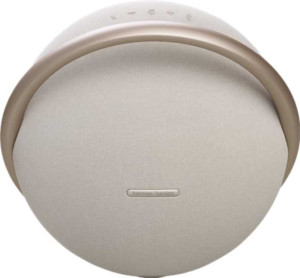
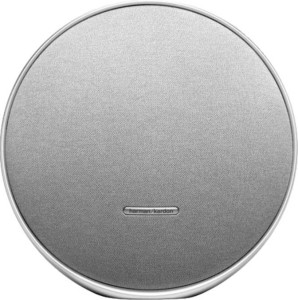
The Harman Kardon Onyx Studio 8 has a notably substantial physical presence, standing 302.5 mm tall, 268 mm wide, and 159.5 mm thick, with a total volume of roughly 12,930 cm³ and a weight of 3,520 g. It houses three drivers and includes a control panel directly on the device, along with a detachable cable for added convenience. The speaker does not offer water resistance, RGB lighting, a touch screen, or a remote control, and no travel bag is included in the box.
The Onyx Studio 8 includes a built-in subwoofer and covers a frequency range spanning from 50 Hz to 20,000 Hz, giving it a reasonably wide sonic reach. It delivers 50W of audio output power through a single channel, with a sound pressure level rated at 80 dB/mW. Magnetic shielding is not present on this model.
The Onyx Studio 8 is powered by a built-in rechargeable battery with a capacity of 3,250 mAh, rated for up to 8 hours of playback on a full charge, which takes approximately 5 hours to complete. A battery level indicator is included to help users track remaining charge. The battery is not removable, and wireless charging is not supported.
The Onyx Studio 8 connects exclusively via Bluetooth 5.2, with a maximum wireless range of 10 m. It does not support NFC pairing, Wi-Fi, AirPlay, Chromecast, DLNA, or Ethernet, making Bluetooth the sole wireless connection method. On the audio codec side, none of the advanced options are available — aptX, aptX HD, aptX Adaptive, aptX Lossless, aptX Low Latency, LDAC, AAC, Auracast, and Bluetooth LE Audio are all absent. There is no 3.5 mm audio jack socket, no AUX input, no 3.5 mm male connector, no external memory slot, and no microphone input.
The Onyx Studio 8 can be used wirelessly and supports smartphone remote control, allowing users to manage playback from their phone. It includes voice prompts for device status feedback and a sleep timer for scheduled shutoff. Fast pairing, voice commands, a mute function, radio, and power bank functionality are not available on this model.
The Onyx Studio 8 supports stereo pairing, allowing it to be linked with a second compatible unit to create a two-speaker stereo setup.