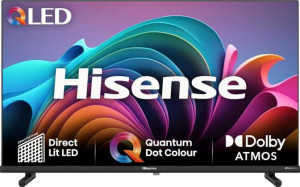
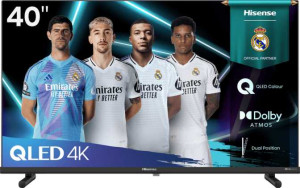
The Hisense 40A5NQTUK features a 40″ QLED, LED-backlit LCD panel with a Full HD resolution of 1920 x 1080 pixels and a pixel density of 55 ppi, capable of rendering up to 1670 million colors at 8-bit depth. Typical brightness is rated at 230 nits, paired with a 5000:1 contrast ratio, and the screen refreshes at 60Hz with a response time of 9.5 ms. HDR10 and HLG are both supported, while HDR10+, Dolby Vision, and adaptive synchronization are not. The panel offers wide viewing angles of 178º both horizontally and vertically, and an anti-reflection coating is present on the screen surface; however, there is no ambient light sensor.
The TV connects to a network wirelessly via Wi-Fi 4 (802.11n) or through a wired connection using the single RJ45 Ethernet port, and Miracast is supported for wireless screen mirroring from compatible devices. For physical connections, there are two HDMI 1.4 ports and three USB ports, along with a 3.5 mm headphone jack. Broadcast reception covers DVB-T, DVB-T2, DVB-C, DVB-S, and DVB-S2 standards. Bluetooth, a VGA connector, a DVI connector, and an external memory slot are all absent.
Audio is delivered through a stereo speaker setup rated at 2 x 8W, with no subwoofer included. The TV supports Dolby Atmos, Dolby Audio, and DTS:X decoding, though Dolby Virtual and SRS TheaterSound HD are not available. A Digital Out connection is present for routing audio to external equipment, and the HDMI port supports ARC for soundbar or receiver integration via a single cable. Dolby Virtual is not supported.
The Hisense 40A5NQTUK measures 900 mm wide, 515 mm tall, and 85 mm thick, with a total weight of 5400 g and a volume of 39397.5 cm³. VESA mount compatibility is included, allowing the TV to be attached to a wall bracket. Operating temperatures are rated between 5 °C and 35 °C.
The TV includes a built-in smart TV platform with a web browser, AirPlay support, and smartphone remote control functionality, though Siri and Apple HomeKit compatibility are not available. USB recording is supported, and practical utilities such as a sleep timer and child lock are on board. The remote control is not rechargeable. Power consumption sits at 70W during operation and drops to 0.5W in standby, with the unit carrying an EU energy label of F.