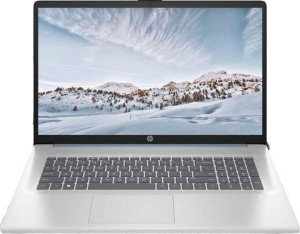
The HP 17 (2025) 17.3″ is classified as a productivity laptop and comes equipped with a backlit keyboard, which adds convenience for working in lower-light environments. It does not use a fanless design, meaning it relies on active cooling to manage heat during operation. The laptop is neither weather-sealed nor built to a rugged standard, so it is intended for standard indoor use rather than harsh or demanding physical conditions.
The HP 17 (2025) 17.3″ features a 17.3″ touchscreen display with a resolution of 1600 x 900 pixels, yielding a pixel density of 106 ppi across its large panel. Typical brightness is rated at 250 nits, and the screen includes an anti-reflection coating to help reduce glare under ambient lighting conditions.
The HP 17 (2025) 17.3″ is powered by a 6-core CPU running at a base speed of 2.3 GHz per core, with multithreading across 12 threads and a turbo clock speed reaching 4.3 GHz, all built on a 7 nm semiconductor process. It comes with 16GB of DDR4 RAM and supports up to 64GB, while storage is handled by a 1TB NVMe SSD connected via PCIe 3.0, using flash-based technology for fast data access. The GPU reaches a turbo frequency of 1,800 MHz and supports DirectX 12, though XeSS (XMX) acceleration is not available. The system is fully 64-bit compatible and supports multithreading for handling parallel workloads.
The HP 17 (2025) 17.3″ records a PassMark score of 15,601 in the multi-core benchmark, reflecting its overall multi-threaded processing capability, while its single-core PassMark result stands at 2,948, indicating the per-core performance available for tasks that rely on single-threaded execution.
The HP 17 (2025) 17.3″ offers a modest but practical port selection, including one USB 3.2 Gen 1 USB-C port and two USB 3.2 Gen 1 USB-A ports, with no USB 3.2 Gen 2, USB 4, Thunderbolt 3, or Thunderbolt 4 ports present. Video output is handled by a single HDMI 1.4 port, while DisplayPort, mini DisplayPort, and VGA outputs are absent. Wireless connectivity covers Wi-Fi 6 (802.11ax) along with backward-compatible Wi-Fi 5 and Wi-Fi 4 standards, and Bluetooth 5.3 is also supported. AirPlay is available for wireless streaming, though there is no RJ45 Ethernet port or external memory card slot on this model.
The HP 17 (2025) 17.3″ includes stereo speakers and a 3.5 mm headset jack for audio output and wired headphone use, though it does not support Dolby Atmos or an S/PDIF output port. A single built-in microphone handles audio input, and a front-facing camera is present for video calls, while 3D facial recognition and voice commands are not supported. Security is addressed through a fingerprint scanner, offering a straightforward biometric login option. The laptop does not include a stylus, an optical disc drive, ray tracing, or DLSS support, and it lacks motion and location sensors such as a gyroscope, accelerometer, GPS, and compass.
The HP 17 (2025) 17.3″ uses integrated AMD Radeon Graphics with 7 execution units, supporting OpenCL 2.2 and OpenGL 4.6, and the CPU carries a clock multiplier of 23 with a thermal design power of 15W and a maximum operating temperature of 95 °C. The processor supports a broad set of instruction sets — including MMX, AES, AVX, AVX2, FMA3, F16C, SSE 4.1, and SSE 4.2 — and features NX bit support, though it does not have an unlocked multiplier or use big.LITTLE heterogeneous core architecture. Cache is structured across three levels, with 384 KB of L1, 3 MB of L2 at 0.5 MB per core, and a 16 MB L3 cache at 2.67 MB per core. The dual-channel memory configuration supports a maximum RAM speed of 4,267 MHz and is compatible with ECC memory, while the CPU is rated for both desktop and laptop platforms.