HP 17-cn4010nr 17.3" Intel Core 3 100U 1.2GHz / 8GB RAM / 256GB SSD specifications and in-depth review

HP 17-cn4010nr 17.3" Intel Core 3 100U 1.2GHz / 8GB RAM / 256GB SSD

Manufacturer: HP

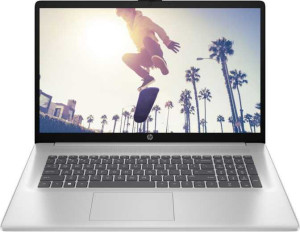
The HP 17 (2024), also known as the HP 17-cn4010nr, is a 17.3-inch laptop designed for everyday computing tasks. Built around an Intel Core 3 100U processor, it uses Intel's big.LITTLE architecture with a mix of performance and efficiency cores reaching a turbo clock speed of 4.7GHz. The machine weighs approximately 2086 g and measures 20 mm thin, giving it a relatively slim profile for a large-screen system. It ships with a one-year warranty and runs a 64-bit capable CPU built on a 10 nm process with a 15W TDP.

On the display side, the HP 17 (2024) features a 17.3-inch panel at 1600 x 900 resolution, delivering a pixel density of 106 ppi with a 60Hz refresh rate and an anti-reflection coating at 250 nits brightness. Performance is backed by 8GB of DDR4 RAM at 3200 MHz, expandable up to 96GB across two memory channels, paired with a 256GB NVMe PCIe 4 SSD. Connectivity includes one USB 3.2 Gen 1 Type-C port, two USB 3.2 Gen 1 Type-A ports, one HDMI 1.4 output, one DisplayPort, and Wi-Fi 6 with Bluetooth 5.3. The integrated Intel UHD Graphics 64EU GPU supports up to four displays and reaches a turbo frequency of 1250 MHz, with OpenCL 3 and OpenGL 4.6 support rounding out the graphics capabilities.

Pros
  • The 17.3-inch screen paired with support for up to four simultaneous displays makes it well-suited for multitasking or extended desktop setups
  • Wi-Fi 6 support ensures faster and more reliable wireless connections on compatible networks
  • Bluetooth 5.3 provides a current-generation wireless standard for peripherals and accessories
  • The NVMe PCIe 4 SSD delivers noticeably faster storage read and write speeds compared to older storage interfaces
  • The dual-microphone setup and front-facing camera make it functional for video calls without additional peripherals
  • Sleep-and-charge USB ports allow connected devices to charge even when the laptop is off or in sleep mode
Cons
  • The 1600 x 900 resolution on a 17.3-inch panel results in a relatively low pixel density of 106 ppi, which can make text and images appear less sharp
  • At 250 nits, the display brightness is on the lower end and may be insufficient in well-lit environments
  • The absence of a backlit keyboard limits usability in low-light conditions
  • No RJ45 Ethernet port means wired network connections are not possible without an adapter
  • There is no external memory card slot, limiting quick file transfers from cameras or other card-based devices
  • The lack of a fingerprint scanner or facial recognition means no biometric login options are available
Who is this for?

This laptop is a reasonable fit for everyday home or office users who prioritize screen real estate, as the large 17.3-inch display makes it comfortable for document work, web browsing, and video streaming over extended sessions. The dual-microphone setup, front-facing camera, and Wi-Fi 6 support make it well-suited for regular video conferencing and remote work. Users who occasionally connect external monitors will also appreciate the ability to drive up to four displays simultaneously, alongside the available HDMI and DisplayPort outputs.

Who is this NOT for?

This laptop is not a good fit for users who need strong visual performance or color-accurate work, as the 1600 x 900 resolution and 250-nit brightness fall short for photo editing, graphic design, or any task requiring a sharp, well-lit display. The integrated Intel UHD Graphics 64EU and modest CPU configuration make it unsuitable for gaming, 3D rendering, or computationally intensive workloads. Users who frequently work in low-light environments will also find the lack of a backlit keyboard a persistent inconvenience, and those who need wired network connectivity will be hindered by the absence of an RJ45 port.

Design:

weight 2086 g
Uses a fanless design
Has a backlit keyboard
warranty period 1 years
volume 2056 cm³
width 400 mm
height 257 mm
thickness 20 mm
is weather-sealed (splashproof)

The HP 17 (2024) has a physical footprint of 400 mm wide by 257 mm deep, with a thickness of just 20 mm and a total volume of 2056 cm³. It weighs 2086 g, which is a typical figure for a large-screen laptop of this size. The system uses an active cooling design rather than a fanless approach, and it does not include a backlit keyboard or weather sealing. The laptop comes with a one-year warranty.

Display:

screen size 17.3"
resolution 1600 x 900 px
pixel density 106 ppi
has a touch screen
brightness (typical) 250 nits
refresh rate 60Hz
has anti-reflection coating
supported displays 4

The HP 17 (2024) features a 17.3-inch display with a 1600 x 900 resolution, yielding a pixel density of 106 ppi, and operates at a standard 60Hz refresh rate. Typical brightness is rated at 250 nits, and the panel includes an anti-reflection coating to help reduce glare in ambient lighting conditions. The screen does not support touch input, and the system is capable of driving up to four displays simultaneously.

Performance:

RAM 8GB
RAM speed 3200 MHz
Uses flash storage
internal storage 256GB
CPU speed 4 x 1.2 & 2 x 0.9 GHz
CPU threads 8 threads
Is an NVMe SSD
uses multithreading
maximum memory amount 96GB
DDR memory version 4
turbo clock speed 4.7GHz
GPU turbo 1250 MHz
PCI Express (PCIe) version 4
semiconductor size 10 nm
Supports 64-bit

The HP 17 (2024) is equipped with 8GB of DDR4 RAM running at 3200 MHz, with the system supporting a maximum memory capacity of 96GB. The CPU runs at a base speed of 4 x 1.2 GHz and 2 x 0.9 GHz across its 8 threads, reaching a turbo clock speed of 4.7GHz, though it does not use multithreading technology. Storage comes in the form of a 256GB NVMe SSD over a PCIe 4 interface, built on a 10 nm semiconductor process. The integrated GPU reaches a turbo frequency of 1250 MHz, and the processor fully supports 64-bit computing.

Benchmarks:

PassMark result 13934
PassMark result (single) 3679

In CPU benchmark testing, the HP 17 (2024) achieves a PassMark multi-core score of 13,934, while its single-core PassMark result comes in at 3,679, reflecting the processor's per-core throughput capacity.

Connectivity:

USB 3.2 Gen 2 ports (USB-C) 0
USB 3.2 Gen 2 ports (USB-A) 0
USB 4 20Gbps ports 0
USB 4 40Gbps ports 0
Thunderbolt 4 ports 0
USB 3.2 Gen 1 ports (USB-C) 1
USB 3.2 Gen 1 ports (USB-A) 2
Thunderbolt 3 ports 0
has an HDMI output
Has USB Type-C
supports Wi-Fi
Wi-Fi version Wi-Fi 6 (802.11ax), Wi-Fi 5 (802.11ac), Wi-Fi 4 (802.11n)
has an external memory slot
Bluetooth version 5.3
RJ45 ports 0
HDMI ports 1
HDMI version HDMI 1.4
DisplayPort outputs 1
has AirPlay
mini DisplayPort outputs 0
has a VGA connector

The HP 17 (2024) offers a practical set of wired and wireless connectivity options. For USB, it includes one USB 3.2 Gen 1 Type-C port and two USB 3.2 Gen 1 Type-A ports; there are no USB 3.2 Gen 2, USB 4, Thunderbolt 3, or Thunderbolt 4 ports. Video output is handled by one HDMI 1.4 port and one DisplayPort, while VGA and mini DisplayPort are absent. The laptop does not include an RJ45 Ethernet port or an external memory card slot. Wireless connectivity covers Wi-Fi 6 (802.11ax) along with Wi-Fi 5 and Wi-Fi 4, paired with Bluetooth 5.3, and the system also supports AirPlay.

Battery:

Has sleep-and-charge USB ports
Has a MagSafe power adapter

The HP 17 (2024) includes sleep-and-charge USB ports, allowing connected devices to be charged even when the laptop is powered off or in sleep mode. It does not use a MagSafe power adapter.

Features:

has stereo speakers
has a socket for a 3.5 mm audio jack
has Dolby Atmos
Stylus included
Has a fingerprint scanner
number of microphones 2
Uses 3D facial recognition
has voice commands
has a front camera
Has S/PDIF Out port
has a gyroscope
has GPS
has an accelerometer
has a compass
Has an optical disc drive

The HP 17 (2024) includes stereo speakers, a 3.5 mm headset jack, and a dual-microphone setup, though it does not feature Dolby Atmos or an S/PDIF output. A front-facing camera is built in, while biometric options such as a fingerprint scanner and 3D facial recognition are absent, and voice commands are not supported. The laptop does not come with a stylus. On the sensor and navigation side, it lacks a gyroscope, accelerometer, compass, and GPS, and there is no optical disc drive included.

Miscellaneous:

clock multiplier 12
GPU name UHD Graphics 64EU
Type Laptop
instruction sets MMX, F16C, FMA3, AES, AVX, AVX2, SSE 4.1, SSE 4.2
L3 cache 10 MB
Has an unlocked multiplier
Has NX bit
CPU temperature 100 °C
OpenCL version 3
OpenGL version 4.6
GPU execution units 64
Has integrated graphics
Supports ECC memory
memory channels 2
RAM speed (max) 5200 MHz
Thermal Design Power (TDP) 15W
Uses big.LITTLE technology

The HP 17 (2024) is powered by a laptop-class CPU using big.LITTLE technology, with a clock multiplier of 12, a 15W TDP, and a maximum operating temperature of 100°C. The multiplier is locked, and the processor supports a broad set of instruction sets including MMX, F16C, FMA3, AES, AVX, AVX2, SSE 4.1, and SSE 4.2, along with NX bit support. It features 10 MB of L3 cache and operates across two memory channels, with a maximum supported RAM speed of 5200 MHz; ECC memory is not supported. Graphics are handled by the integrated Intel UHD Graphics 64EU, which carries 64 execution units and supports OpenCL 3 and OpenGL 4.6.
Final Verdict

The HP 17 (2024) is a straightforward large-screen laptop that covers the basics of everyday computing without overreaching. Its most practical asset is the 17.3-inch display combined with multi-monitor support, making it a workable option for home users and remote workers who value screen space and video call readiness. However, its display resolution, brightness ceiling, and integrated graphics place clear boundaries on what it can comfortably handle, and users with more demanding visual or processing needs will find those limits apparent in regular use. For light daily tasks — document work, web browsing, and video conferencing — the HP 17 (2024) delivers a functional and reasonably equipped experience, but it is best approached with a clear understanding of the workloads it is designed to support.