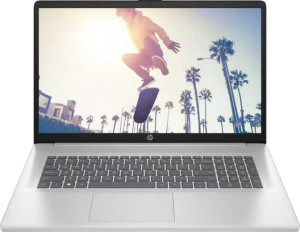
Design:
| Type |
Productivity |
| Uses a fanless design |
✕ |
| Has a backlit keyboard |
✓ |
| is weather-sealed (splashproof) |
✕ |
| has a rugged build |
✕ |
The HP Essential 17 (2025) is classified as a productivity laptop and comes equipped with a backlit keyboard, making it practical for use in lower-light environments. It does not use a fanless design, meaning it relies on active cooling to manage heat. The build is neither rugged nor weather-sealed, so it is not rated for splashproof protection or demanding physical conditions.
Display:
| screen size |
17.3" |
| resolution |
1600 x 900 px |
| pixel density |
106 ppi |
| has a touch screen |
✓ |
| refresh rate |
60Hz |
| has anti-reflection coating |
✕ |
| supported displays |
4 |
The HP Essential 17 (2025) features a 17.3-inch display with a resolution of 1600 x 900 pixels and a pixel density of 106 ppi, delivering a reasonably detailed image across its large screen area. It supports touch input and runs at a 60Hz refresh rate, though it lacks an anti-reflection coating. The system can drive up to 4 supported displays simultaneously, offering flexibility for multi-monitor setups.
Performance:
| RAM |
32GB |
| RAM speed |
3200 MHz |
| Uses flash storage |
✓ |
| internal storage |
2048GB |
| CPU speed |
2 x 1.3 & 8 x 0.9 GHz |
| CPU threads |
12 threads |
| Is an NVMe SSD |
✓ |
| DirectX version |
DirectX 12 |
| GPU clock speed |
300 MHz |
| uses multithreading |
✓ |
| maximum memory amount |
64GB |
| DDR memory version |
5 |
| turbo clock speed |
4.6GHz |
| GPU turbo |
1250 MHz |
| PCI Express (PCIe) version |
4 |
| semiconductor size |
10 nm |
| has XeSS (XMX) |
✕ |
| Supports 64-bit |
✓ |
The HP Essential 17 (2025) is equipped with 32GB of DDR5 RAM running at 3200 MHz, with support for up to 64GB maximum, giving it headroom for memory-intensive workloads. Storage is handled by a 2048GB NVMe SSD using PCIe 4 and flash technology, ensuring fast data access across the board. The CPU operates at speeds of 2 x 1.3 GHz and 8 x 0.9 GHz across 12 threads, with multithreading enabled and a turbo clock that reaches 4.6GHz, all built on a 10nm semiconductor process. The GPU runs at a base clock of 300 MHz with a turbo of 1250 MHz, supports DirectX 12 and 64-bit processing, but does not include XeSS (XMX) acceleration.
Benchmarks:
| Geekbench 6 result (multi) |
7605 |
| Geekbench 6 result (single) |
2183 |
| PassMark result |
13420 |
| PassMark result (single) |
3347 |
In benchmark testing, the HP Essential 17 (2025) achieves a Geekbench 6 multi-core score of 7605 and a single-core score of 2183, reflecting its multi-threaded processing capability relative to single-core tasks. On the PassMark suite, it records an overall score of 13420, with a single-core PassMark result of 3347, providing a consistent picture of its CPU performance across both multi-threaded and single-threaded workloads.
Connectivity:
| USB 3.2 Gen 2 ports (USB-C) |
0 |
| USB 3.2 Gen 2 ports (USB-A) |
2 |
| USB 4 20Gbps ports |
0 |
| USB 4 40Gbps ports |
0 |
| Thunderbolt 4 ports |
0 |
| USB 3.2 Gen 1 ports (USB-C) |
1 |
| USB 3.2 Gen 1 ports (USB-A) |
0 |
| Thunderbolt 3 ports |
0 |
| has an HDMI output |
✓ |
| Has USB Type-C |
✓ |
| supports Wi-Fi |
✓ |
| Wi-Fi version |
Wi-Fi 6 (802.11ax), Wi-Fi 5 (802.11ac), Wi-Fi 4 (802.11n) |
| has an external memory slot |
✕ |
| RJ45 ports |
0 |
| HDMI ports |
1 |
| DisplayPort outputs |
0 |
| USB 2.0 ports |
0 |
| has AirPlay |
✓ |
| mini DisplayPort outputs |
0 |
| has a VGA connector |
✕ |
The HP Essential 17 (2025) offers a practical range of wired and wireless connectivity options. On the port side, it includes two USB 3.2 Gen 2 Type-A ports and one USB 3.2 Gen 1 Type-C port, while higher-speed interfaces such as Thunderbolt 3, Thunderbolt 4, USB 4, and DisplayPort are absent. A single HDMI output is available for external display use, though there is no VGA connector, mini DisplayPort, or external memory slot. There are no RJ45 ports for wired networking. Wireless connectivity is covered by Wi-Fi 6 (802.11ax), with backward compatibility for Wi-Fi 5 and Wi-Fi 4, and the system also supports AirPlay.
Battery:
| Has sleep-and-charge USB ports |
✕ |
| Has a MagSafe power adapter |
✕ |
On the battery and power side, the HP Essential 17 (2025) does not include sleep-and-charge USB ports, meaning connected devices cannot be charged while the laptop is powered off or in sleep mode. It also does not feature a MagSafe power adapter, so charging relies on a standard connection method.
Features:
| has stereo speakers |
✓ |
| has a socket for a 3.5 mm audio jack |
✓ |
| supports ray tracing |
✕ |
| supports DLSS |
✕ |
| has Dolby Atmos |
✕ |
| Stylus included |
✕ |
| Has a fingerprint scanner |
✓ |
| number of microphones |
1 |
| Uses 3D facial recognition |
✕ |
| has voice commands |
✕ |
| has a front camera |
✓ |
| Has S/PDIF Out port |
✕ |
| has a gyroscope |
✕ |
| has GPS |
✕ |
| has an accelerometer |
✕ |
| has a compass |
✕ |
| Has an optical disc drive |
✕ |
The HP Essential 17 (2025) includes stereo speakers, a 3.5mm headset jack, and a single built-in microphone for audio input and output, though it does not support Dolby Atmos or an S/PDIF port. For security and communication, it features a fingerprint scanner and a front-facing camera, while 3D facial recognition and voice commands are not available. Motion and location sensors such as a gyroscope, accelerometer, GPS, and compass are absent, and there is no optical disc drive. On the graphics feature side, ray tracing and DLSS are not supported, and no stylus is included in the package.
Miscellaneous:
| clock multiplier |
0 |
| PassMark result (overclocked) |
13427 |
| GPU name |
Iris Xe Graphics 80EU |
| Type |
Laptop |
| CPU socket |
LGA 1700 |
| Has an unlocked multiplier |
✕ |
| L2 cache |
9.5 MB |
| L3 cache |
12 MB |
| Has NX bit |
✓ |
| CPU temperature |
100 °C |
| render output units (ROPs) |
20 |
| texture mapping units (TMUs) |
40 |
| shading units |
640 |
| OpenCL version |
3 |
| OpenGL version |
4.6 |
| GPU execution units |
80 |
| Has integrated graphics |
✓ |
| Supports ECC memory |
✕ |
| memory channels |
2 |
| Thermal Design Power (TDP) |
15W |
| Uses big.LITTLE technology |
✓ |
| instruction sets |
SSE 4.2, SSE 4.1, AVX, AES, FMA3, F16C, MMX |
| RAM speed (max) |
5200 MHz |
The HP Essential 17 (2025) uses a laptop-class CPU seated in an LGA 1700 socket, built around a 15W TDP and big.LITTLE architecture, with a maximum operating temperature of 100°C. The processor does not have an unlocked multiplier and carries 9.5MB of L2 cache and 12MB of L3 cache, while supporting NX bit for hardware-level security. It supports a range of instruction sets including SSE 4.1, SSE 4.2, AVX, AES, FMA3, F16C, and MMX, and the system does not support ECC memory, with RAM operating across 2 memory channels at a maximum speed of 5200 MHz. Graphics are handled by the integrated Intel Iris Xe Graphics 80EU, which features 640 shading units, 40 texture mapping units, and 20 render output units, with support for OpenCL 3 and OpenGL 4.6. The overclocked PassMark result stands at 13427, and the clock multiplier is locked at 0 with no unlocked multiplier available.