HP Omen 17 (2025) 17.3" (Ryzen AI 9 365 / RTX 5060 Laptop / 64GB RAM / 1TB) specifications and in-depth review

HP Omen 17 (2025) 17.3" (Ryzen AI 9 365 / RTX 5060 Laptop / 64GB RAM / 1TB)

Manufacturer: HP

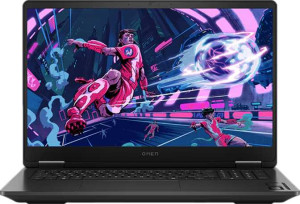
The HP Omen 17 (2025) is a large-format gaming laptop built around AMD and NVIDIA hardware, targeting users who need a capable desktop-replacement machine. Its 17.3″ IPS panel runs at a 144Hz refresh rate with a 1920 x 1080 resolution, anti-reflection coating, and support for up to four simultaneous displays. The backlit keyboard and stereo speakers round out the everyday usability, while the chassis houses active cooling rather than a fanless design, which is typical for hardware of this class.

Under the hood, the Ryzen AI 9 365 delivers 20 CPU threads across ten cores clocked at 2 GHz base with a 5 GHz turbo, sitting on a 45W TDP envelope and built on a 5 nm process node. The discrete NVIDIA RTX 5060 Laptop GPU is based on the Blackwell architecture and carries 8GB of GDDR7 memory on a 128-bit bus running at an effective 28000 MHz, yielding up to 448 GB/s of memory bandwidth and 9.684 TFLOPS of floating-point throughput. The system ships with 64GB of DDR5 RAM, a 1TB NVMe SSD over PCIe 5, DirectX 12 Ultimate support, hardware ray tracing, and DLSS, with connectivity provided by three USB 3.2 Gen 2 Type-A ports, one USB 3.2 Gen 2 Type-C port, HDMI, and a single RJ45 Ethernet port.

Pros
  • The 64GB of DDR5 RAM running at up to 7500 MHz provides substantial headroom for memory-intensive gaming and multitasking workloads
  • Hardware ray tracing and DLSS support allow compatible titles to leverage both enhanced lighting fidelity and upscaled rendering
  • The 144Hz IPS display with anti-reflection coating is well-suited to fast-paced content while remaining comfortable in varied lighting environments
  • Three USB 3.2 Gen 2 Type-A ports alongside one USB 3.2 Gen 2 Type-C port offer a broad and fast wired peripheral setup
  • The NVMe SSD connected over PCIe 5 delivers a fast storage interface, and the 1TB capacity provides reasonable room for games and applications
  • Sleep-and-charge USB ports allow connected devices to be powered even when the laptop is off or asleep
Cons
  • The 1920 x 1080 resolution on a 17.3-inch panel results in a pixel density of only 127 ppi, which produces a noticeably less sharp image at normal viewing distances
  • There are no Thunderbolt, USB 4, or DisplayPort outputs, limiting options for high-bandwidth peripherals and external display configurations
  • The absence of a fingerprint scanner or 3D facial recognition leaves the machine without hardware-based biometric authentication
  • No external memory card slot is present, making direct transfer from cameras or other card-based devices inconvenient
  • A single microphone is included with no mention of noise cancellation or array configuration, which may limit voice capture quality
Who is this for?

This laptop is well-matched for users who engage in gaming and GPU-accelerated workloads from a fixed or semi-fixed location, as the Blackwell-architecture discrete GPU with hardware ray tracing, DLSS support, and 9.684 TFLOPS of floating-point throughput is geared toward rendering-heavy applications. The 64GB of DDR5 RAM paired with a PCIe 5 NVMe SSD makes it a capable machine for users who run multiple demanding applications simultaneously, such as game streaming alongside recording software or content creation tools. The 144Hz IPS display with anti-reflection coating also suits users who spend extended sessions in varied lighting conditions and benefit from a smoother visual experience during fast-paced gaming or video editing.

Who is this NOT for?

Users who prioritize portability and lightweight travel use will find this laptop poorly suited to their needs, as the 17.3-inch form factor and active cooling system make it bulky and inconvenient to carry regularly. The 1920 x 1080 resolution at 127 ppi on a screen of this size produces a noticeably soft image, so professionals who depend on sharp, color-accurate visuals for photography editing, graphic design, or detailed visual work will likely find the display limiting. Additionally, the lack of Thunderbolt ports, biometric authentication, and any motion or location sensors makes it a poor fit for users in enterprise, security-sensitive, or field-based environments where those capabilities are routinely expected.

Design:

Type Gaming
Uses a fanless design
Has a backlit keyboard
is weather-sealed (splashproof)
has a rugged build

The HP Omen 17 (2025) is classified as a gaming laptop, designed with an active cooling system rather than a fanless setup. It includes a backlit keyboard, making it usable in low-light environments. The chassis is not weather-sealed or splashproof, and it does not carry a rugged build rating, so it is intended for standard indoor use rather than harsh or demanding physical conditions.

Display:

screen size 17.3"
resolution 1920 x 1080 px
pixel density 127 ppi
Display type LCD, LED-backlit, IPS
has a touch screen
refresh rate 144Hz
has anti-reflection coating
supported displays 4

The HP Omen 17 (2025) features a 17.3″ LCD IPS panel with LED backlighting, delivering a resolution of 1920 x 1080 px at a pixel density of 127 ppi. The screen runs at a 144Hz refresh rate, which benefits fast-paced content, and includes an anti-reflection coating to help manage glare in varied lighting conditions. Touch input is not supported, but the system can drive up to four simultaneous displays. The panel does not support touch input.

Performance:

RAM 64GB
Uses flash storage
internal storage 1024GB
CPU speed 10 x 2 GHz
CPU threads 20 threads
VRAM 8GB
floating-point performance 9.684 TFLOPS
GDDR version GDDR7
texture rate 151.3 GTexels/s
pixel rate 46.56 GPixel/s
Is an NVMe SSD
DirectX version DirectX 12 Ultimate
GPU clock speed 952 MHz
uses multithreading
maximum memory amount 256GB
DDR memory version 5
turbo clock speed 5GHz
GPU turbo 1455 MHz
PCI Express (PCIe) version 5
semiconductor size 5 nm
has XeSS (XMX)
Supports 64-bit

The HP Omen 17 (2025) is equipped with a ten-core, 20-thread CPU built on a 5 nm process, running at a base speed of 2 GHz per core and boosting up to 5 GHz, with multithreading and 64-bit support enabled. The system comes with 64GB of DDR5 RAM expandable up to 256GB, paired with a 1TB NVMe SSD over a PCIe 5 interface for flash-based storage. On the graphics side, the discrete GPU carries 8GB of GDDR7 memory, a base clock of 952 MHz boosting to 1455 MHz, and delivers 9.684 TFLOPS of floating-point performance alongside a texture rate of 151.3 GTexels/s and a pixel rate of 46.56 GPixel/s, with DirectX 12 Ultimate support included; XeSS (XMX) is not supported.

Benchmarks:

Geekbench 6 result (multi) 12581
Geekbench 6 result (single) 2533
PassMark (G3D) result 19987
PassMark result 29482
PassMark result (single) 3841

In CPU benchmarking, the HP Omen 17 (2025) scores 2533 in Geekbench 6 single-core and 12581 in Geekbench 6 multi-core, reflecting the processor's threaded throughput. The overall PassMark result sits at 29482, with a single-core PassMark score of 3841. Graphics performance is measured at a PassMark G3D score of 19987, representing the discrete GPU's rasterization capability as recorded by that benchmark.

Connectivity:

USB 3.2 Gen 2 ports (USB-C) 1
USB 3.2 Gen 2 ports (USB-A) 3
USB 4 20Gbps ports 0
USB 4 40Gbps ports 0
Thunderbolt 4 ports 0
USB 3.2 Gen 1 ports (USB-C) 0
USB 3.2 Gen 1 ports (USB-A) 0
Thunderbolt 3 ports 0
has an HDMI output
Has USB Type-C
supports Wi-Fi
has an external memory slot
RJ45 ports 1
HDMI ports 1
DisplayPort outputs 0
USB 2.0 ports 0
has AirPlay
mini DisplayPort outputs 0
has a VGA connector

The HP Omen 17 (2025) offers a wired and wireless connectivity setup built around its gaming focus. USB ports consist of three USB 3.2 Gen 2 Type-A ports and one USB 3.2 Gen 2 Type-C port, with no USB 2.0, Gen 1, USB 4, or Thunderbolt ports present. Video output is handled by a single HDMI port, while DisplayPort, mini DisplayPort, and VGA outputs are absent. Wired networking is covered by one RJ45 Ethernet port, and the laptop supports Wi-Fi as well as AirPlay for wireless connectivity. There is no external memory card slot on this model.

Battery:

Has sleep-and-charge USB ports
Has a MagSafe power adapter

The HP Omen 17 (2025) includes sleep-and-charge USB ports, allowing connected devices to be charged even when the laptop is powered off or in a sleep state. It does not use a MagSafe power adapter for charging.

Features:

has stereo speakers
has a socket for a 3.5 mm audio jack
supports ray tracing
supports DLSS
has Dolby Atmos
Stylus included
Has a fingerprint scanner
number of microphones 1
Uses 3D facial recognition
has voice commands
has a front camera
Has S/PDIF Out port
has a gyroscope
has GPS
has an accelerometer
has a compass
Has an optical disc drive

The HP Omen 17 (2025) supports ray tracing and DLSS on the graphics side, catering to rendering and upscaling workloads in compatible applications. Audio is handled by stereo speakers and a 3.5 mm headset jack, though Dolby Atmos and an S/PDIF output are not present. A single microphone and a front-facing camera are built in, while fingerprint scanning, 3D facial recognition, and voice commands are not available. The laptop does not include motion or location sensors such as a gyroscope, accelerometer, compass, or GPS, and there is no optical disc drive or stylus included.

Miscellaneous:

clock multiplier 20
AMD SAM / Intel Resizable BAR Intel Resizable BAR
GPU architecture Blackwell
has LHR
Thermal Design Power (TDP) 45W
Supports 3D
Supports multi-display technology
OpenCL version 3
OpenGL version 4.6
Supports ECC memory
memory bus width 128-bit
effective memory speed 28000 MHz
maximum memory bandwidth 448 GB/s
render output units (ROPs) 32
texture mapping units (TMUs) 104
shading units 3328
Has Double Precision Floating Point (DPFP)
GPU memory speed 1750 MHz
number of transistors 21900 million
Type Laptop, Desktop
Uses big.LITTLE technology
Has an unlocked multiplier
instruction sets MMX, F16C, FMA3, AES, AVX, AVX2, SSE 4.1, SSE 4.2
GPU execution units 12
GPU name Radeon 780M
Has integrated graphics
memory channels 2
RAM speed (max) 7500 MHz
L3 core 2.4 MB/core
L3 cache 24 MB
L2 core 1 MB/core
L2 cache 10 MB
CPU temperature 100 °C
Has NX bit

The discrete GPU in the HP Omen 17 (2025) is based on the Blackwell architecture and comprises 3328 shading units, 104 texture mapping units, and 32 render output units, backed by 21,900 million transistors and a 128-bit memory bus running at an effective speed of 28,000 MHz with a maximum bandwidth of 448 GB/s. It supports multi-display output, stereoscopic 3D, Double Precision Floating Point, OpenCL 3, OpenGL 4.6, and Intel Resizable BAR, and does not carry LHR restrictions. The CPU operates with a 45W TDP, a clock multiplier of 20, an unlocked multiplier, and a maximum rated temperature of 100 °C; it does not use big.LITTLE core architecture. Cache configuration includes 24 MB of L3 cache at 2.4 MB per core and 10 MB of L2 cache at 1 MB per core, with RAM supported across two memory channels at speeds up to 7500 MHz. The processor also includes integrated Radeon 780M graphics with 12 execution units, supports ECC memory, NX bit security, and the instruction sets MMX, F16C, FMA3, AES, AVX, AVX2, SSE 4.1, and SSE 4.2.
Final Verdict

The HP Omen 17 (2025) is a desktop-replacement gaming laptop that consolidates substantial processing and graphics hardware into a large-format chassis, making it a coherent choice for users who game or run GPU-accelerated tasks from a consistent location. Its Blackwell-architecture discrete GPU with hardware ray tracing and DLSS support, combined with 64GB of DDR5 RAM and a PCIe 5 NVMe SSD, gives it a technically well-rounded internal configuration for its intended category. That said, the 1080p resolution on a 17.3-inch panel and the absence of Thunderbolt connectivity place some practical limits on its versatility beyond core gaming scenarios. For users whose primary need is a capable stationary gaming machine, the Omen 17 (2025) delivers a focused and internally consistent specification set that aligns closely with that purpose.