HP Victus 15 (2025) 15.6" specifications and in-depth review

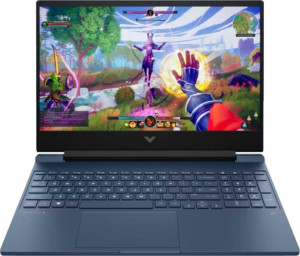
HP Victus 15 (2025) 15.6"

Manufacturer: HP

The HP Victus 15 (2025) is a 15.6″ gaming laptop built around a configuration that balances everyday usability with gaming-oriented hardware. It carries a backlit keyboard, stereo speakers, a front camera, and a 3.5mm audio jack, all housed in a chassis measuring 357 x 255 x 23mm and weighing approximately 2290g. The system ships with a 70Wh battery rated for a one-hour charge time and supports sleep-and-charge via USB, making it reasonably practical for desk-to-desk use.

On the performance side, the machine is equipped with 64GB of DDR5 RAM running at 5600MHz across two memory slots, paired with 4TB of NVMe PCIe 4.0 SSD storage. The CPU operates at up to 4.7GHz turbo across 12 threads, built on a 4nm process with a 35W TDP and 16MB of L3 cache. The dedicated GPU is based on the Ada Lovelace architecture, offering 6GB of GDDR6 VRAM on a 96-bit bus, a boost clock of 2700MHz, and floating-point performance rated at 12.13 TFLOPS, with support for DirectX 12, ray tracing, and DLSS. The display runs at 1920x1080 resolution with a 144Hz refresh rate, 300 nits of brightness, and an anti-reflection IPS panel.

Pros
  • 64GB of DDR5 RAM with support for up to 256GB gives the system substantial headroom for memory-intensive tasks
  • The 4TB NVMe PCIe 4.0 SSD provides generous local storage without relying on slower drive technology
  • A 144Hz IPS display with anti-reflection coating makes it practical for extended gaming or work sessions in varied lighting
  • The 70Wh battery charges fully in one hour, reducing downtime between uses
  • Sleep-and-charge USB support allows connected devices to charge even when the laptop is powered down
  • Support for ray tracing and DLSS expands compatibility with modern graphically demanding titles
Cons
  • At 2290g, the chassis is on the heavier side for a 15.6-inch laptop, making it less convenient to carry frequently
  • The display is capped at 1920x1080 resolution, which at 15.6 inches results in a pixel density of only 141 ppi
  • No Thunderbolt 3 or Thunderbolt 4 ports are present, limiting high-bandwidth peripheral and external display options
  • There is no fingerprint scanner or facial recognition, so biometric login is not available
  • The absence of a DisplayPort output restricts video connectivity to a single HDMI port
  • No external memory card slot means expanding accessible storage requires USB-based solutions
Who is this for?

This laptop suits users who need a capable gaming and productivity machine at a fixed desk or home setup, where its 2290g weight is less of a concern. The 144Hz IPS display with ray tracing and DLSS support makes it a practical choice for gamers who want smoother visuals and modern rendering features without building a dedicated desktop. The 64GB of DDR5 RAM paired with a 4TB NVMe SSD also makes it well-suited for content creators or power users who run memory-heavy applications and need substantial local storage, while the one-hour charge time and sleep-and-charge USB support add a degree of everyday practicality.

Who is this NOT for?

Users who frequently work on the move will find the 2290g chassis and relatively bulky dimensions inconvenient for regular commuting or travel. The 1920x1080 resolution at 141 ppi may not satisfy professionals who rely on sharp detail for tasks such as photo editing, video color grading, or high-resolution design work, where a denser panel would be more appropriate. Additionally, the absence of Thunderbolt ports and a single HDMI output make this a poor fit for users who need to connect multiple high-bandwidth peripherals or drive several external displays simultaneously in a professional multi-monitor setup.

Design:

Type Gaming
weight 2290 g
Uses a fanless design
Has a backlit keyboard
warranty period 1 years
volume 2093.805 cm³
width 357 mm
height 255 mm
thickness 23 mm
is weather-sealed (splashproof)
has a rugged build

The HP Victus 15 (2025) is a gaming laptop with a weight of 2290g and a compact footprint of 357 x 255mm at 23mm thick, giving it a total volume of roughly 2093.8 cm³. It features a backlit keyboard and uses an active cooling design rather than a fanless setup. The build is neither rugged nor weather-sealed, and it does not carry any splash-resistance rating. The device comes with a one-year warranty.

Display:

screen size 15.6"
resolution 1920 x 1080 px
pixel density 141 ppi
Display type LCD, LED-backlit, IPS
has a touch screen
brightness (typical) 300 nits
refresh rate 144Hz
has anti-reflection coating
supported displays 4

The laptop features a 15.6″ LCD IPS panel with LED backlighting, delivering a resolution of 1920 x 1080 pixels at a pixel density of 141 ppi. The display runs at a 144Hz refresh rate, making it well-suited for gaming workloads, and offers a typical brightness of 300 nits alongside an anti-reflection coating to reduce glare. It does not support touch input, but the system can drive up to 4 displays simultaneously.

Performance:

RAM 64GB
RAM speed 5600 MHz
Uses flash storage
internal storage 4096GB
CPU speed 2 x 3.55 & 4 x 3.2 GHz
CPU threads 12 threads
VRAM 6GB
floating-point performance 12.13 TFLOPS
GDDR version GDDR6
texture rate 204.8 GTexels/s
pixel rate 113.76 GPixel/s
Is an NVMe SSD
DirectX version DirectX 12
GPU clock speed 800 MHz
uses multithreading
maximum memory amount 256GB
DDR memory version 5
turbo clock speed 4.7GHz
GPU turbo 2700 MHz
memory slots 2
PCI Express (PCIe) version 4
semiconductor size 4 nm
has XeSS (XMX)
Supports 64-bit

The system is equipped with 64GB of DDR5 RAM running at 5600MHz across two memory slots, with a maximum supported capacity of 256GB. Storage is handled by a 4096GB NVMe SSD connected via PCIe 4.0, using flash-based technology for fast read and write access. The CPU operates across 12 multithreaded cores at speeds up to 4.7GHz turbo, built on a 4nm process, and supports 64-bit instruction sets. On the graphics side, the dedicated GPU carries 6GB of GDDR6 VRAM, a base clock of 800MHz boosting up to 2700MHz, and delivers 12.13 TFLOPS of floating-point performance alongside a texture rate of 204.8 GTexels/s and a pixel rate of 113.76 GPixel/s, with full DirectX 12 support. XeSS (XMX) is not supported.

Benchmarks:

PassMark (G3D) result 17148
PassMark result 19033
PassMark result (single) 3546

In PassMark testing, the laptop scores 19033 in the overall CPU benchmark and 3546 in the single-core test, reflecting its multi-threaded processing capability alongside more modest single-core throughput. The GPU achieves a PassMark G3D score of 17148, indicating its capacity for graphics-intensive workloads.

Connectivity:

USB 3.2 Gen 2 ports (USB-C) 1
USB 3.2 Gen 2 ports (USB-A) 2
USB 4 20Gbps ports 0
USB 4 40Gbps ports 0
Thunderbolt 4 ports 0
USB 3.2 Gen 1 ports (USB-C) 0
USB 3.2 Gen 1 ports (USB-A) 0
Thunderbolt 3 ports 0
has an HDMI output
Has USB Type-C
supports Wi-Fi
Wi-Fi version Wi-Fi 6 (802.11ax), Wi-Fi 5 (802.11ac), Wi-Fi 4 (802.11n)
has an external memory slot
Bluetooth version 5.4
RJ45 ports 1
HDMI ports 1
DisplayPort outputs 0
USB 2.0 ports 0
has AirPlay
mini DisplayPort outputs 0
has a VGA connector

The laptop's port selection includes one USB 3.2 Gen 2 Type-C port and two USB 3.2 Gen 2 Type-A ports, while there are no USB 2.0, USB 4, Thunderbolt 3, or Thunderbolt 4 ports present. Video output is handled by a single HDMI port, with no DisplayPort, mini DisplayPort, or VGA connector available. Wired networking is covered by one RJ45 port, and wireless connectivity spans Wi-Fi 6 (802.11ax) along with backward-compatible Wi-Fi 5 and Wi-Fi 4 standards. Bluetooth 5.4 is also supported, as is AirPlay. There is no external memory card slot on this model.

Battery:

battery size 70 Wh
charge time 1 hours
Has sleep-and-charge USB ports
Has a MagSafe power adapter

The laptop houses a 70Wh battery with a rated charge time of one hour, allowing for relatively quick turnaround between sessions. It supports sleep-and-charge through its USB ports, enabling connected devices to be charged even when the laptop is not actively running. A MagSafe power adapter is not included or supported.

Features:

has stereo speakers
has a socket for a 3.5 mm audio jack
supports ray tracing
supports DLSS
has Dolby Atmos
Stylus included
Has a fingerprint scanner
number of microphones 1
Uses 3D facial recognition
has voice commands
has a front camera
Has S/PDIF Out port
has a gyroscope
has GPS
has an accelerometer
has a compass
Has an optical disc drive

For audio, the laptop includes stereo speakers and a 3.5mm headset jack, though it does not support Dolby Atmos or an S/PDIF output. A single microphone and a front-facing camera are built in, while biometric options such as a fingerprint scanner and 3D facial recognition are absent, as are voice commands. On the gaming side, the machine supports both ray tracing and DLSS, adding to its credentials as a gaming-oriented system. No stylus is included, and the laptop lacks motion and positioning sensors including a gyroscope, accelerometer, compass, and GPS. An optical disc drive is not part of the build.

Miscellaneous:

clock multiplier 32
Type Desktop, Laptop
Has NX bit
instruction sets MMX, F16C, FMA3, AES, AVX, AVX2, SSE 4.1, SSE 4.2
Has an unlocked multiplier
L3 cache 16 MB
L2 cache 6 MB
render output units (ROPs) 8
texture mapping units (TMUs) 16
shading units 256
OpenCL version 2.1
OpenGL version 4.6
GPU name Radeon 740M
Has integrated graphics
Supports ECC memory
memory channels 2
RAM speed (max) 7500 MHz
CPU temperature 100 °C
Thermal Design Power (TDP) 35W
Uses big.LITTLE technology
number of transistors 18900 million
AMD SAM / Intel Resizable BAR Intel Resizable BAR
has LHR
Supports 3D
Supports multi-display technology
memory bus width 96-bit
effective memory speed 16000 MHz
maximum memory bandwidth 192 GB/s
Has Double Precision Floating Point (DPFP)
GPU memory speed 2000 MHz
GPU architecture Ada Lovelace

The CPU carries a clock multiplier of 32, an unlocked multiplier, a 35W TDP, and a maximum operating temperature of 100°C, with big.LITTLE technology in use across its cores. It supports a broad set of instruction sets including MMX, F16C, FMA3, AES, AVX, AVX2, SSE 4.1, and SSE 4.2, along with NX bit and Double Precision Floating Point. Cache configuration sits at 16MB of L3 and 6MB of L2, and the processor is built with 18,900 million transistors. The dedicated GPU is based on the Ada Lovelace architecture and is complemented by a Radeon 740M integrated graphics unit. It features 256 shading units, 16 TMUs, and 8 ROPs, with a memory bus width of 96 bits, a GPU memory speed of 2000 MHz, an effective memory speed of 16,000 MHz, and a maximum memory bandwidth of 192 GB/s. The system supports OpenCL 2.1, OpenGL 4.6, stereoscopic 3D, and multi-display output, and uses Intel Resizable BAR. RAM can reach speeds of up to 7500 MHz across two memory channels, though ECC memory is not supported. LHR is not present on this configuration.
Final Verdict

The HP Victus 15 (2025) is a gaming laptop that makes a solid case for users who want a capable, storage-rich system built around a fixed or semi-fixed setup. Its combination of 64GB DDR5 RAM, a 4TB NVMe SSD, and a 144Hz IPS display with ray tracing and DLSS support gives it genuine substance for both gaming and demanding productivity workloads. That said, its weight, modest display resolution, and limited external display connectivity mean it works best for users who prioritize raw performance over portability or multi-monitor flexibility. For those whose needs align with its strengths, the Victus 15 (2025) delivers a well-specified configuration that holds up well in its intended role.