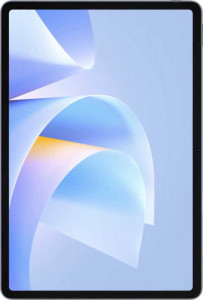
The Huawei MatePad 11.5 (2026) measures 262.6 × 177.5 mm with a thickness of just 6.1 mm and a weight of 515 g, giving it a volume of approximately 284.33 cm³. The device does not include a stylus, a detachable keyboard, or backlit keyboard support, and tilt sensitivity is absent as well. There is no water resistance rating for this model, so it offers no certified protection against moisture exposure.
The display on the Huawei MatePad 11.5 (2026) is an 11.5″ LCD touch panel running at a resolution of 2456 × 1600 px, which translates to a pixel density of 255 ppi, and it supports a 120Hz refresh rate for fluid on-screen motion. The tablet also features an e-paper display mode, adding versatility for reading-oriented use. However, the screen lacks branded damage-resistant glass, an anti-reflection coating, and does not support HDR10, HDR10+, or Dolby Vision, nor does it use sapphire glass for added protection.
The Huawei MatePad 11.5 (2026) is equipped with a processor built on a 7 nm semiconductor process, featuring a multi-core configuration running at 2 × 2.28 GHz, 6 × 2.05 GHz, and 4 × 1.3 GHz, paired with 12GB of RAM and 256GB of internal storage — with no external memory slot available for expansion. The chip supports 64-bit processing and includes integrated graphics handled by the Maleoon 920c GPU. In Geekbench 6 benchmarks, the tablet scores 1310 in the single-core test and 3754 in the multi-core test, reflecting the overall processing capability of this configuration.
The Huawei MatePad 11.5 (2026) features a 13 MP rear camera with an f/1.8 aperture and a CMOS sensor, capable of recording video at 1080p and 30fps, with continuous autofocus active during recording. Manual controls are available for focus, exposure, ISO, and white balance, while HDR mode is supported for still photography. The front camera comes in at 8 MP with an f/2.2 aperture and is present for video calls and selfies, though it lacks a front-facing flash. Neither camera offers optical zoom, optical image stabilization, slow-motion recording, timelapse, burst mode, panorama, HDR10 or Dolby Vision recording, a back-illuminated sensor, or any flash unit on the rear — and 3D capture and manual shutter speed control are also absent.
The Huawei MatePad 11.5 (2026) includes stereo speakers for audio output, but does not feature a 3.5 mm headphone jack or a built-in radio. On the wireless audio side, none of the high-quality Bluetooth codec options are supported — there is no aptX, aptX HD, aptX Low Latency, aptX Adaptive, aptX Lossless, or LDAC, which limits lossless and low-latency wireless audio transmission to compatible devices.
The Huawei MatePad 11.5 (2026) is fitted with a 10100 mAh rechargeable battery that provides a battery level indicator so users can monitor remaining charge at a glance. The battery is non-removable and does not support fast charging or wireless charging, meaning it relies solely on standard wired charging to replenish power.
The Huawei MatePad 11.5 (2026) supports Wi-Fi 4, 5, and 6 (802.11n/ac/ax) alongside Bluetooth 5.2, and connects to other devices via a USB Type-C port running USB 2.0. On the software side, the tablet offers a range of usability features including split-screen multitasking, dark mode, widgets, customizable notifications, sharing intents, voice commands, child lock, multi-user support, battery health check, and camera/microphone privacy controls. An accelerometer is present, and the device supports mobile device position tracking, but it lacks a gyroscope, compass, barometer, GPS, and Galileo satellite support. Biometric security options are absent — there is no fingerprint scanner, iris scanner, or 3D facial recognition. The tablet does not include a cellular module, 5G support, NFC, HDMI output, Ethernet, or an infrared sensor, and it does not receive direct OS updates from the vendor.
The Huawei MatePad 11.5 (2026) uses DDR5 memory and supports multithreading, allowing the processor to handle multiple threads simultaneously for more efficient task execution.