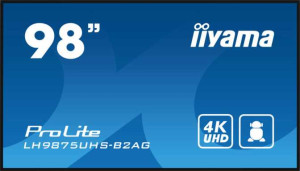
iiyama Prolite LH9875UHS-B2AG 98" specifications and in-depth review

iiyama Prolite LH9875UHS-B2AG 98"

Manufacturer: iiyama

The iiyama Prolite LH9875UHS-B2AG is a large-format 97.5-inch monitor built around an IPS panel with LED backlighting, designed for environments where screen real estate and image consistency matter. With 3840x2160 pixel resolution spread across its expansive display area, it delivers a pixel density of 45 ppi alongside wide 178-degree viewing angles both horizontally and vertically. The panel features a matte, anti-glare coating, making it practical in spaces with varied ambient lighting conditions.

On the connectivity side, the display offers three HDMI 2.0 ports, one DisplayPort 1.4 output, a VGA connector, two USB ports, a 3.5mm audio jack, and built-in Ethernet alongside Wi-Fi 5 (802.11ac) and Wi-Fi 4 (802.11n) wireless support. Stereo speakers rated at 2x16W are integrated into the unit. The monitor has an operating power draw of 331W, a standby consumption of just 0.5W, and supports VESA mounting as well as portrait orientation. It weighs approximately 77.8 kg and carries an EU energy label of F.

Pros
  • The 97.5-inch IPS panel with 178-degree viewing angles both horizontally and vertically ensures consistent image quality from virtually any position in the room
  • Built-in Wi-Fi 5 and Ethernet support allow flexible network connectivity without relying solely on wired infrastructure
  • Three HDMI 2.0 ports and a DisplayPort 1.4 output provide multiple simultaneous source connections for varied setups
  • Integrated stereo speakers rated at 2x16W deliver a reasonable level of onboard audio output without requiring additional hardware
  • VESA mount compatibility and portrait mode support offer meaningful installation flexibility for different deployment environments
  • Standby power consumption of just 0.5W keeps idle energy use very low despite the large display size
Cons
  • At 77.8 kg, the monitor is extremely heavy, making installation and repositioning a significant logistical challenge
  • The 8ms response time and 60Hz refresh rate with no adaptive synchronization make this display unsuitable for fast-motion or gaming use cases
  • An EU energy label of F indicates relatively high energy consumption during operation, with a rated draw of 331W
  • The 45 ppi pixel density across a 97.5-inch panel results in a comparatively low sharpness level for close viewing distances
  • No swivel stand is included, limiting lateral adjustment options once the monitor is positioned
  • Color calibration is not supported, which may be a drawback in workflows where precise color accuracy needs to be verified or adjusted
Who is this for?

This monitor is well suited to environments where a large shared display surface is a practical necessity, such as meeting rooms, control rooms, digital signage installations, or public information displays. The 97.5-inch IPS panel with 178-degree viewing angles in both directions ensures that content remains legible and consistent even when viewed from the sides or at a distance. Its built-in Wi-Fi 5 and Ethernet connectivity, combined with three HDMI 2.0 inputs and a DisplayPort 1.4 output, make it straightforward to integrate into multi-source or networked display setups. The inclusion of VESA mount support and portrait mode compatibility also makes it a practical fit for installations requiring a fixed or custom-mounted configuration.

Who is this NOT for?

This display is not well suited to users who need fast-motion or interactive visual performance, as its 60Hz refresh rate, 8ms response time, and complete absence of adaptive synchronization technology make it a poor match for gaming or any application sensitive to motion clarity. The 45 ppi pixel density spread across such a large panel means that users working at close range — such as in graphic design, photo editing, or fine detail work — are likely to find the image sharpness insufficient for their needs. Its weight of nearly 78 kg and the absence of a swivel stand also rule it out for anyone needing a display that can be easily repositioned or adjusted on a regular basis.

Display:

Display type IPS, LCD, LED-backlit
response time 8 ms
screen size 97.5"
resolution 3840 x 2160 px
pixel density 45 ppi
Adaptive synchronization None
has anti-glare coating
refresh rate 60Hz
maximum horizontal viewing angle 178º
maximum vertical viewing angle 178º
has a matte panel
has a glossy panel
has a touch screen

The display uses an IPS LCD panel with LED backlighting, spanning a substantial 97.5 inches and rendering content at a 3840x2160 pixel resolution with a pixel density of 45 ppi. It operates at a 60Hz refresh rate with an 8ms response time, and no adaptive synchronization technology is supported. Both horizontal and vertical viewing angles reach 178 degrees, ensuring consistent image quality across a wide range of positions. The panel is matte rather than glossy and features an anti-glare coating, while touch screen functionality is not included.

General info:

Type Standard
EU energy label F
supports total tilt
Has a swivel stand
Supports VESA mount
height 1260 mm
width 2204 mm
thickness 101 mm
weight 77800 g
supports portrait mode
maximum operating temperature 40 °C
lowest potential operating temperature 0 °C
volume 280481.04 cm³

This is a standard-type monitor with a weight of 77.8 kg and physical dimensions of 2204 mm wide, 1260 mm tall, and 101 mm thick. It supports tilt adjustment and portrait mode orientation, though a swivel stand is not included. VESA mounting is supported, offering flexibility for wall or arm installations. The unit carries an EU energy label of F and is rated for operation in environments ranging from 0°C to 40°C.

Colors:

brightness (typical) 500 nits
supports color calibration
display colors 1070 million
bit depth 8-bit
contrast ratio 1200:1

The display offers a typical brightness of 500 nits and a contrast ratio of 1200:1, with an 8-bit panel capable of rendering up to 1070 million colors. Color calibration is not supported. These characteristics reflect a display tuned for consistent, well-lit output across its large screen area.

Connectivity:

HDMI ports 3
supports Thunderbolt
DisplayPort outputs 1
DisplayPort version DisplayPort 1.4
has a socket for a 3.5 mm audio jack
has a DVI connector
USB ports 2
Has USB Type-C
HDMI version HDMI 2.0
supports Ethernet
supports Wi-Fi
Wi-Fi version Wi-Fi 5 (802.11ac), Wi-Fi 4 (802.11n)
has AirPlay
mini DisplayPort outputs 0
has a VGA connector

The monitor provides a broad range of wired and wireless connectivity options, including three HDMI 2.0 ports, one DisplayPort 1.4 output, a VGA connector, two USB ports, and a 3.5mm audio jack. Ethernet is supported alongside built-in Wi-Fi, with compatibility for Wi-Fi 5 (802.11ac) and Wi-Fi 4 (802.11n). Thunderbolt, USB Type-C, DVI, mini DisplayPort, and AirPlay are not available on this model.

Power:

operating power consumption 331W
standby power consumption 0.5W

During normal operation, the monitor draws 331W, which is consistent with a large-format display of this size. When idle, standby power consumption drops considerably to just 0.5W.

Features:

has PiP
has stereo speakers
has built-in smart TV
audio output power 2 x 16W
has a remote control
supports Dolby Digital
supports Dolby Digital Plus
has DTS Surround
has an ambient light sensor
has a front camera

The monitor includes built-in stereo speakers rated at 2x16W, providing integrated audio output without the need for external speakers. Picture-in-Picture, smart TV functionality, a remote control, an ambient light sensor, and a front camera are all absent. On the audio side, Dolby Digital, Dolby Digital Plus, and DTS Surround are not supported.

Final Verdict

The iiyama Prolite LH9875UHS-B2AG is a purpose-built large-format display that makes most sense in fixed, professional installation contexts — meeting rooms, control environments, or digital signage setups — where its 97.5-inch IPS panel with wide 178-degree viewing angles and versatile connectivity genuinely add value. The combination of three HDMI 2.0 inputs, DisplayPort 1.4, built-in Wi-Fi, and Ethernet gives it solid integration flexibility, while VESA mount support and portrait mode capability further extend its deployment options. That said, its relatively low pixel density, 60Hz refresh rate, and substantial weight mean it is firmly a specialized tool rather than a general-purpose display. For the environments it is designed for, it delivers a coherent and well-specified package; for anything outside that scope, its limitations become quickly apparent.