iiyama Prolite TE9218UWI-B1AG 92" specifications and in-depth review

iiyama Prolite TE9218UWI-B1AG 92"

Manufacturer: iiyama

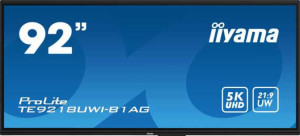
The iiyama Prolite TE9218UWI-B1AG 92″ is a large-format ultrawide monitor built around a 91.5-inch VA LCD panel with LED backlighting. Designed for expansive display environments, its most defining characteristic is the 5120 x 2160 pixel touchscreen, which spans an exceptionally wide canvas suitable for collaborative, presentation, or command-center use cases. The matte panel with anti-glare coating helps manage reflections across such a large surface area, and portrait mode is supported despite the monitor's substantial physical dimensions.

On the technical side, the display delivers 1070 million colors at 10-bit depth with a contrast ratio of 4000:1 and a typical brightness of 500 nits, running at 60Hz with a 6.5 ms response time and no adaptive synchronization. Connectivity is extensive, covering five HDMI 2.1 ports, one DisplayPort 1.4 output, twelve USB ports, USB Type-C, wired Ethernet, Wi-Fi 6, and a 3.5 mm audio jack. Built-in stereo speakers rated at 2 x 20W provide onboard audio without external hardware. The monitor does not include Thunderbolt, VGA, DVI, AirPlay, PiP, a front camera, or an ambient light sensor, and carries an EU energy label of G reflecting its 227W operating power draw.

Pros
  • The 5120 x 2160 pixel resolution across a 91.5-inch VA panel provides an exceptionally wide display area suited to multi-source or collaborative viewing environments
  • Touch screen support across such a large surface enables direct interaction at a scale appropriate for group presentations or control room applications
  • A contrast ratio of 4000:1 combined with 10-bit depth and 1070 million colors results in strong tonal range and color depth for a large-format display
  • The anti-glare matte panel helps reduce reflections across the wide screen surface, improving visibility in varied lighting conditions
  • Connectivity is extensive, with five HDMI 2.1 ports, twelve USB ports, USB Type-C, DisplayPort 1.4, wired Ethernet, and Wi-Fi 6 support all present
  • Built-in stereo speakers rated at 2 x 20W deliver meaningful onboard audio output without requiring external hardware in large-room settings
Cons
  • A pixel density of just 60 ppi across the 91.5-inch panel means image sharpness at close viewing distances is limited
  • The EU energy label of G and 227W operating power consumption reflect a high energy draw during active use
  • No tilt adjustment or swivel stand is available, leaving VESA mounting as the only ergonomic repositioning option
  • At 67,600 g, the monitor's weight makes installation and any physical repositioning a significant logistical undertaking
  • No adaptive synchronization technology is present, which limits smoothness during fast or variable-frame-rate content
  • Color calibration is not supported, so users have no built-in means to adjust color output for accuracy-sensitive applications
Who is this for?

This monitor is built for large-scale, fixed installations where screen size, touch interactivity, and multi-source connectivity are central requirements. Environments such as control rooms, collaborative meeting spaces, and public information displays will benefit from the 91.5-inch ultrawide touchscreen combined with five HDMI 2.1 ports and twelve USB connections, which allow multiple inputs to be managed from a single display. The matte anti-glare panel with Wi-Fi 6 support further suits semi-public or open-plan settings where ambient light and wireless network integration are practical considerations.

Who is this NOT for?

Users who need sharp close-up image quality will be constrained by the 60 ppi pixel density, which is inadequate for desk-level viewing or any use case where fine detail matters. The absence of tilt and swivel adjustments, combined with a weight of 67,600 g, makes this monitor entirely impractical for environments requiring flexible or frequent repositioning. It is also not suited to applications that demand color accuracy or smooth motion rendering, given that color calibration and adaptive synchronization are both absent from the specification set.

Display:

Display type VA, LCD, LED-backlit
response time 6.5 ms
screen size 91.5"
resolution 5120 x 2160 px
pixel density 60 ppi
Adaptive synchronization None
has anti-glare coating
refresh rate 60Hz
maximum horizontal viewing angle 178º
maximum vertical viewing angle 178º
has a matte panel
has a glossy panel
has a touch screen

The display uses a VA LCD panel with LED backlighting spanning 91.5 inches, delivering a resolution of 5120 x 2160 pixels at a pixel density of 60 ppi. It features a matte surface with anti-glare coating and supports touch input, while viewing angles reach 178 degrees both horizontally and vertically. The panel runs at 60Hz with a 6.5 ms response time, has no adaptive synchronization technology, and is not a glossy panel.

General info:

Type Ultrawide
EU energy label G
supports total tilt
Has a swivel stand
Supports VESA mount
height 1000 mm
width 2203 mm
thickness 92 mm
weight 67600 g
supports portrait mode
maximum operating temperature 40 °C
lowest potential operating temperature 0 °C
volume 202676 cm³

This is an ultrawide monitor with substantial physical dimensions, measuring 2203 mm wide, 1000 mm tall, and 92 mm thick, with a total weight of 67,600 g. It supports portrait mode and VESA mounting, though neither tilt adjustment nor a swivel stand is available. The monitor carries an EU energy label of G and is rated to operate within a temperature range of 0 °C to 40 °C.

Colors:

brightness (typical) 500 nits
supports color calibration
display colors 1070 million
bit depth 10-bit
contrast ratio 4000:1

The display is capable of rendering 1070 million colors at 10-bit depth, supported by a contrast ratio of 4000:1 and a typical brightness of 500 nits, resulting in a wide tonal range and strong depth between light and dark areas. Color calibration is not supported, so there is no built-in process for adjusting color accuracy to a specific standard.

Connectivity:

HDMI ports 5
supports Thunderbolt
DisplayPort outputs 1
DisplayPort version DisplayPort 1.4
has a socket for a 3.5 mm audio jack
has a DVI connector
USB ports 12
Has USB Type-C
HDMI version HDMI 2.1
supports Ethernet
supports Wi-Fi
Wi-Fi version Wi-Fi 6 (802.11ax), Wi-Fi 5 (802.11ac), Wi-Fi 4 (802.11n)
has AirPlay
mini DisplayPort outputs 0
has a VGA connector

The monitor offers an extensive range of connectivity options, including five HDMI 2.1 ports, one DisplayPort 1.4 output, twelve USB ports, USB Type-C, wired Ethernet, and a 3.5 mm audio jack. Wireless connectivity is covered by Wi-Fi 6 (802.11ax), with backward compatibility for Wi-Fi 5 and Wi-Fi 4. Thunderbolt, DVI, VGA, mini DisplayPort, and AirPlay are not supported.

Power:

operating power consumption 227W
standby power consumption 0.5W

The monitor draws 227W during active operation, reflecting the demands of powering such a large-format display, while standby power consumption drops significantly to just 0.5W when the screen is idle.

Features:

has PiP
has stereo speakers
has built-in smart TV
audio output power 2 x 20W
has a remote control
supports Dolby Digital
supports Dolby Digital Plus
has DTS Surround
has an ambient light sensor
has a front camera

The monitor includes built-in stereo speakers rated at 2 x 20W, providing a substantial onboard audio output suited to large-room environments. It does not support Dolby Digital, Dolby Digital Plus, or DTS Surround audio formats, and there is no remote control, ambient light sensor, front camera, PiP functionality, or smart TV platform present.
Final Verdict

The iiyama Prolite TE9218UWI-B1AG 92″ is a highly specialized large-format display that makes a strong case for itself in fixed, institutional, or collaborative environments where sheer screen coverage and versatile input management are the top priorities. Its 91.5-inch ultrawide touchscreen with 10-bit color depth, a 4000:1 contrast ratio, and extensive multi-port connectivity give it a well-defined purpose in control rooms, presentation spaces, and similar professional settings. The trade-offs — including a low pixel density, high power consumption, and the absence of ergonomic adjustability — are significant, but they are largely irrelevant within the specific contexts this monitor is designed to serve. For organizations seeking a large-scale interactive display with broad connectivity and solid onboard audio, it represents a coherent and purpose-driven solution.