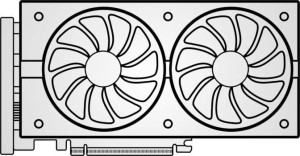
Inno3D GeForce RTX 5050 Compact specifications and in-depth review

Inno3D GeForce RTX 5050 Compact

Manufacturer: Inno3D

The Inno3D GeForce RTX 5050 Compact is a compact-form graphics card based on NVIDIA's Blackwell architecture, measuring 148 mm wide and 118 mm in height. It features 2560 shading units alongside support for ray tracing and DLSS, making it a capable option within its segment. With a 130W thermal design power, the card is positioned toward systems where power draw and physical footprint are relevant considerations. It connects via PCIe 5.0 and supports up to four displays simultaneously.

On the memory side, the card carries 8GB of GDDR6 VRAM across a 128-bit bus, delivering a maximum bandwidth of 320 GB/s at an effective memory speed of 20000 MHz. The GPU operates at a base clock of 2317 MHz with a turbo frequency reaching 2572 MHz, yielding a texture rate of 205.8 GTexels/s and a pixel rate of 82.3 GPixels/s. Display output is handled through one HDMI 2.1b port and three DisplayPort connections, with no USB-C or DVI outputs present. The card is manufactured on a 5 nm process node and incorporates approximately 16.9 billion transistors, with support for DirectX 12 Ultimate, OpenGL 4.6, and OpenCL 3.

Pros
  • Compact physical dimensions of 148 mm x 118 mm make it suitable for small form factor builds where card length and height are constrained
  • Support for ray tracing and DLSS expands rendering options for compatible workloads
  • Four display outputs — one HDMI 2.1b and three DisplayPort — allow flexible multi-monitor setups without additional hardware
  • ECC memory support adds data integrity reliability for compute-sensitive tasks
  • Intel Resizable BAR support enables the CPU to access the full VRAM pool, which can improve frame delivery in supported scenarios
  • PCIe 5.0 interface ensures compatibility with current-generation platforms without bandwidth limitations
Cons
  • 128-bit memory bus width limits memory bandwidth scaling compared to wider configurations in the same category
  • 8GB of VRAM may become a constraint in workloads or applications that require larger framebuffer allocations
  • No USB-C display output restricts connectivity options for monitors or displays that rely solely on that interface
  • Absence of water cooling support limits thermal management options for users building in thermally constrained enclosures
  • No RGB lighting for users whose builds incorporate coordinated lighting aesthetics
Who is this for?

This card is a practical fit for users building small form factor systems, given its compact 148 mm x 118 mm dimensions that ease installation in constrained cases. Its support for ray tracing, DLSS, and DirectX 12 Ultimate makes it a reasonable choice for general gaming and graphics workloads at moderate settings, while ECC memory support and Double Precision Floating Point capability also make it applicable to users running compute or data-integrity-sensitive tasks. The four-display output configuration, combining HDMI 2.1b and three DisplayPort connections, suits users who need multi-monitor setups within a compact build.

Who is this NOT for?

Users pursuing high-resolution or memory-intensive workloads — such as large texture rendering, extensive 3D scene processing, or AI model inference with large datasets — may find the 8GB VRAM and 128-bit memory bus insufficient for sustained performance. The card also lacks USB-C display output, making it a poor match for users whose monitor ecosystem relies on that connection type. Additionally, those who require advanced thermal management flexibility, such as custom liquid cooling loops, will find no support for water cooling, which may be a drawback in thermally demanding or acoustically sensitive environments.

Performance:

GPU clock speed 2317 MHz
GPU turbo 2572 MHz
pixel rate 82.3 GPixel/s
floating-point performance 13.17 TFLOPS
texture rate 205.8 GTexels/s
GPU memory speed 2500 MHz
shading units 2560
texture mapping units (TMUs) 80
render output units (ROPs) 32
Has Double Precision Floating Point (DPFP)

The Performance section of the Inno3D GeForce RTX 5050 Compact reveals a GPU base clock of 2317 MHz that boosts up to 2572 MHz in turbo mode, supported by 2560 shading units and 80 texture mapping units delivering a texture rate of 205.8 GTexels/s. The pixel rate sits at 82.3 GPixel/s, handled through 32 render output units, while overall floating-point performance reaches 13.17 TFLOPS. GPU memory operates at a speed of 2500 MHz, and the card includes support for Double Precision Floating Point, broadening its suitability for compute-oriented workloads alongside standard graphics tasks.

Memory:

effective memory speed 20000 MHz
maximum memory bandwidth 320 GB/s
VRAM 8GB
GDDR version GDDR6
memory bus width 128-bit
Supports ECC memory

The card is equipped with 8GB of GDDR6 VRAM running across a 128-bit memory bus, reaching an effective memory speed of 20000 MHz and a maximum bandwidth of 320 GB/s. ECC memory support is included, which adds a layer of reliability for workloads where data integrity is a priority.

Features:

DirectX version DirectX 12 Ultimate
OpenGL version 4.6
OpenCL version 3
Supports multi-display technology
supports ray tracing
Supports 3D
supports DLSS
has XeSS (XMX)
AMD SAM / Intel Resizable BAR Intel Resizable BAR
has LHR
has RGB lighting
supported displays 4

The card supports DirectX 12 Ultimate, OpenGL 4.6, and OpenCL 3, covering a broad range of graphics and compute APIs. Ray tracing and DLSS are both supported, while XeSS (XMX) is not present. Multi-display technology is included with support for up to four simultaneous displays, and stereoscopic 3D is also available. Intel Resizable BAR is supported, whereas LHR is not in effect and the card does not feature RGB lighting.

Ports:

has an HDMI output
HDMI ports 1
HDMI version HDMI 2.1b
DisplayPort outputs 3
USB-C ports 0
DVI outputs 0
mini DisplayPort outputs 0

The card's output configuration consists of one HDMI 2.1b port and three DisplayPort outputs, providing a total of four physical connections for display use. There are no USB-C, DVI, or mini DisplayPort outputs present on this card.

General info:

GPU architecture Blackwell
Thermal Design Power (TDP) 130W
PCI Express (PCIe) version 5
semiconductor size 5 nm
number of transistors 16900 million
Has air-water cooling
width 148 mm
height 118 mm

Built on the Blackwell architecture and fabricated using a 5 nm process, the GPU integrates 16,900 million transistors and connects to the system via PCIe 5.0. It carries a thermal design power of 130W and relies on air cooling, with no water cooling option included. The card measures 148 mm in width and 118 mm in height, reflecting its compact physical footprint.

Final Verdict

The Inno3D GeForce RTX 5050 Compact presents itself as a well-defined option for users whose priorities revolve around compact system integration without foregoing support for modern graphics features like ray tracing, DLSS, and DirectX 12 Ultimate. Its 130W TDP, 5 nm fabrication, and restrained physical dimensions make it a coherent fit for small form factor builds, while ECC memory support and Double Precision Floating Point capability extend its relevance into light compute scenarios. That said, the 8GB VRAM ceiling and 128-bit bus are real constraints that define its ceiling for more demanding workloads. For users whose needs align with its strengths — principally compact builds, multi-display output, and moderate graphics tasks — the RTX 5050 Compact delivers a focused and purposeful specification set that holds together well within its intended scope.

Popular Comparisons

Inno3D GeForce RTX 5050 Compact
VS
Sapphire Pulse Radeon RX 7600 XT