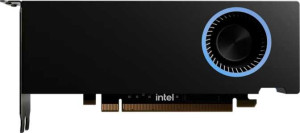
Intel Arc Pro B50 specifications and in-depth review

Intel Arc Pro B50

Manufacturer: Intel

The Intel Arc Pro B50 is a professional-grade graphics card designed for a variety of high-performance computing tasks. Equipped with 16GB of GDDR6 VRAM, this card offers a solid foundation for demanding workloads and applications.

With a base GPU clock speed of 1700 MHz and a turbo boost of 2600 MHz, the Intel Arc Pro B50 delivers impressive performance. It also supports DirectX 12 Ultimate and features a maximum memory bandwidth of 224 GB/s, making it suitable for modern graphical workloads and multi-display setups.

Pros
  • Supports up to 4 displays simultaneously, making it suitable for multi-monitor setups.
  • Equipped with 16GB of GDDR6 VRAM, providing ample memory for demanding graphical tasks.
  • Supports ray tracing for enhanced visual effects in compatible applications.
  • Has ECC memory support for error correction, increasing reliability in professional workloads.
Cons
  • Lacks HDMI, DisplayPort, and USB-C outputs, limiting connectivity options.
  • Does not support DLSS, which could reduce graphical performance in compatible games.
  • No air-water cooling system, which may limit thermal management for extended high-performance use.
Who is this for?

The Intel Arc Pro B50 is well-suited for professionals working with graphical workloads requiring stable and reliable performance. With 16GB of GDDR6 VRAM and support for ray tracing, it excels in tasks such as 3D rendering, video editing, and other resource-intensive applications. Its multi-display technology makes it ideal for users who need to manage multiple monitors simultaneously, providing flexibility in complex workflows or multi-monitor setups.

Who is this NOT for?

This graphics card may not be suitable for gamers or users who prioritize cutting-edge gaming features. It lacks support for DLSS, which could impact performance in games that benefit from it. Additionally, the absence of HDMI and DisplayPort outputs limits connectivity options, making it less ideal for users who require broader display compatibility or high-speed connections to a variety of devices. Its lack of air-water cooling may also be a concern for those using it in extended high-performance environments.

Performance:

GPU clock speed 1700 MHz
GPU turbo 2600 MHz
pixel rate 41.6 GPixel/s
floating-point performance 10.65 TFLOPS
texture rate 332.8 GTexels/s
GPU memory speed 1750 MHz
shading units 2048
texture mapping units (TMUs) 128
render output units (ROPs) 16
Has Double Precision Floating Point (DPFP)

The performance of the Intel Arc Pro B50 is driven by its solid specifications, including a base GPU clock speed of 1700 MHz, with a turbo boost of up to 2600 MHz for demanding tasks. It offers a floating-point performance of 10.65 TFLOPS and a pixel rate of 41.6 GPixel/s, ensuring smooth graphics processing. Additionally, the card supports 2048 shading units and 128 texture mapping units, providing enhanced rendering power. With a memory speed of 1750 MHz and 16 ROPs, it handles high-performance workloads efficiently. The card also supports double precision floating point (DPFP), ensuring accuracy for professional applications.

Memory:

effective memory speed 14000 MHz
maximum memory bandwidth 224 GB/s
VRAM 16GB
GDDR version GDDR6
memory bus width 128-bit
Supports ECC memory

The Intel Arc Pro B50 comes equipped with 16GB of GDDR6 VRAM, ensuring ample memory for demanding graphical tasks. Its effective memory speed is 14000 MHz, while the memory bus width is 128-bit, allowing for efficient data handling. With a maximum memory bandwidth of 224 GB/s, it supports high-speed data transfers. Additionally, the card supports ECC memory, providing error correction for enhanced reliability in professional applications.

Features:

DirectX version DirectX 12 Ultimate
OpenGL version 4.6
OpenCL version 3
Supports multi-display technology
supports ray tracing
Supports 3D
supports DLSS
has XeSS (XMX)
has LHR
has RGB lighting
supported displays 4

The Intel Arc Pro B50 supports a range of advanced features, including DirectX 12 Ultimate for cutting-edge graphics, ray tracing for enhanced visual effects, and multi-display technology for connecting multiple monitors. It also supports XeSS (XMX) for improved image quality, along with stereoscopic 3D for immersive viewing experiences. The card can drive up to 4 displays simultaneously, but does not support DLSS or RGB lighting.

Ports:

has an HDMI output
DisplayPort outputs 0
USB-C ports 0
DVI outputs 0
mini DisplayPort outputs 4

The Intel Arc Pro B50 features 4 mini DisplayPort outputs for connecting displays, but does not include HDMI, DisplayPort, or USB-C ports. Additionally, it lacks DVI outputs, making mini DisplayPort the primary video output option for multiple displays.

General info:

GPU architecture Xe2-HPG
release date September 2025
Thermal Design Power (TDP) 70W
PCI Express (PCIe) version 5
semiconductor size 5 nm
number of transistors 19600 million
Has air-water cooling
width 167 mm
height 69 mm

The Intel Arc Pro B50 is built on the Xe2-HPG GPU architecture with a 5 nm semiconductor size, housing 19.6 billion transistors. It operates with a 70W Thermal Design Power (TDP) and supports PCIe 5.0 for fast data transfer. The card measures 167 mm in width and 69 mm in height, but does not feature air-water cooling.

Final Verdict

The Intel Arc Pro B50 is a solid choice for professional users seeking a reliable graphics card for demanding workloads, offering a generous 16GB of GDDR6 VRAM and strong multi-display support. Its performance in tasks like 3D rendering and video editing is enhanced by ray tracing capabilities, making it a strong contender for graphics-intensive applications. However, its lack of DLSS support and limited connectivity options may hinder its appeal for gaming or users needing broader display compatibility. Overall, it's a well-rounded option for professionals who prioritize stability and high-quality graphics performance.