Jackery Explorer 240 v2 specifications and in-depth review

Jackery Explorer 240 v2

Manufacturer: Jackery

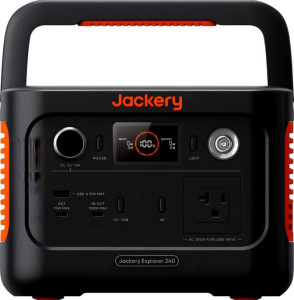
The Jackery Explorer 240 v2 is a compact portable power station designed for users who need reliable off-grid power in a manageable form factor. Weighing 3,600 g and built with a carry handle, it strikes a practical balance between portability and capacity. Its 256 Wh battery can be recharged via AC wall outlet in as little as two hours, making it a flexible option for a range of use cases. A built-in display, LED light, and smartphone app support via Wi-Fi and Bluetooth round out the feature set.

On the output side, the Explorer 240 v2 provides five ports in total: one AC outlet rated at 300 W continuous and 600 W peak, two USB-C ports, one USB-A port, and one car port. Solar charging is supported at up to 100 W input, with a full charge achievable in approximately 3.3 hours under optimal conditions. The unit also includes a UPS mode with a 20 ms switchover speed, and the LFP battery is rated for 3,000 charge cycles. A five-year warranty is included.

Pros
  • The 3,000-cycle battery lifecycle points to long-term durability for repeated use
  • UPS mode with a 20 ms switchover speed provides reliable protection for sensitive devices during power interruptions
  • Supports both Wi-Fi and Bluetooth, enabling full smartphone remote control
  • Recharges via AC in just two hours, keeping downtime short
  • The carry handle and sub-3.6 kg weight make it genuinely easy to move around
  • A five-year warranty offers solid long-term coverage for a portable power unit
Cons
  • A single AC outlet limits the ability to run multiple mains-powered devices simultaneously
  • Car charging takes up to five hours, making it a slow option when AC power is unavailable
  • No wireless charging pad, so devices must rely solely on wired port connections
  • The 300 W continuous AC output may not be sufficient for higher-draw appliances
Who is this for?

This unit is a practical fit for users who need a portable backup power source for light off-grid or outdoor use, such as camping trips, van travel, or weekend getaways where running small electronics and USB-charged devices is the priority. The two-hour AC recharge time and 3,000-cycle battery lifecycle make it a reliable option for those who plan to use it regularly over many years. Its built-in UPS mode with a 20 ms switchover also suits anyone looking to protect sensitive equipment — such as a router or small workstation — from brief power interruptions at home or in a small office setting. The carry handle and manageable weight make it easy to move between locations without assistance.

Who is this NOT for?

Users who need to power high-draw appliances — such as electric skillets, power tools, or space heaters — will find the 300 W continuous AC output insufficient for sustained operation. The single AC outlet also limits scenarios where multiple mains-powered devices need to run simultaneously. Similarly, anyone planning to rely on solar as a primary charging method in variable conditions may find the 3.3-hour solar charge time restrictive, particularly since it depends on achieving the full 100 W solar input. It is also not suited for extended off-grid stays where a much larger battery capacity would be needed to cover overnight or multi-day energy demands.

Power:

AC output 300 W
battery size 256 Wh
AC output (peak) 600 W
charge time 2 h
charge time (solar) 3.3 h
charge time (car) 5 h
solar input (max) 100 W

The Explorer 240 v2 carries a 256 Wh battery and delivers a continuous AC output of 300 W, with a peak capacity of 600 W to handle brief power spikes. Recharging via a standard AC outlet takes around two hours, while solar charging — supported at up to 100 W input — brings that time to approximately 3.3 hours. Car charging is also available, though it takes longer at roughly five hours for a full charge.

Ports:

number of outputs (total) 5
AC ports 1
USB-C ports 2
USB ports 1
car ports 1
TT-30 ports 0

The Explorer 240 v2 offers five output ports in total, covering a range of common charging needs. These include one AC outlet, two USB-C ports, one USB-A port, and one car port. There is no TT-30 port included on this unit.

Design:

weight 3600 g
volume 5937.624 cm³
Has a display
has a touch screen
has a carry handle
thickness 231 mm
height 168 mm
width 153 mm

The Explorer 240 v2 measures 231 mm × 168 mm × 153 mm and has a total volume of approximately 5,937.6 cm³, making it a reasonably compact unit for its class. It weighs 3,600 g and includes a carry handle, which makes it straightforward to move from one location to another. The unit features a built-in display for monitoring status at a glance, though it does not have a touch screen — navigation is handled through physical controls.

Features:

has UPS mode
has a wireless charging pad
lifecycle 3000 cycles
UPS switchover speed 20ms
has an LED light
supports a remote smartphone
supports Wi-Fi
Has Bluetooth
warranty period 5 years

The Explorer 240 v2 includes a UPS mode with a 20 ms switchover speed, providing a fast transition to battery power when mains supply is interrupted. The battery is rated for 3,000 charge cycles, and the unit comes backed by a five-year warranty. Connectivity is handled through both Wi-Fi and Bluetooth, enabling smartphone remote control. An LED light is built in for added utility, though there is no wireless charging pad. The unit does not include a wireless charging pad.

Final Verdict

The Jackery Explorer 240 v2 is a well-rounded compact power station that delivers a sensible combination of portability and practicality for light-duty use. Its 3,000-cycle battery lifecycle paired with a five-year warranty signals genuine long-term reliability, and the two-hour AC recharge time keeps it ready without lengthy downtime. Wi-Fi and Bluetooth connectivity, UPS mode with fast switchover, and a manageable carry weight add meaningful utility for everyday scenarios ranging from camping to home backup. Where it falls short is in raw output capacity — users with higher power demands or multi-device mains setups may quickly reach its limits. For those whose needs align with its capabilities, however, the Explorer 240 v2 represents a focused and dependable tool in the portable power station category.