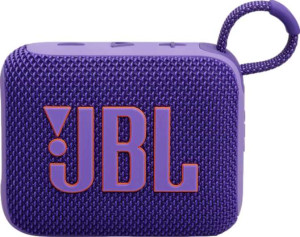
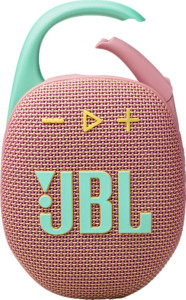
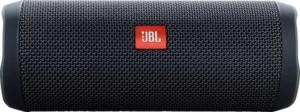
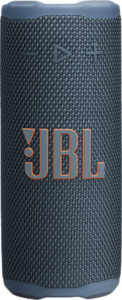
The JBL Go 4 is a compact speaker measuring 94.3 × 75.7 × 42.2 mm with a total volume of roughly 301.25 cm³ and a weight of 190 g, keeping it easy to carry without adding noticeable bulk. It is built around a single 45 mm driver and carries an IP67 ingress protection rating, confirming full dustproofing and resistance to water submersion. Physical controls are integrated directly onto the unit, giving straightforward access to key functions without the need for a touchscreen or remote control. The speaker does not include a neodymium magnet, RGB lighting, a detachable cable, or a travel bag, and it is not configured as a neckband-style device.
The JBL Go 4 uses a single driver configuration outputting 4.2 W, with a passive radiator included to help reinforce the lower end of its frequency response, which spans from 90 Hz up to 20,000 Hz. The signal-to-noise ratio is rated at 85 dB, and the speaker does not feature stereo speakers, a subwoofer, or magnetic shielding. There is no microphone present — neither a standard nor a noise-canceling one — meaning the unit is intended purely for audio playback rather than hands-free calls.
The JBL Go 4 is powered by an 850 mAh rechargeable battery that is built-in and non-removable, delivering a rated 9 hours of battery life per charge. Bringing it back to full capacity takes approximately 3 hours, and a battery level indicator is included so the remaining charge can be checked at a glance. The speaker does not support wireless charging, requiring a wired connection for all charging needs.
The JBL Go 4 connects wirelessly via Bluetooth 5.3 with a maximum range of 10 m, and notably supports both Bluetooth LE Audio and Auracast broadcast audio, which allows compatible devices to receive the audio stream. A USB Type-C port is present, used for charging rather than audio transfer. The speaker does not support NFC pairing, Wi-Fi, Ethernet, AirPlay, or DLNA, and there is no 3.5 mm audio jack socket, AUX input, 3.5 mm male connector, microphone input, or external memory slot. On the codec side, none of the advanced Bluetooth audio codecs — including aptX, aptX HD, aptX Adaptive, aptX Lossless, aptX Low Latency, LDAC, or AAC — are supported.
The JBL Go 4 can be used wirelessly and supports remote smartphone control, allowing playback to be managed from a connected device. Voice prompts are included to provide audible feedback during operation, though the speaker does not offer voice commands, so all direct interaction relies on physical controls. It does not include fast pairing, a mute function, a sleep timer, or a built-in radio, and it cannot function as a power bank to charge other devices.
The JBL Go 4 supports stereo pairing, allowing two compatible units to be connected together to produce a stereo soundstage rather than a single mono output.