JBL Junior 320 specifications and in-depth review

JBL Junior 320

Manufacturer: JBL

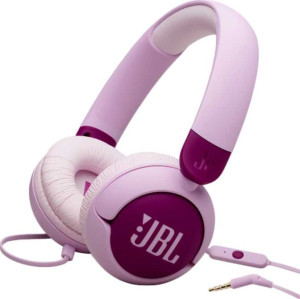
The JBL Junior 320 is an over-ear wired headphone built specifically for younger listeners, offering a lightweight construction at just 116.8 g and a tangle-free cable that suits everyday use by children. It includes an in-line control panel and can function as a headset thanks to its built-in microphone, making it a practical option for calls and learning scenarios alike.

On the technical side, the JBL Junior 320 covers a frequency range of 20 Hz to 20,000 Hz through a 32 mm driver unit, paired with an impedance of 34 Ohms and a sound pressure level of 85 dB/mW. The headphone relies on a wired connection, requires no battery or charging, and provides passive noise reduction through its closed-back over-ear design. A single microphone is present, though it does not feature noise-canceling capability.

Pros
  • Designed specifically for kids, making it a purpose-built option for younger users
  • Tangle-free cable reduces frustration and wear during everyday use
  • Lightweight at 116.8 g, which helps with comfort during extended wear
  • Can be used as a headset thanks to its built-in microphone and in-line control panel
  • Passive noise reduction helps block ambient sound without requiring any power
  • Stereo speakers deliver two-channel audio
Cons
  • Cable is not detachable, so a damaged cable cannot be easily replaced
  • Does not fold, which limits how compactly it can be stored or transported
  • No travel bag is included
  • The built-in microphone does not feature noise cancellation
  • Lacks in/on-ear detection, so audio does not pause automatically when removed
Who is this for?

This headphone is a practical fit for children in everyday listening and learning scenarios, thanks to its kid-focused design, lightweight build of 116.8 g, and tangle-free cable that holds up well with younger users. The in-line control panel and headset functionality make it useful for online classes or video calls, while passive noise reduction helps maintain focus in moderately noisy environments. Its wired, battery-free operation also means there is no need to charge or manage power levels.

Who is this NOT for?

Users who need wireless or Bluetooth connectivity will find this headphone unsuitable, as it relies entirely on a wired connection with no option to go cable-free. The non-detachable cable makes it a poor choice for anyone who values easy cable replacement, and the absence of active noise cancellation means it falls short in loud or high-distraction environments where deeper sound isolation is needed. It is also not a good fit for travel-oriented users, as it cannot be folded and does not include a carrying bag.

Design:

Fit Over-ear
weight 116.8 g
has a detachable cable
can be folded
is designed for kids
has a tangle free cable
travel bag is included
has an open-back design
has stereo speakers

The JBL Junior 320 features an over-ear fit and is specifically designed for kids, weighing just 116.8 g to keep it comfortable during extended wear. It is equipped with stereo speakers and a tangle-free cable, which adds practicality for younger users in daily situations. The headphone does not fold, lacks a detachable cable, and does not include a travel bag. Its closed-back construction means it does not have an open-back design.

Sound quality:

has active noise cancellation (ANC)
lowest frequency 20 Hz
highest frequency 20000 Hz
driver unit size 32 mm
impedance 34 Ohms
supports spatial audio
sound pressure level 85 dB/mW
has a neodymium magnet
has passive noise reduction

The JBL Junior 320 covers a frequency range of 20 Hz to 20,000 Hz through a 32 mm driver unit, with an impedance of 34 Ohms and a sound pressure level of 85 dB/mW. It provides passive noise reduction to help block out ambient sound, though it does not include active noise cancellation or spatial audio support. The drivers do not use a neodymium magnet.

Power:

Has USB Type-C
has a battery level indicator
Has a solar power battery
has a rechargeable battery
has a removable battery

The JBL Junior 320 requires no battery or charging of any kind — it does not include a rechargeable battery, a removable battery, or a solar power option. There is no USB Type-C port and no battery level indicator, as the headphone operates entirely without a power source.

Connectivity:

connectivity Wired

The JBL Junior 320 uses a wired connection, meaning it connects to devices through a physical cable rather than wirelessly.

Features:

has a noise-canceling microphone
has ambient sound mode
has in/on-ear detection
number of microphones 1
control panel placed on a device
can be used as a headset
Has an in-line control panel

The JBL Junior 320 can be used as a headset, with a single built-in microphone and an in-line control panel for convenient on-cable adjustments. The microphone does not feature noise-canceling capability, and the headphone lacks ambient sound mode as well as in/on-ear detection for automatic music pausing. There is no control panel placed directly on the ear cup itself.

Final Verdict

The JBL Junior 320 is a straightforward, purpose-built headphone that delivers on its core promise of serving younger listeners in everyday situations. Its lightweight construction, tangle-free cable, and headset functionality with in-line controls make it a genuinely practical choice for children attending online classes or engaging in casual listening. While it does not offer wireless connectivity, active noise cancellation, or a foldable design, those omissions are consistent with its intended use case rather than unexpected shortcomings. For parents seeking a reliable, battery-free wired headphone designed with kids in mind, the JBL Junior 320 covers the essentials without unnecessary complexity.

Popular Comparisons

JBL Junior 320
JBL Junior 320
VS
JBL Junior 320BT
JBL Junior 320BT
JBL Junior 320
JBL Junior 320
VS
JBL Tune 310C
JBL Tune 310C