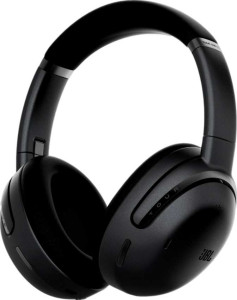
The JBL Tour One M3 features an over-ear fit and weighs 278 g, making it a reasonably compact option for daily use. It can be folded for easier storage and comes with a travel bag included, adding convenience for transport. The headphone uses a closed-back design with stereo speakers and supports both wired and cable-free use, with a detachable, tangle-free cable measuring 1.2 m in length. There is no water resistance, and it is not intended for children. The battery charges via the included connection, and the overall build is oriented toward adult, everyday use rather than rugged or outdoor conditions.
The JBL Tour One M3 handles noise reduction on two fronts, combining active noise cancellation (ANC) with passive noise isolation for a quieter listening environment. Its 40 mm driver unit covers a wide frequency range from 10 Hz to 40,000 Hz, with an impedance of 18 Ohms and a sound pressure level of 122 dB/mW. Spatial audio is supported, broadening the perceived soundstage beyond standard stereo playback. The drivers do not use a neodymium magnet.
The JBL Tour One M3 is equipped with an 850 mAh built-in rechargeable battery that delivers up to 70 hours of playback, dropping to 40 hours when ANC is active. A full charge takes 2 hours via USB Type-C, and a battery level indicator is on hand to keep track of remaining power. The battery is not removable, and the headphone supports neither wireless charging nor solar charging.
The JBL Tour One M3 supports both wireless and wired connectivity, with Bluetooth 5.3 handling the wireless side at a maximum range of 10 m. Codec support includes LDAC, AAC, and Bluetooth LE Audio, while Auracast broadcast audio is also on board. aptX, aptX HD, aptX Adaptive, aptX Low Latency, aptX Lossless, and LDHC are not supported. Fast pairing and NFC pairing are absent, so connections are established through the standard Bluetooth pairing process.
The JBL Tour One M3 can function as a headset and features eight microphones with noise-canceling capability, making it suited for calls alongside music listening. An ambient sound mode allows environmental audio to pass through when needed. Controls are placed directly on the headphone itself, though there is no in-line control panel on the cable. The headphone supports two-device multipoint connectivity, allowing simultaneous pairing with two sources, but lacks in/on-ear detection, so music does not pause automatically when the headphones are removed.