Kamrui Hyper H1 specifications and in-depth review

Kamrui Hyper H1

Manufacturer: Kamrui

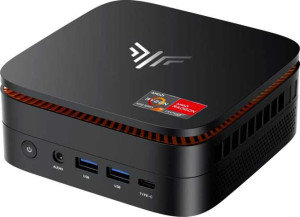
The Kamrui Hyper H1 is a compact mini PC built around a Micro-ATX form factor, measuring just 129 x 51 x 129 mm and occupying roughly 848.69 cm³ of space. It ships with 32GB of DDR5 RAM running at 4800 MHz, a 1TB NVMe SSD, and supports up to 64GB of memory across two channels, making it a fairly well-equipped small-footprint desktop for everyday and productivity workloads.

Under the hood, the Kamrui Hyper H1 runs an 8-core, 16-thread processor with a base clock of 3.2 GHz per core and a turbo frequency of 4.7 GHz, backed by a 50W TDP and a 16MB L3 cache. Graphics are handled by the integrated AMD Radeon 680M, an RDNA 2.0 architecture GPU built on a 6 nm process, delivering 3.379 TFLOPS of floating-point performance, support for DirectX 12 Ultimate, and the ability to drive up to four displays simultaneously. Connectivity includes Wi-Fi 6, Bluetooth 5.2, two USB 3.2 Gen 2 Type-A ports, four USB 3.2 Gen 1 Type-A ports, one USB 3.2 Gen 2 Type-C port, an HDMI 2.0 output, a DisplayPort output, and a single RJ45 Ethernet port.

Pros
  • Supports up to 64GB of DDR5 RAM with a maximum speed of 6400 MHz, offering meaningful headroom beyond the base 32GB configuration
  • The 1TB NVMe SSD provides substantial storage capacity with fast access speeds in a compact form factor
  • Wi-Fi 6 support ensures faster wireless throughput and better performance in congested network environments compared to older standards included
  • Seven USB ports in total across multiple speed grades give a broad range of peripheral connectivity options without requiring a hub
  • The Radeon 680M GPU supports DirectX 12 Ultimate, ray tracing, and multi-display output across up to four screens simultaneously
  • ECC memory support adds a layer of data integrity protection uncommon in mini PCs of this size
Cons
  • The CPU multiplier is locked, removing any option for manual clock speed adjustment
  • No 3.5 mm headset jack means audio peripherals require a separate adapter or USB-based solution
  • Air-water cooling is absent, which may limit sustained thermal performance under prolonged workloads given the 50W TDP in such a compact chassis
  • No Thunderbolt or USB 4 ports are available, restricting high-bandwidth peripheral and external display options
  • The warranty period is limited to one year
  • No S/PDIF output is available for digital audio passthrough to compatible receivers or sound systems
Who is this for?

The Kamrui Hyper H1 is well-suited to users who need a space-efficient desktop solution without sacrificing meaningful compute capability — particularly those working in home office, light content creation, or media center setups. Its 32GB of DDR5 RAM expandable to 64GB makes it a practical fit for multitasking workflows and applications that benefit from fast memory throughput. The inclusion of Wi-Fi 6, Bluetooth 5.2, and a broad set of USB ports also makes it a strong candidate for connected desktop environments where multiple peripherals and wireless devices are in regular use. Users who need to drive multiple screens will appreciate the support for up to four simultaneous displays via the Radeon 680M GPU, and those requiring data reliability in professional contexts will find value in ECC memory compatibility.

Who is this NOT for?

Users with demanding workloads such as high-end gaming, 3D rendering, or video production are likely to find the integrated Radeon 680M GPU insufficient, as it lacks the dedicated memory and raw throughput of a discrete graphics card. The locked CPU multiplier and laptop-type processor also mean there is no path for performance tuning, making it a poor fit for enthusiasts seeking overclocking or sustained peak computational output. Additionally, the absence of Thunderbolt ports and USB 4 connectivity limits its appeal for professionals who rely on high-bandwidth external storage arrays or advanced display configurations requiring those interfaces. Those who depend on a 3.5 mm audio jack for headsets or speakers will also find the lack of one an ongoing inconvenience without additional hardware.

General info:

SSD storage capacity 1000GB
form factor Micro-ATX
Is an NVMe SSD
thickness 129 mm
height 51 mm
width 129 mm
volume 848.691 cm³

The Kamrui Hyper H1 follows a Micro-ATX form factor and occupies a notably compact footprint, measuring 129 mm in both width and thickness with a height of just 51 mm, resulting in a total volume of roughly 848.69 cm³. Storage is handled by a 1TB NVMe SSD, offering both generous capacity and fast data access through the NVMe interface.

CPU:

Thermal Design Power (TDP) 50W
CPU speed 8 x 3.2 GHz
turbo clock speed 4.7GHz
CPU threads 16 threads
Has integrated graphics
uses multithreading
L3 cache 16 MB
L2 cache 4 MB
L1 cache 512 KB
L2 core 0.5 MB/core
L3 core 2 MB/core
clock multiplier 32
Has an unlocked multiplier
Supports 64-bit
CPU temperature 95 °C

The processor in the Kamrui Hyper H1 features 8 cores running at 3.2 GHz, with a turbo clock speed reaching up to 4.7 GHz, and supports multithreading for a total of 16 threads. It carries a 50W TDP and a maximum operating temperature of 95 °C, with a clock multiplier of 32 that is locked rather than unlocked. Cache memory is structured across three levels — 512 KB of L1, 4 MB of L2 at 0.5 MB per core, and 16 MB of L3 cache at 2 MB per core — and the CPU supports both 64-bit computing and integrated graphics.

Graphics card:

floating-point performance 3.379 TFLOPS
GPU clock speed 2000 MHz
GPU turbo 2200 MHz
texture rate 105.6 GTexels/s
pixel rate 70.4 GPixel/s
supports ray tracing
supports DLSS
PCI Express (PCIe) version 4
texture mapping units (TMUs) 48
shading units 768
render output units (ROPs) 32
DirectX version DirectX 12 Ultimate
OpenGL version 4.6
OpenCL version 2
semiconductor size 6 nm
supported displays 4
has LHR
Supports multi-display technology
Has Double Precision Floating Point (DPFP)
number of transistors 13100 million

The integrated graphics solution delivers 3.379 TFLOPS of floating-point performance, with a base GPU clock of 2000 MHz boosting up to 2200 MHz, and is built on a 6 nm process housing 13,100 million transistors. It includes 768 shading units, 48 texture mapping units, and 32 render output units, producing a texture rate of 105.6 GTexels/s and a pixel rate of 70.4 GPixel/s. The GPU connects via PCIe 4.0 and supports DirectX 12 Ultimate, OpenGL 4.6, and OpenCL 2, along with ray tracing and double precision floating point, though DLSS is not supported. Multi-display output is available across up to four screens simultaneously, and LHR is not present.

Memory:

RAM 32GB
RAM speed 4800 MHz
DDR memory version 5

The Kamrui Hyper H1 comes equipped with 32GB of DDR5 RAM running at 4800 MHz, providing a solid memory configuration for a mini PC in this category.

Connectivity:

Wi-Fi version Wi-Fi 6 (802.11ax), Wi-Fi 5 (802.11ac), Wi-Fi 4 (802.11n)
supports Wi-Fi
Has Bluetooth
Bluetooth version 5.2
USB 2.0 ports 0
USB 3.2 Gen 2 ports (USB-A) 2
USB 3.2 Gen 1 ports (USB-A) 4
USB 3.2 Gen 2 ports (USB-C) 1
USB 4 40Gbps ports 0
USB 4 20Gbps ports 0
USB 3.2 Gen 2x2 ports 0
USB 3.2 Gen 1 ports (USB-C) 0
Thunderbolt 4 ports 0
Thunderbolt 3 ports 0
DisplayPort outputs 1
HDMI version HDMI 2.0
HDMI ports 1
RJ45 ports 1
has a socket for a 3.5 mm audio jack
has a VGA connector
Has S/PDIF Out port

Wireless connectivity is covered by Wi-Fi 6 (802.11ax) with backwards compatibility for Wi-Fi 5 and Wi-Fi 4, alongside Bluetooth 5.2. On the wired side, there is one RJ45 Ethernet port for a stable network connection. The USB port selection includes two USB 3.2 Gen 2 Type-A ports, four USB 3.2 Gen 1 Type-A ports, and one USB 3.2 Gen 2 Type-C port, with no USB 2.0, USB 4, or Thunderbolt ports present. Display output is handled by one HDMI 2.0 port and one DisplayPort output, while a 3.5 mm headset jack, VGA connector, and S/PDIF output are not included.

Benchmarks:

PassMark result 23052
PassMark result (single) 3210
Geekbench 6 result (multi) 8905
Geekbench 6 result (single) 1851
Cinebench R20 (multi) result 5074
Cinebench R20 (single) result 587

In benchmark testing, the Kamrui Hyper H1 achieves a PassMark multi-thread score of 23,052 and a single-thread score of 3,210. Geekbench 6 results come in at 8,905 for multi-core and 1,851 for single-core workloads. Cinebench R20 rounds out the picture with a multi-core result of 5,074 and a single-core score of 587.

Miscellaneous:

maximum memory amount 64GB
has an external memory slot
GPU architecture RDNA 2.0
Has air-water cooling
Supports 3D
Supports ECC memory
has XeSS (XMX)
GPU name Radeon 680M
Has NX bit
GPU execution units 12
memory channels 2
Type Laptop
instruction sets SSE 4.2, SSE 4.1, AVX, AES, FMA3, F16C, MMX
RAM speed (max) 6400 MHz
warranty period 1 years
Uses flash storage

The Kamrui Hyper H1 uses a laptop-type CPU paired with a Radeon 680M GPU built on the RDNA 2.0 architecture, featuring 12 execution units. Memory can be expanded up to 64GB across two channels, with a maximum supported RAM speed of 6400 MHz, and the system is compatible with ECC memory, though there is no external memory slot. The CPU supports a range of instruction sets including SSE 4.1, SSE 4.2, AVX, AES, FMA3, F16C, and MMX, and includes an NX bit for hardware-level security. Stereoscopic 3D output is supported, while XeSS, air-water cooling, and flash storage are not present. The unit comes with a one-year warranty.
Final Verdict

The Kamrui Hyper H1 is a compact mini PC that delivers a well-rounded specification set for its form factor, combining a capable 8-core processor, 32GB of DDR5 RAM with ECC support and 64GB expandability, a 1TB NVMe SSD, and an integrated Radeon 680M GPU capable of driving up to four displays. It covers the connectivity essentials with Wi-Fi 6, Bluetooth 5.2, and a versatile USB port arrangement, making it a practical desktop replacement for home office use, light productivity, and media-focused setups. Where it falls short is in scenarios that demand discrete-level graphics performance, high-bandwidth peripheral interfaces, or unrestricted CPU tuning — areas where its integrated architecture and locked multiplier impose clear boundaries. For users whose workloads align with what the hardware can reasonably deliver, the Hyper H1 presents a coherent and space-efficient desktop option that punches within its lane without overreaching.