Kamrui Hyper H2 specifications and in-depth review

Kamrui Hyper H2

Manufacturer: Kamrui

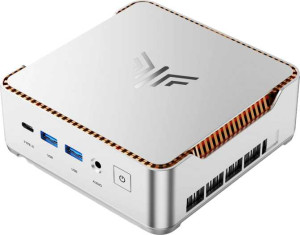
The Kamrui Hyper H2 is a compact Mini PC built around a Micro-ATX form factor, measuring 128.2 mm on each side with a total volume of just 65.74 cm³. It ships with a 1TB NVMe SSD, 16GB of DDR5 RAM running at 3200 MHz, and supports up to 192GB of maximum memory across two channels — making it a reasonably well-equipped small desktop for everyday and light productivity workloads.

The unit runs a laptop-class CPU with a 55W TDP, ten cores split across a big.LITTLE configuration delivering base clocks of 2.4 GHz and 1.8 GHz with a turbo ceiling of 4.8 GHz, backed by 20MB of L3 cache and 16 threads. Graphics are handled by the Intel UHD Graphics 710, with 16 execution units, a 1500 MHz turbo, and support for up to four displays via HDMI 2.0, DisplayPort, and a Thunderbolt 4 port that also serves as a USB 4 40Gbps connection. Connectivity includes Wi-Fi 6, Bluetooth 5.2, a single RJ45 port, six USB-A ports across Gen 1 and Gen 2 standards, and a 3.5 mm audio jack, while ECC memory support adds a layer of data integrity for compatible use cases.

Pros
  • Supports up to four simultaneous display outputs, making it suited for multi-monitor setups
  • Includes a Thunderbolt 4 port with USB 4 40Gbps speeds, enabling fast data transfer and flexible peripheral connectivity
  • Wi-Fi 6 support ensures faster wireless throughput and better performance in congested network environments
  • ECC memory support adds a layer of data reliability useful for applications where memory integrity matters
  • The 1TB NVMe SSD provides substantial local storage with fast read and write access
  • Maximum memory capacity of 192GB across two channels offers significant headroom for memory-intensive workloads
Cons
  • The locked CPU multiplier prevents any form of manual clock adjustment
  • No USB-C ports below USB 4 speeds limits flexibility for connecting common USB-C peripherals directly
  • RAM is running at 3200 MHz despite the platform supporting up to 5600 MHz, leaving memory bandwidth headroom unused
  • Only a one-year warranty period is included
  • No S/PDIF output limits options for connecting to certain external audio equipment
  • The integrated UHD Graphics 710 with only 16 execution units is limited for graphically demanding tasks
Who is this for?

This Mini PC is a practical fit for users who need a compact desktop for office productivity, light multitasking, or home server duties, where its ten-core CPU, 16GB of DDR5 RAM, and 1TB NVMe SSD provide a responsive everyday experience. The support for up to four simultaneous displays makes it well-suited to multi-monitor work environments such as trading desks, digital signage setups, or productivity-focused workstations. ECC memory support also makes it a reasonable choice for small-scale deployments where data integrity is a priority, such as edge computing or light network-attached storage use cases.

Who is this NOT for?

Users looking to handle graphically demanding workloads — including video editing, 3D rendering, or modern gaming — will find the integrated UHD Graphics 710 with just 16 execution units inadequate for those tasks. Similarly, the locked CPU multiplier and laptop-class processor make this a poor fit for anyone seeking overclocking capability or sustained high-performance compute workloads that benefit from desktop-grade thermal headroom. The absence of USB-C ports below USB 4 speeds also makes it a less convenient choice for users with a wide range of USB-C peripherals that operate at standard USB 3.2 Gen 1 or Gen 2 speeds.

General info:

SSD storage capacity 1000GB
form factor Micro-ATX
release date November 2025
Is an NVMe SSD
thickness 128.2 mm
height 4 mm
width 128.2 mm
volume 65.74096 cm³

The Kamrui Hyper H2 follows a Micro-ATX form factor and occupies a total volume of just 65.74 cm³, with both its thickness and width measuring 128.2 mm and a height of only 4 mm. Storage is handled by a 1TB NVMe SSD, offering solid sequential performance typical of the NVMe interface within a notably compact physical footprint.

CPU:

Thermal Design Power (TDP) 55W
CPU speed 6 x 2.4 & 4 x 1.8 GHz
turbo clock speed 4.8GHz
CPU threads 16 threads
Has integrated graphics
uses multithreading
L3 cache 20 MB
clock multiplier 24
Has an unlocked multiplier
Supports 64-bit
CPU temperature 100 °C

The CPU operates within a 55W TDP envelope and uses a ten-core configuration split between six cores running at 2.4 GHz and four cores at 1.8 GHz, with a turbo clock ceiling of 4.8 GHz. It supports multithreading for a total of 16 threads, pairs that with 20 MB of L3 cache, and carries a clock multiplier of 24 — though the multiplier is locked, ruling out any manual overclocking. The processor supports 64-bit operation, includes integrated graphics, and is rated for a maximum CPU temperature of 100 °C.

Graphics card:

GPU turbo 1500 MHz
maximum memory bandwidth 89.6 GB/s
PCI Express (PCIe) version 5
OpenGL version 4.6
OpenCL version 3
semiconductor size 10 nm
supported displays 4

The integrated GPU reaches a turbo clock of 1500 MHz and delivers a maximum memory bandwidth of 89.6 GB/s, built on a 10 nm semiconductor process. It connects via PCIe 5 and supports up to four displays simultaneously, while API coverage includes OpenGL 4.6 and OpenCL 3.

Memory:

RAM 16GB
RAM speed 3200 MHz
DDR memory version 5

The Kamrui Hyper H2 comes equipped with 16GB of DDR5 RAM running at a speed of 3200 MHz, offering the bandwidth advantages that come with the DDR5 memory standard.

Connectivity:

Wi-Fi version Wi-Fi 6 (802.11ax), Wi-Fi 4 (802.11n), Wi-Fi 5 (802.11ac)
supports Wi-Fi
Has Bluetooth
Bluetooth version 5.2
USB 2.0 ports 0
USB 3.2 Gen 2 ports (USB-A) 2
USB 3.2 Gen 1 ports (USB-A) 4
USB 3.2 Gen 2 ports (USB-C) 0
USB 4 40Gbps ports 1
USB 4 20Gbps ports 0
USB 3.2 Gen 2x2 ports 0
USB 3.2 Gen 1 ports (USB-C) 0
Thunderbolt 4 ports 1
Thunderbolt 3 ports 0
DisplayPort outputs 1
HDMI version HDMI 2.0
HDMI ports 1
RJ45 ports 1
has a socket for a 3.5 mm audio jack
has a VGA connector
Has S/PDIF Out port

Wireless connectivity covers Wi-Fi 6 (802.11ax) alongside backward-compatible Wi-Fi 5 and Wi-Fi 4 standards, complemented by Bluetooth 5.2. On the wired side, the unit provides one RJ45 Ethernet port, six USB-A ports — two at USB 3.2 Gen 2 speeds and four at USB 3.2 Gen 1 — plus one USB 4 40Gbps port that also functions as a Thunderbolt 4 connection; there are no USB-C ports at lower USB 3.2 speeds, no USB 2.0 ports, and no Thunderbolt 3. Display output is handled by one HDMI 2.0 port and one DisplayPort, while audio connectivity includes a 3.5 mm headset jack; a VGA connector and S/PDIF output are not present.

Benchmarks:

PassMark result 23765
PassMark result (single) 3679

In PassMark testing, the Kamrui Hyper H2 achieves a multi-core score of 23,765 alongside a single-core score of 3,679, reflecting the CPU's overall throughput capacity across both parallel and single-threaded workloads.

Miscellaneous:

maximum memory amount 192GB
GPU name UHD Graphics 710
Type Laptop
instruction sets MMX, F16C, FMA3, AES, AVX, AVX2, SSE 4.1, SSE 4.2
Has NX bit
GPU execution units 16
Supports ECC memory
memory channels 2
RAM speed (max) 5600 MHz
Uses big.LITTLE technology
warranty period 1 years

The system uses a laptop-class CPU built on big.LITTLE technology and pairs it with the Intel UHD Graphics 710, which features 16 execution units. Memory can be configured across two channels with a maximum capacity of 192GB and a top supported RAM speed of 5600 MHz; ECC memory is also supported, adding a degree of data integrity for compatible configurations. The CPU supports a broad set of instruction sets including MMX, AES, AVX, AVX2, FMA3, F16C, SSE 4.1, and SSE 4.2, and includes NX bit support for hardware-level security. The unit carries a warranty period of one year.
Final Verdict

The Kamrui Hyper H2 is a compact Mini PC that covers the essentials for office work, light multitasking, and multi-display setups with a capable ten-core CPU, DDR5 memory, and a 1TB NVMe SSD packed into a very small footprint. Its support for up to four simultaneous displays combined with Thunderbolt 4 and Wi-Fi 6 gives it a connectivity profile that punches above what its form factor might suggest, and ECC memory support adds a layer of reliability rarely found at this scale. That said, the laptop-class processor and integrated graphics keep it firmly within the bounds of everyday computing, making it best suited to users whose workloads align with productivity and light data tasks rather than graphically or computationally intensive applications. For those use cases, the Hyper H2 represents a well-rounded, space-conscious option with a solid feature set.