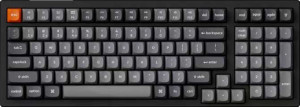
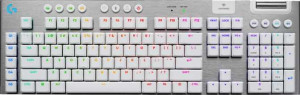
The Keychron K4 Max QMK Wireless is a gaming mechanical keyboard with a full 96% layout and a standard profile, measuring 391.29 × 140.27 × 40.68mm and weighing 1290g. It supports three connection modes — Bluetooth 5.1, 2.4GHz wireless, and wired USB — and delivers a 1000Hz polling rate alongside a plate mount construction. Wireless use is backed by a 190-hour battery life, and the detachable cable adds flexibility when switching to a wired setup. The keyboard is designed for Mac compatibility and comes with a one-year warranty.
The keyboard features a plastic case available in black or gray, paired with a steel plate for added structural rigidity. It includes south-facing RGB backlighting across the full keyboard surface, which affects how lighting interacts with keycap legends. Adjustable feet allow the typing angle to be modified, though no wrist rest is included in the box.
The Keychron K4 Max QMK Wireless uses Keychron Super Switch mechanical switches with a linear feel, offering smooth keypresses without tactile feedback or audible click. Actuation occurs at 2mm with a 45g actuation force, and total travel distance is 4mm. The switches are hot-swappable, meaning they can be replaced without soldering, giving users the option to change switch types at any point without disassembling the board.
The keyboard supports N-key rollover (NKRO), ensuring every simultaneous keypress is registered without ghosting. On the firmware side, QMK support enables extensive key remapping, macro programming, and layout customization, though ZMK and VIA are not supported. The board does not include analog input, rapid trigger, adjustable actuation, dual actuation, USB passthrough, or an onboard display.
The keyboard uses an ANSI (United States) layout with a standard key arrangement, making it compatible with widely available replacement keycaps. The keycaps themselves are PBT double-shot in an OEM profile, a construction that resists shine over time and ensures legends remain legible through the double-molding process. Media controls are accessible via the Fn key rather than dedicated keys, and the board does not include a rotary dial.