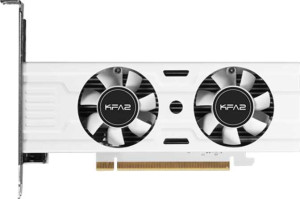
KFA2 GeForce RTX 3050 Low Profile White 6GB specifications and in-depth review

KFA2 GeForce RTX 3050 Low Profile White 6GB

Manufacturer: KFA2

The KFA2 GeForce RTX 3050 Low Profile White 6GB is a discrete graphics card designed around a compact form factor, measuring 185 mm wide and 121 mm tall. It carries a white aesthetic finish, distinguishing it visually from the majority of low-profile GPU offerings that ship in standard black. Rated at 70W TDP and cooled by air only, it connects to the host system via PCIe 4.0 and supports up to four simultaneous display outputs.

The card is built on Nvidia's Ampere architecture using an 8 nm process with 8700 million transistors. Its 2304 shading units, 72 texture mapping units, and 32 render output units drive a turbo clock of 1470 MHz, delivering 6.774 TFLOPS of floating-point performance alongside texture and pixel rates of 105.8 GTexels/s and 47.04 GPixel/s respectively. Memory consists of 6GB of GDDR6 running at 14000 MHz effective speed over a 96-bit bus for 168 GB/s of bandwidth, with ECC support included. The feature set covers DirectX 12 Ultimate, OpenGL 4.6, OpenCL 3, ray tracing, DLSS, stereoscopic 3D, Intel Resizable BAR, and multi-display technology, while XeSS, LHR, and RGB lighting are not present.

Pros
  • A white finish sets this card apart visually from typical GPU designs, making it a practical fit for white-themed system builds
  • Four video outputs — two HDMI 2.1 and two DisplayPort — provide meaningful multi-monitor flexibility for a card of this size
  • The 70W TDP keeps power consumption low, making it compatible with systems that have limited PSU capacity
  • Support for ray tracing and DLSS brings modern rendering and upscaling capabilities to a compact, low-power form factor
  • ECC memory support enables error detection and correction, extending the card's suitability to light compute workloads
  • Intel Resizable BAR support improves the efficiency of CPU-to-GPU data access without requiring additional hardware
Cons
  • The 96-bit memory bus constrains maximum bandwidth to 168 GB/s, which can become a bottleneck in memory-intensive scenarios
  • 6GB of GDDR6 VRAM limits the card's ability to handle larger textures or higher-resolution frame buffers effectively
  • Air cooling is the only thermal option available, with no support for liquid or hybrid cooling configurations
  • The absence of USB-C output reduces compatibility with certain modern monitors and docking solutions
Who is this for?

This card suits users who are building or upgrading systems with a specific aesthetic in mind, as the white finish makes it one of the few discrete GPUs that integrates naturally into white-themed builds without requiring aftermarket modifications. Its 70W TDP and compact 185 mm x 121 mm footprint also make it a practical choice for smaller enclosures where power draw and physical clearance are genuine constraints. Those wanting access to modern rendering features like ray tracing, DLSS, and four-display output within a low-power system will find the feature set well-matched to that use case.

Who is this NOT for?

Users who push GPUs with high-resolution textures or memory-intensive rendering workloads will find the 6GB GDDR6 frame buffer and 96-bit memory bus a limiting factor, as both cap out relatively quickly under demanding conditions. The card is also a poor fit for those who rely on USB-C display connectivity, since no such port is available, restricting compatibility with certain modern monitors and docking solutions. Additionally, users who need liquid or hybrid GPU cooling for silent operation or tighter thermal management will find no support for it here, as the card is limited entirely to air cooling.

Performance:

GPU clock speed 1042 MHz
GPU turbo 1470 MHz
pixel rate 47.04 GPixel/s
floating-point performance 6.774 TFLOPS
texture rate 105.8 GTexels/s
GPU memory speed 1750 MHz
shading units 2304
texture mapping units (TMUs) 72
render output units (ROPs) 32
Has Double Precision Floating Point (DPFP)

The GPU operates at a base clock of 1042 MHz and boosts to 1470 MHz under load, with 2304 shading units, 72 texture mapping units, and 32 render output units contributing to a floating-point throughput of 6.774 TFLOPS, a texture rate of 105.8 GTexels/s, and a pixel rate of 47.04 GPixel/s. GPU memory runs at 1750 MHz, and Double Precision Floating Point (DPFP) is supported, adding utility for compute workloads alongside standard graphics tasks.

Memory:

effective memory speed 14000 MHz
maximum memory bandwidth 168 GB/s
VRAM 6GB
GDDR version GDDR6
memory bus width 96-bit
Supports ECC memory

The card features 6GB of GDDR6 VRAM with an effective memory speed of 14000 MHz, channeled through a 96-bit bus to deliver a maximum bandwidth of 168 GB/s. The 96-bit bus width is a structural characteristic of this memory configuration that directly defines its throughput ceiling. ECC memory support is included, enabling error detection and correction for workloads where maintaining data integrity is a meaningful requirement.

Features:

DirectX version DirectX 12 Ultimate
OpenGL version 4.6
OpenCL version 3
Supports multi-display technology
supports ray tracing
Supports 3D
supports DLSS
has XeSS (XMX)
AMD SAM / Intel Resizable BAR Intel Resizable BAR
has LHR
has RGB lighting
supported displays 4

The card supports DirectX 12 Ultimate, OpenGL 4.6, and OpenCL 3, offering solid API coverage across both graphics and compute applications. Ray tracing and DLSS are both enabled, bringing hardware-accelerated lighting effects and AI-based upscaling into the feature set, while stereoscopic 3D and multi-display technology allow for more flexible output configurations across up to four screens. Intel Resizable BAR is present to improve CPU access to the GPU frame buffer. XeSS (XMX), LHR, and RGB lighting are not included on this card.

Ports:

has an HDMI output
HDMI ports 2
HDMI version HDMI 2.1
DisplayPort outputs 2
USB-C ports 0
DVI outputs 0
mini DisplayPort outputs 0

Video output is handled by four ports in total: two HDMI 2.1 connections and two DisplayPort outputs, enabling multi-monitor configurations across a pair of modern interface standards. There are no USB-C, DVI, or mini DisplayPort options on this card, so connectivity is concentrated entirely on these two current-generation display interfaces.

General info:

GPU architecture Ampere
Thermal Design Power (TDP) 70W
PCI Express (PCIe) version 4
semiconductor size 8 nm
number of transistors 8700 million
Has air-water cooling
width 185 mm
height 121 mm

The card is based on the Ampere architecture, produced on an 8 nm process node with a transistor count of 8700 million, and interfaces with the motherboard through PCIe 4.0. It carries a 70W thermal design power rating and relies entirely on air cooling, with no liquid or hybrid cooling option supported. Physically, it measures 185 mm in width and 121 mm in height, placing it in a compact bracket category suited to systems where installation space is a consideration.

Final Verdict

The KFA2 GeForce RTX 3050 Low Profile White 6GB occupies a well-defined niche that few cards address: a compact, low-power discrete GPU with a white finish and a four-output configuration that makes it a genuinely practical option for aesthetically coordinated builds with space and power constraints. Ray tracing, DLSS, DirectX 12 Ultimate, and ECC memory support round out a feature set that feels complete for the card's intended scope. The 6GB GDDR6 frame buffer and 96-bit memory bus do place a ceiling on how far it can scale with demanding workloads, and the absence of liquid cooling limits thermal flexibility. For users whose priorities align with compact sizing, visual consistency, and modern API support over raw performance headroom, this card delivers on each of those fronts without meaningful compromise within its design parameters.